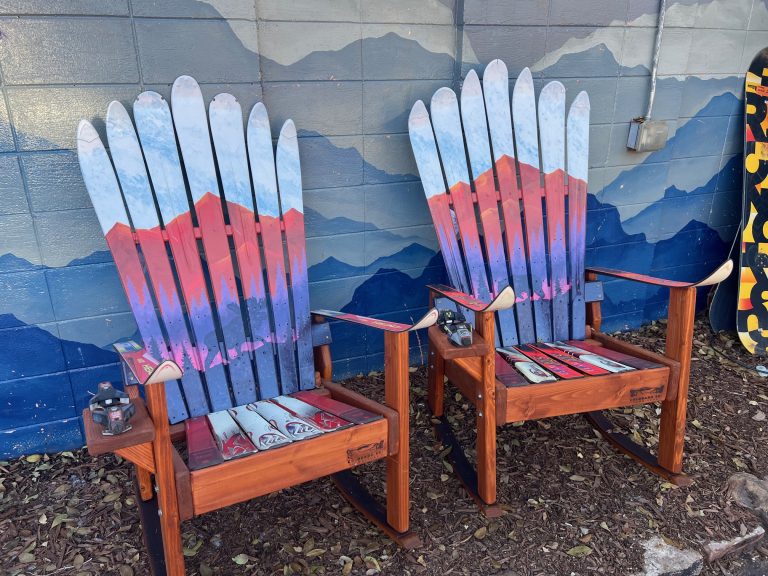
Custom Wall Panels for a Break Room Nobody Wants to Sit In
Every office has one room where the walls quietly gave up. Usually it is the break room, a beige rectangle with a breaker box on one side, a patched spot where the old vending machine got dragged out, and a thermostat nobody is allowed to touch. Custom wall panels for a break room are the honest fix for that, and the ones Colorado Ski Chairs builds are hand painted panels made to the exact dimensions of your wall, in Manitou Springs, Colorado. They cover what you cannot fix and give people something worth looking at while the coffee finishes.
The Wall Everybody Walks Past and Nobody Fixes
You know the one. It is the wall behind the counter where the microwave lives, or the long blank stretch across from the sink, and it has been on the facilities list for three years. Somebody painted it once, in a color chosen from a fan deck in 2014. There is a scuff at shoulder height where the chair backs hit it, a plate over an abandoned data port, and a square of slightly newer drywall that fooled nobody.
Fixing that wall properly means a contractor, a weekend, dust in the server closet and a conversation with a landlord about what counts as an improvement. So it does not get fixed. It gets ignored, year after year, while everyone eats lunch facing it.
The thing is, the break room is where people actually stand around. Not the lobby, where visitors pass through in forty seconds on their way to a conference room. The break room is where the same twenty people spend ten minutes a day, every day, for years. It is the most looked at wall in the building and it is almost always the ugliest. That gap is the whole argument for this piece.
A panel does not repair the wall. It covers it, completely and on purpose, with something somebody made by hand. The drywall underneath stays exactly as bad as it was, which is fine, because nobody is ever going to see it again.
What a Custom Wall Panel Actually Is
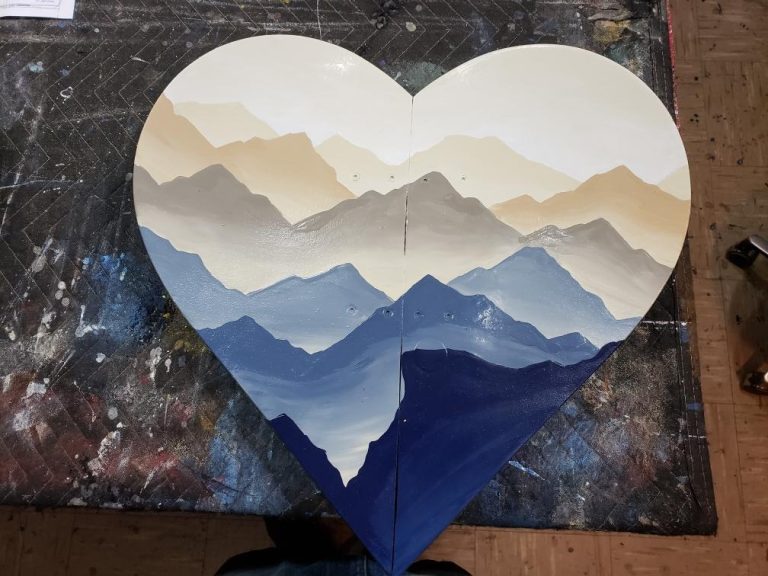
The Design with Impact custom wall panels are large hand painted panels built to order and mounted to a wall as one piece. They are not a framed print and they are not a vinyl wrap. The panel itself is physical, built from reclaimed material cut into shape, and the scene on it is painted by hand in weatherproof enamel.
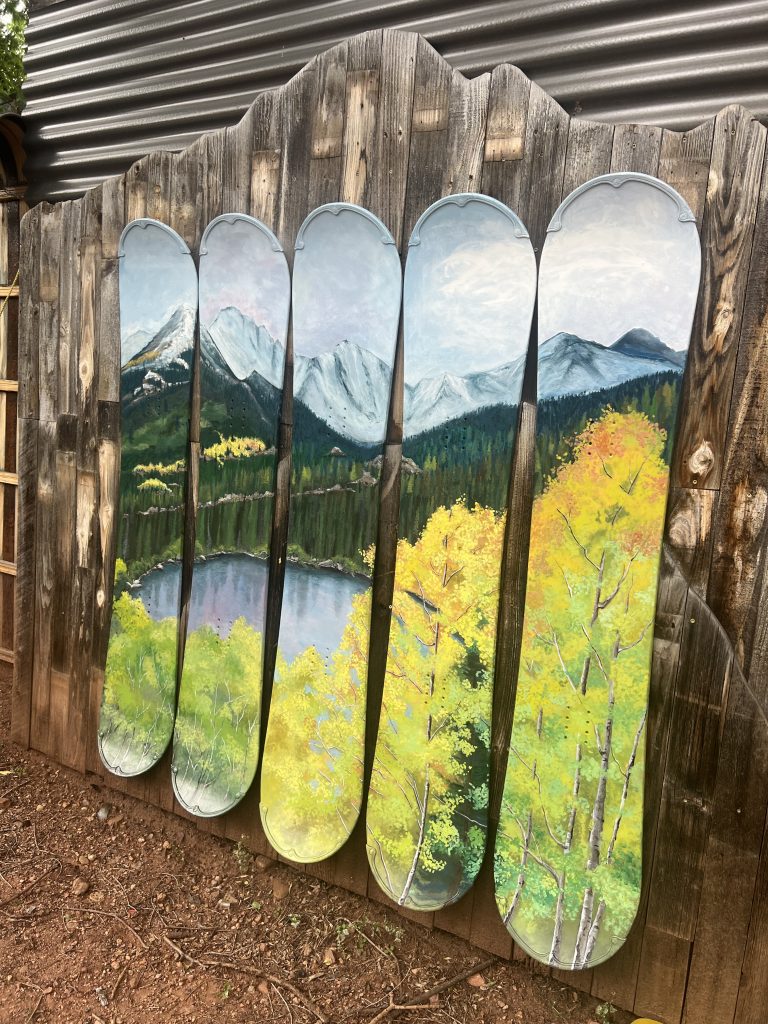
Shape matters more than people expect, and it is the main reason custom wall panels for a break room look different from anything you can order in a box. The panels are cut as tall vertical elements, the rounded profile of a ski or a snowboard deck, and lined up side by side so the scene runs across all of them at once. Up close you read individual boards. From across the room you read one picture. That double read is why the piece works in a room where people stand at two very different distances from it, which is exactly what a break room is.
The scene is whatever suits the room. A mountain range. A resort profile. A specific run somebody in the office argues about. One panel we built runs the length of a break room counter in grayscale, with a skier carving across the middle, a mountain biker on the right, pine trees stacked along the bottom edge and a thin line of ridge running the whole width. It passes behind the counter, around the outlets, and keeps going. It is the only thing in that room anybody photographs.
Built for indoor or outdoor use, which sounds like boilerplate until you remember that break rooms have patios attached to them, and the same finish that survives a Colorado winter on a fence is not going to mind a coffee splash.
Why Custom Wall Panels for a Break Room Beat Another Lobby Upgrade
Lobbies get the budget. That is not an argument against lobbies, it is just how facilities spending works. The lobby is where clients form an impression, so the lobby gets the art, the good chairs and the plant service.
The break room gets a corkboard with a 2019 evacuation map on it.
Here is the case for flipping that, at least a little. Your clients see the lobby a handful of times a year. Your own people see the break room five days a week. Whatever is on that wall is the background to every awkward Monday, every quick vent about a deadline, every birthday cake somebody bought at the grocery store on the way in. Nobody writes that down in an engagement survey, but people absolutely notice whether the room they eat in was thought about or not.
There is also the practical angle. A break room wall is usually long and low, broken up by a counter, a fridge nook or a window. That is a bad shape for framed art, which comes in rectangles, and a good shape for a panel that gets built to the dimensions you actually have. Custom wall panels for a break room solve a proportion problem that an off the shelf piece cannot touch.

Built to Your Wall, Not Picked Off a Size List
Sizes and finishes are built to the wall rather than picked off a list. The listing does carry ten reference dimensions, which are useful for budgeting and for picturing the thing, and they run from roughly 36 by 36 inches up to roughly 60 by 96 inches, with most of the sensible combinations in between. Treat them as the shape of the conversation, not as a menu.
What actually happens is simpler. You measure the wall. You measure the counter or the fridge or the window that interrupts it. You call with those numbers and the panel gets built to them.
A piece of advice that costs nothing when you are sizing custom wall panels for a break room: let the panel run wider than the furniture under it. A panel sized to match the counter exactly looks like it was trying to match the counter. A panel that overhangs it by a foot on each side looks like the counter was installed in front of the art. Same wall, same money, completely different read.
Height is the other one people get wrong. In a break room, the sightline is a person standing at a counter, not a person sitting on a sofa. Panels in a break room generally want to start higher and stay in the upper two thirds of the wall, where a leaning chair back and a cart full of catering trays are never going to reach them.
If you are not sure, send photos with a tape measure in the frame. That is a normal request here and it saves everyone a round trip.
Hand Painted in the Kind of Enamel They Put on Fire Hydrants
The scene is painted in weatherproof enamel, the same kind used on fire hydrants. That comparison is in the product listing and it is a good one, because a fire hydrant is a thing that sits outdoors in Colorado for decades, gets hit by sprinklers, road salt, UV and the occasional truck mirror, and still reads bright red from a block away.
In practical terms it means the panel is finished for indoor or outdoor use, and a break room is about the gentlest environment it will ever see. Coffee, soda, somebody’s enthusiastic microwave accident, a cleaning crew with a spray bottle. None of that is a threat.
What hand painted really buys you is that the piece is not repeatable. A printed graphic has an edge quality that your eye clocks as printed even when you are not thinking about it, because every line has the same weight. A painted ridgeline does not. The brush loads up and runs thin. The peaks land where the painter put them, which is close to the reference and never identical to it. Stand two feet away and you can see where the color was worked.
That matters more in a room people stand in than in a room people walk through. You get a long look at it over years. A print gets boring. A painting keeps giving up small details, which is a strange thing to say about a break room wall and is still true.
Breaker Boxes, Patch Jobs and the Previous Tenant’s Taste
These panels started as a way to hide breaker boxes and cover up wall damage. That is still half of what they do. It is worth saying out loud, because most people shopping for office art do not realize that the repair job and the nice thing can be the same purchase.
The second generation office is where custom wall panels for a break room really earn their keep. You take over a space somebody else branded. Their accent wall is a color nobody on your team would have chosen. There are anchor holes where their sign used to be, a patched rectangle where their reception logo came off, and a panel box that the lease says you cannot enclose. You are three years into a seven year term and nobody is approving a renovation.
A panel built to that wall solves it in one delivery. No drywall work, no painters, no dust, no weekend. Depending on the wall and the hardware it can come down again when you leave, which is a sentence that makes facilities managers relax visibly.
On the breaker box specifically, be straight with us when you call. Code and common sense both say a panel box needs to stay reachable, so a panel over one is designed around access rather than sealing it off. Tell us where the box is, how big it is and whether anybody opens it more than once a year, and the build accounts for it. What we will not do is pretend the box is not there and then hand you a problem.
Skis, Snowboards or Barnwood, and How Much Gear It Takes
Four base materials are offered, and they change the surface more than people expect. All snowboards gives you wide panels with very few gaps, the closest thing to a continuous canvas, which suits a detailed scene. All skis gives you narrow slats and many thin vertical gaps, so the result reads more graphic and more slatted, almost architectural. The hybrid of ski and snowboard mixes widths and gives you an irregular rhythm, which is the one people pick when they want it to look handmade from across the room. Reclaimed barnwood has no ski or board in it at all, just salvaged board with its own weathering, and it suits a space going for warm rather than sporty.
Now the honest part about quantities, because it comes up every time. How much reclaimed material a panel eats is an output of the size you chose, not a number you pick in advance. A panel is wall sized, so the count follows the wall. There is no fixed figure and nobody is going to invent one for you.
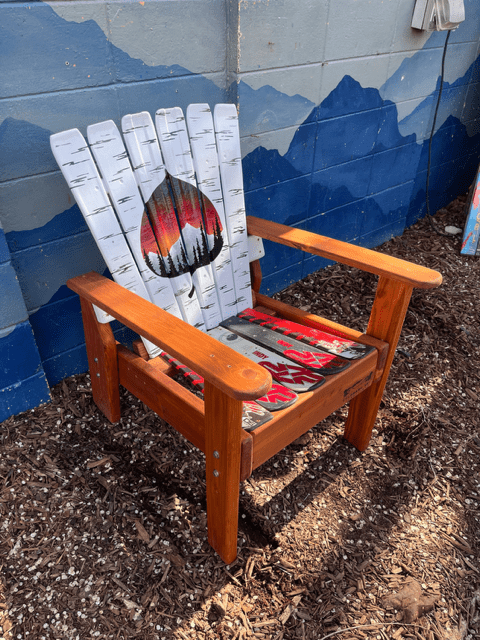
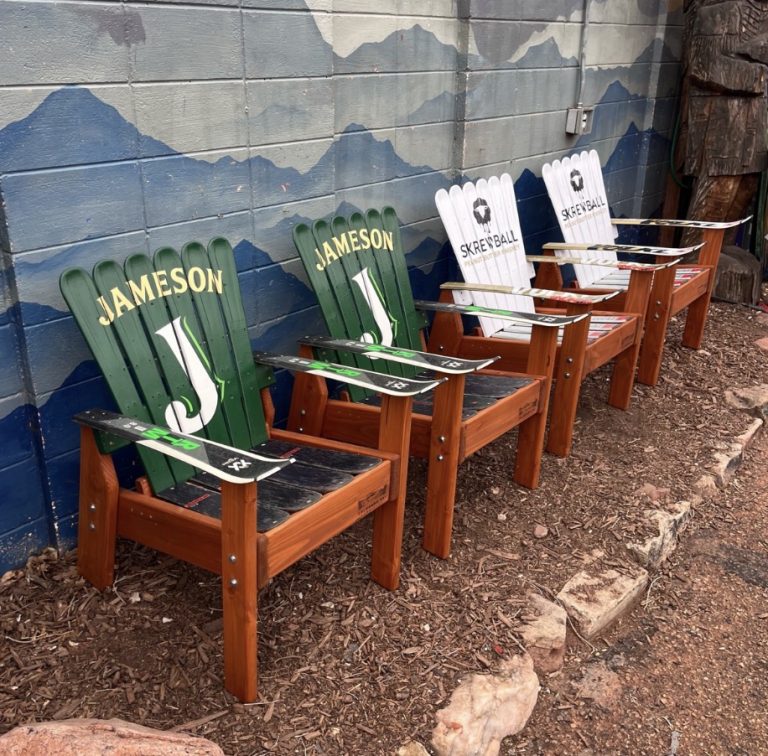
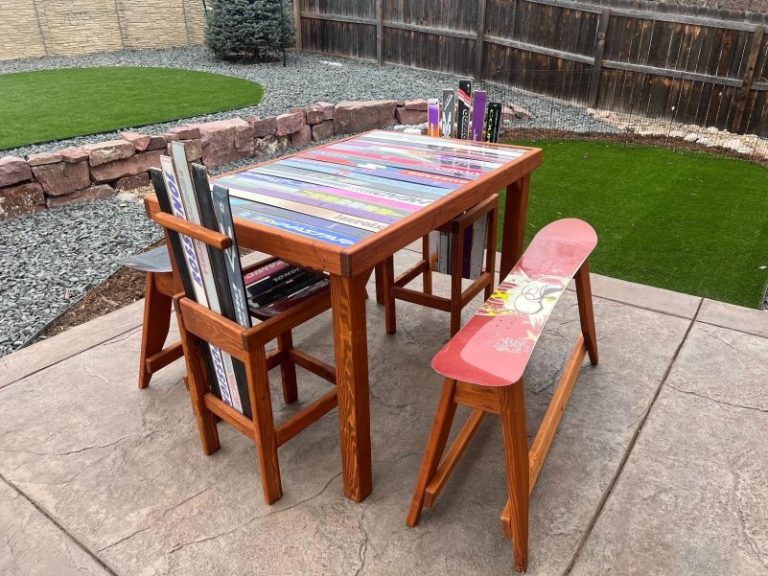
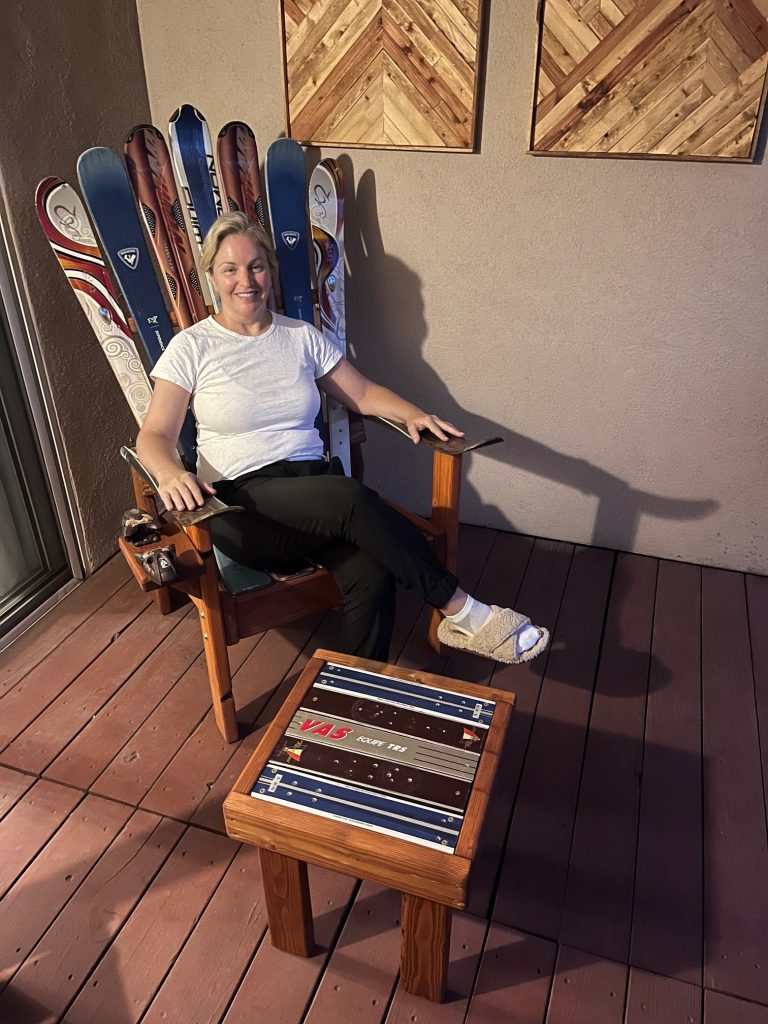
For scale, here is what the rest of the catalog takes, since people use the chair numbers as a yardstick. A single Adirondack ski chair takes four to five pairs of skis, and a matched set of two takes eight to ten pairs. A snowboard chair needs at least three boards. A hockey stick chair takes twelve to fifteen sticks. A golf club chair takes a full set, eleven or twelve clubs. Almost nobody owns that much retired gear, which is why the standard arrangement on a Sentimental build is that the customer sends the pairs that actually mean something, those go into the visible parts, and the shop matches the rest from its own stock of vintage and retro skis.
Same logic applies to a panel. If your company has a crate of old demo skis in a storage unit, or the founder still has the board he learned on, send photos first. Condition gets confirmed before anything is cut. And if the gear is long gone, we will source a close match by brand and era and tell you plainly that it is a match, not the original.
Backlighting, and When the Panel Should Be the Focal Point
Integrated backlighting is available if the panel is meant to be the focal point rather than the backdrop. That is the actual decision, and it is worth making on purpose instead of by default.
Backdrop means the panel sits behind the life of the room, which is how most custom wall panels for a break room are used. People eat in front of it, a cart gets parked against the counter, the toaster oven does its thing. The panel improves the room without demanding anything. That is the right call for most break rooms, and it does not need light.
Focal point means the panel is the reason the room looks the way it does. Lighting behind the boards throws a soft edge glow around each shape and separates the panel from the wall, so it reads as an object rather than a surface. In a room with overhead fluorescents and nothing else, that difference is dramatic. In a break room with a wall of windows, it mostly disappears during the day and earns its money after four in the afternoon in January.
If the room doubles as the place you put clients when the conference room is booked, which is true in more offices than will admit it, backlighting is probably worth it. If it is purely a staff room, put the money into size instead. A bigger panel beats a lit one almost every time.
Logos, Branding, and an Honest Word About Decals
Here is the part people get wrong, and the part worth reading carefully if your company’s mark is going on the wall.
The scene is hand painted. The logo is not. A logo is never painted, and that is deliberate rather than a limitation. A hand painted mark is a hand painted mark, which means the proportions drift slightly, the corner radius is approximate and the brand color is a mix rather than a spec. Your marketing lead will spot it in two seconds and will be right to. So the logo goes on as a logo decal floated onto the painted background, where it holds its exact shape and its exact color.
The listing prices two of the options outright. A vinyl logo applied straight onto the boards runs plus $385, and it will show the gaps between the boards, because it follows the surface it is stuck to. That is completely fine for a bold wordmark or a simple shape, and it looks like a mistake on a detailed mark with thin lettering. A vinyl logo appliqué affixed to an aluminum backer runs plus $585, and the backer bridges the gaps so the mark sits whole and continuous on top of the scene. The extra $200 is buying you the gap problem going away. If your logo has fine serifs, a thin outline or small type under it, pay the $200 and do not think about it again.
Plastic appliques are an alternative, priced differently, and they can go front or back. The third option, and the one people remember, is a laser cut logo made from upcycled skis and snowboards. Your mark, cut out of the same retired gear the panel is built from. It is not right for every brand and it is extremely right for a few.
One practical note for whoever is sending artwork. Send vector files. A screenshot pulled off the website gets you a conversation you did not want to have, and it will cost you a week.
Not a Chairlift, and Not a Replica of One
Worth clearing up, because the catalog has three very different things in it and people blur them together.
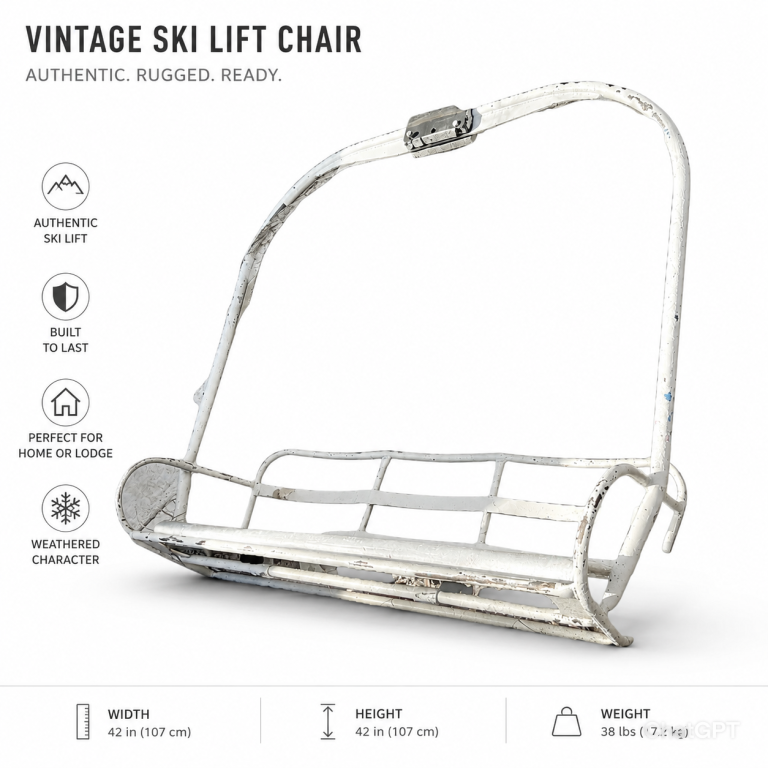
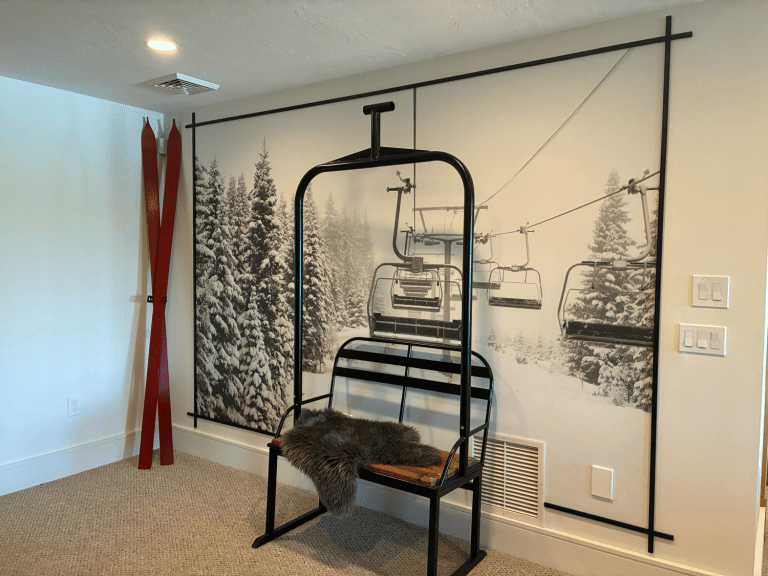
There are genuine retired lifts, which really did run on a mountain. The refurbished original three person lift from Loveland Ski Resort is exactly that, an actual chair pulled out of service and rebuilt on a welded base. It is not a tribute piece.
There are handcrafted replicas, like the two person replica ski chairlift bench, which are welded steel recreations built to order in Colorado. They are honest about what they are. Nobody is going to tell you a replica came off a mountain.
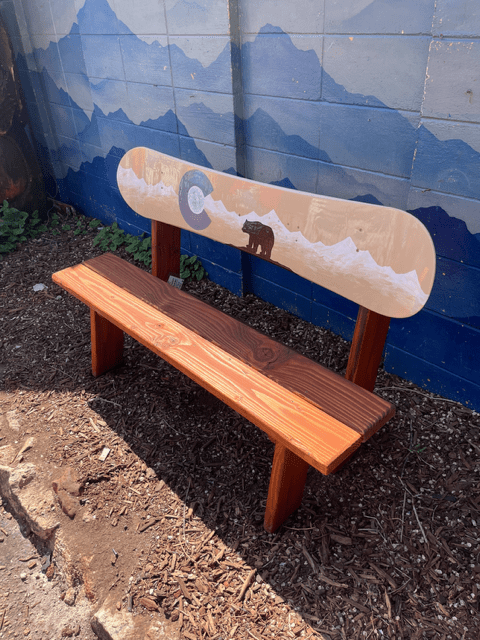
And then there are pieces like this one, which are neither. A custom wall panel is a built object made from reclaimed ski and snowboard material and painted by hand. The boards came from somewhere, obviously. Nobody knows which hills, nobody is going to guess, and you will not find a story about a particular resort attached to them here. The honest version is better anyway: this is reclaimed gear that would otherwise sit in a landfill for the next four hundred years, turned into the only interesting thing in your break room.
If what you actually want is wall art made from snowboards in a smaller, ready to hang format, the Mountain Lake Wall Mural is the five board version of the same idea at a published price. The custom panel is what you order when the wall will not cooperate with a standard size.
What It Costs and How to Start
The listing carries a $695 figure, and that is a starting reference rather than a final number. Price depends on the size, the finish and how the mark goes on, so branded and built to size work is quoted rather than listed. The two logo options above are published, which means you can build most of a budget line before anybody picks up a phone, and that is unusual enough in custom work to be worth pointing out.
Starting is low effort. Measure the wall, photograph it with everything that interrupts it in frame, and call 303.775.7273 with those numbers and your artwork. A real person in Manitou Springs will talk you through size, base material, whether the scene should be a specific place or something general, and which logo treatment your particular mark needs.
Production is a build, not a shipment off a shelf, so plan ahead rather than ordering the week before a client visit. Everything gets made in Colorado and ships nationwide. More one off work lives under Custom Designs, and the rest of the hanging pieces are grouped under Wall Art.
Frequently Asked Questions
Can a custom wall panel cover an electrical panel or a breaker box?
Yes, and that is one of the original reasons these were built. The panel is designed around access rather than sealing the box off, so tell us where it is and how often it gets opened and the build accounts for it.
Can my company logo be hand painted on the panel?
No, and that is on purpose. A logo is never painted, because a painted mark drifts off the exact shape and brand color. It goes on as a logo decal floated onto the painted background, with a vinyl logo at plus $385, a vinyl appliqué on an aluminum backer at plus $585, plastic appliques, or a laser cut logo made from upcycled skis and snowboards.
What sizes do custom wall panels come in?
They are built to your wall rather than picked off a list. The listing shows ten reference dimensions running from roughly 36 by 36 inches to roughly 60 by 96 inches, and anything in or around that range is normal. Call 303.775.7273 with your measurements.
How much do custom wall panels for a break room cost?
The listing carries a $695 figure as a starting reference. Final price depends on the size, the finish and how the logo goes on, so built to size and branded work is quoted on a call rather than listed.
If you have read this far, you are almost certainly picturing a specific wall. Take the tape measure to it before you forget, then take a look at the custom wall panels and call 303.775.7273. Worst case, the breaker box stays ugly for another year and you are no worse off than you are right now.