The Outdoor Bench Made From Old Skis, Built to Stay Out
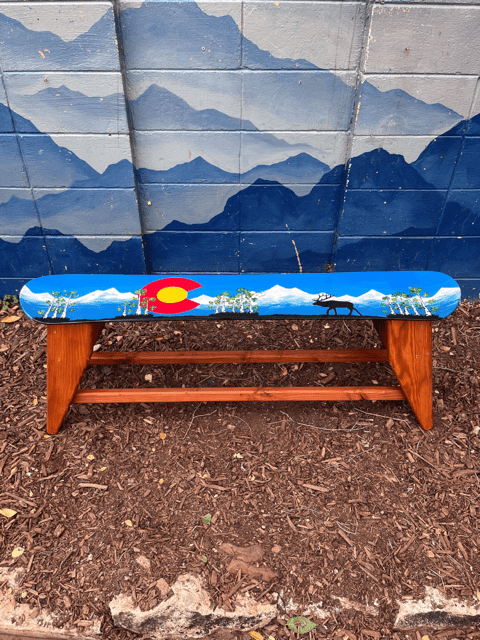
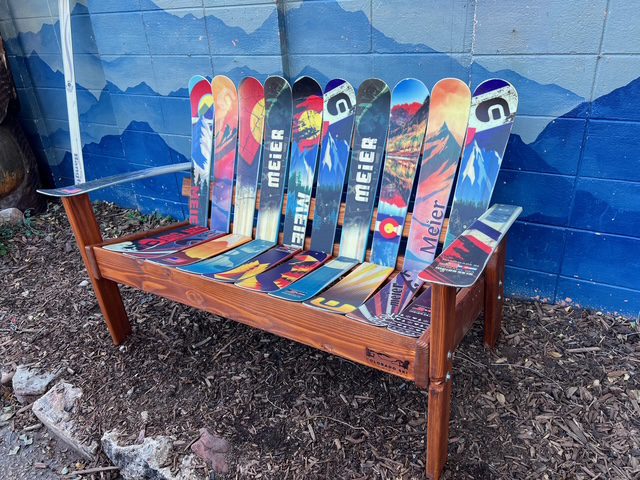
There is a bench out behind the shop in Manitou Springs that stops people mid sentence. Sixty inches of retired powder skis laid shoulder to shoulder, a mountain range and a sunset hand painted across them, all of it bolted to a stained wood frame that looks like it could take a winter without complaining. If you have been circling the question of what to do with the gear stacked in the garage, an outdoor bench made from old skis is the answer that actually gets sat on instead of admired and then ignored.
Why Powder Skis Make a Surprisingly Good Seat
Here is the thing about powder skis. They are wide. That is their entire reason for existing. Somebody figured out that a fat ski floats instead of submarining, and a whole category was born, and then a lot of us bought a pair for the three genuinely deep days we get in a good year. Those skis spent most of their career leaning against a wall looking optimistic.
Turn one on its side and lay it flat, though, and that width stops being a lift line flex and starts being furniture. The Alpine Low Back Powder Ski Bench is built on exactly that idea. Wide skis laid side by side give you a seat with far less gapping between the slats than you get from narrow carving skis, so the surface under you reads as a solid plane instead of a row of fence pickets. You notice it the second you sit down. Nobody has ever sat on this bench and then asked about ski waist widths, but that is the engineering underneath the comfort.
The other advantage is visual. A powder ski has real estate, which means the top sheet graphics have somewhere to live. The bench in the photos is built from a run of brightly printed skis, blues and reds and a sunset burning across the middle, and the whole thing reads as one painting rather than a collection of parts. Narrow skis can look busy. Fat skis give the art room to breathe.
So the practical summary. An outdoor bench made from old skis is more comfortable and better looking when the skis started life wide. That is not marketing, it is just geometry, and it is the reason this particular bench has become one of the steadier sellers in the bench lineup.
What You Are Actually Looking At
Specifics, because vague furniture descriptions help nobody. This bench measures 34 inches tall, 36 inches deep and 60 inches wide. That depth is worth pausing on. Thirty six inches is deep for a bench. It is closer to a loveseat than to the park bench you picture when somebody says the word bench, and it means you can actually sit back into it rather than perching on the front edge with your spine doing all the work.
The shape is the Alpine low back. The back comes up behind your shoulder blades and then stops, which keeps the sight line open. Put a tall backed piece of furniture on a deck and you have built a wall. Put this one there and you have added seating without blocking the view you presumably bought the deck for. The skis fan slightly as they rise, following the Adirondack logic that has kept that chair shape alive for a hundred years, and the frame underneath is solid stained wood with the joints doing honest work.
Frame stain is yours to pick. Blue Grey, Gray, Ebony, Redwood and Walnut are the standing options, and they change the personality of the piece more than you would guess. Ebony under bright ski graphics is sharp and modern. Redwood, which is what the bench in the photos wears, looks like it has always been on that patio. Walnut splits the difference and goes with almost everything.
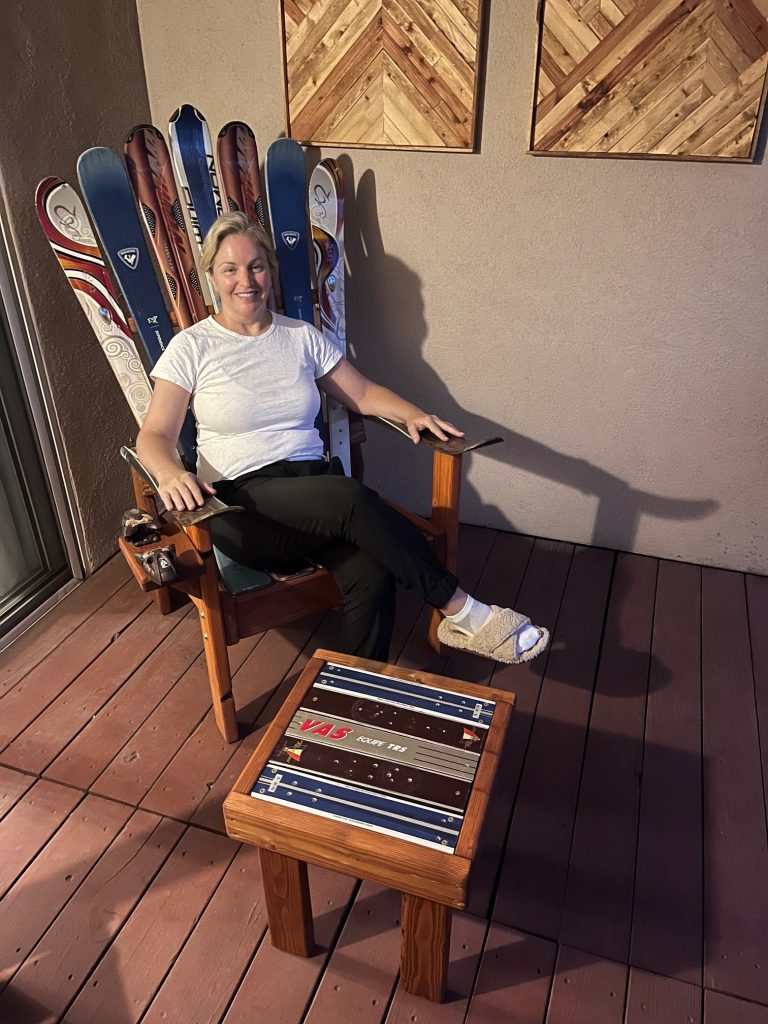
The skis themselves are real retired skis, not new boards printed to look vintage. They came off feet. They have the small dings and base scratches that come from being used by somebody, and those stay. Sanding a ski down until it looks factory fresh would defeat the entire point of building furniture out of skis in the first place.
Built to Stay Outside, Which Is Harder Than It Sounds
Plenty of outdoor furniture is outdoor furniture the way a convertible is a winter car. Technically yes, practically you are going to regret it by February. This bench is finished for the other kind of outdoor.
Every painted design on it goes on in exterior oil paint, applied by hand. That is slower and more expensive than spraying something and calling it a day, and it is the reason the color is still there after a few seasons of Colorado sun, which is a genuinely hostile light source at altitude. The hand painting is also why no two of these benches come out identical. A person painted it. People have good days.
The honest caveat is that nothing outdoors lasts forever without a little attention. Furniture that sits under a covered porch or a deck overhang will look new for years. Furniture that sits in open sky through a full cycle of snow, hail and July afternoons is going to weather, and weathering on a hand painted ski bench actually ages rather nicely, but it does age. If you have a specific brutal spot in mind, a west facing deck with no shade or a yard that collects standing snow, call the shop at 303.775.7273 and describe it. There are finishing choices that help, and it is a two minute conversation.
Production runs about two to four weeks, sometimes longer when the shop is deep in a queue. If you have a real deadline, an anniversary or a closing date on a cabin, say so up front. Deadlines usually get met. They get met far more reliably when somebody mentions them in advance instead of in week three.
How Many Skis Go Into a Sixty Inch Bench
This is the question that comes up on nearly every call, usually phrased as some version of “I have a pair in the garage, is that enough?”
Short answer, not for this. A sixty inch bench takes several pairs. More than people expect, every single time. It is worth knowing the rest of the ladder too, because it reframes the whole catalog once you see it. A single Adirondack ski chair takes four to five pairs of skis. A matched set of two takes eight to ten. A snowboard chair needs at least three boards. A hockey stick chair runs twelve to fifteen sticks. A golf club chair takes a full set, eleven or twelve clubs. These are not numbers anybody picked to sound impressive. They are what it takes to cover the seat and the back with enough material that the piece is structurally sound and visually complete.
Which runs straight into the obvious problem. Almost nobody owns that much retired gear. A household that skis hard might have three or four pairs worth keeping, and two of those are still in rotation.
So here is how it actually works. The standard version of this bench is built from the shop’s own stock of vintage and retro skis, accumulated over years from donations, shop clearouts and people cleaning out garages. You do not have to supply anything. You order a bench, a bench shows up. Clean and simple.
The sentimental version is where your gear comes in, and that is covered below in its own section, because it is a different conversation and it deserves one.
One thing worth saying plainly while we are on the subject of what things are made of. This is a bench built from skis. It is not a chairlift, and it is not a replica of one. Colorado Ski Chairs does build both of those, genuine retired lifts that actually hung off a cable at a resort and handcrafted welded steel replica chairlift benches that were built new in Colorado, and the product pages say clearly which is which. This bench is neither. It is skis, a wood frame and a lot of hand painting, and nobody is going to tell you it came off a mountain.
Where This Bench Actually Ends Up
The single most common spot is next to a fire pit. That makes sense. A sixty inch bench seats more people than two chairs take up in footprint, it does not blow over, and the low back means the people sitting on it are still part of the conversation with everyone standing around.
Second most common is the covered porch, usually the one facing whatever view justified the mortgage. The thirty six inch depth earns its keep here. People end up sitting sideways on it with their feet up, which is not how benches usually work, and it is the clearest signal that a piece of furniture is comfortable.
Then there are the commercial spots, and they have been coming up more. Short term rental owners buy these as the piece that makes the listing photo, which is why the bench also sits in the Host Packages category. A mountain rental with generic patio furniture from a big box store looks like every other mountain rental. One with a hand painted ski bench on the deck gets remembered and, more to the point, gets booked.
Lodges and restaurants with outdoor seating use them along a wall where guests wait. Offices with a patio put one outside the back door, which turns a smoking area nobody uses into a place where people eat lunch. And a surprising number end up in entryways and mudrooms, indoors, as the thing you sit on to deal with boots. The finish does not care which side of the door it lives on.
Low Back or Regular Seat Height, and the Rocker Question
Two choices on this bench that people tend to miss, and both change how it feels.
The first is base height. The low Adirondack height is the default and it is what you see in the photos, a seat that sits closer to the ground with that laid back recline. It is the right call for a fire pit, a deck where people are settling in, anywhere the posture is lounging. The other option is a full size chair base, standard seat height, the kind of elevation you get from a dining chair. That version is noticeably easier to get out of, which matters more than people like to admit, and it is the better choice for an entryway, a lobby, a restaurant waiting area, or any home where somebody has knees with opinions.
Same bench, same skis, same width. Entirely different piece of furniture to use. Worth thinking about for a minute before ordering, because it is not something you can change afterward.
The second choice is the rocker. For an additional seventy five dollars the bench gets built as a rocking bench, on repurposed oak wine barrel slats. A sixty inch rocking bench is an experience. It is also a commitment, since a rocker wants a flat surface to live on and does not love uneven flagstone. On a deck or a covered porch it is wonderful. The shop is honest about this on the phone rather than selling you a rocker for a sloped patio.
Stain color is the third lever, and it is free. Blue Grey, Gray, Ebony, Redwood or Walnut. If you are matching existing furniture, say what you are matching and send a photo.
Paint, Flags, Murals, and an Honest Word About Logos
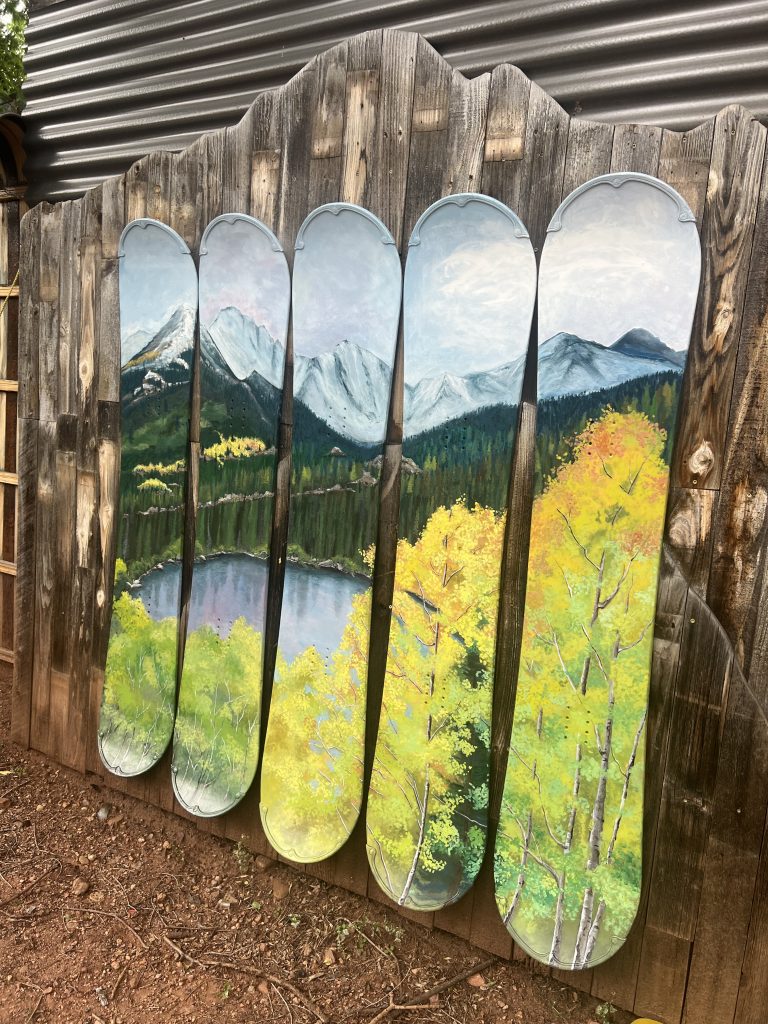
The bench in the photos wears a mountain and sunset scene, but that is a starting point rather than a catalog item. Hand painted work is the shop’s whole thing. Mountains, trees, a lake, a state flag, a specific ridgeline somebody can see from their deck, a scene from a photo of a place that matters. Custom painting runs seventy five dollars an hour, which makes most additions cheaper than people assume.
There is also a less expensive direction that is worth knowing about. A lot of buyers want the original ski and snowboard art left as it is, no mural painted over it, just the top sheet graphics the skis came with arranged into something that works together. That version runs about two hundred and fifty dollars less than the hand painted scene, and it has its own appeal. Those graphics were designed by actual designers, and a run of them lined up side by side looks like a wall of album covers.
Now the part that surprises every business buyer, so it gets said clearly. A logo is never painted. Hand painted murals, flags, scenes and lettering all go on in exterior oils, and the shop will happily claim that work is painted by hand because it is. A company logo is a different animal. A brand mark has to hold its exact proportions and exact colors, and a human with a brush, no matter how good, introduces drift. So the logo goes on as a logo decal floated onto the painted background, which holds the mark precisely. Aluminum appliques and plastic appliques are the other two routes, each priced differently, and either can go on the front or the back depending on which way the piece faces. Branded pricing is quoted on a call, because it depends on the mark, the size, the placement and the quantity. That number is 303.775.7273.
Nobody at the shop will tell you a logo was hand painted when it was not. That seems like a low bar, and yet here we are.
Sending Us Your Own Skis
This is the conversation that makes the phone ring. Somebody’s dad passed, and his skis are in the garage. Somebody’s kid raced through high school and the race skis are still in the rafters. Somebody retired after thirty years of ski patrol and the gear came home with them.
Here is how a sentimental build honestly works, because the math from earlier does not go away. A sixty inch bench needs several pairs, and you probably have one or two that actually mean something. So you send the pairs that matter, and the shop matches the rest from its own stock of vintage and retro skis, choosing for era and color so the whole thing reads as one piece. Your skis go into the visible parts, the seat and the back where you see them and touch them. That is the arrangement, said plainly, and it is how nearly every sentimental build gets done.
If the original skis are already gone, donated or tossed or lost in a move, that is not the end of it. The shop can source a close match by brand and era, and will tell you that is what it is. A 1980s Rossignol that matches the pair your father skied is a lovely thing. It is not his pair, and nobody is going to pretend otherwise. Honesty here matters more than the sale.
Practically, it starts with photos. Text or email pictures of what you have, including the top sheets and the lengths, and the shop will tell you what it can work with and what the finished bench would look like. Some skis are too far gone. Delamination is real. Better to hear that before shipping a pair across the country.
Ordering, Timing, and the Part Nobody Likes
The bench runs fourteen hundred and ninety one dollars as configured, with free shipping, built to order in Manitou Springs and sent anywhere in the country. Add seventy five for the rocker, subtract about two hundred and fifty for the original ski art version, add custom painting at seventy five an hour if you want something specific on it.
Is that a lot for a bench? Compared to a flat pack from a big box store, obviously yes. Compared to replacing that flat pack every third summer when the slats go gray and the hardware rusts through, the arithmetic looks different. This is handmade, locally built, hand painted furniture made from materials that already survived a career on a mountain. Divide the price across the years you will actually have it and it stops looking like a splurge and starts looking like a decision.
Production is two to four weeks typically. Longer in the run up to the holidays, which is the single most useful thing to know if you are reading this in late October with December in mind. A bench ordered now is comfortable. A bench ordered on December tenth is a conversation about expedited everything.
Questions get answered fastest on the phone at 303.775.7273. Colors, sizes, whether your deck can take a rocker, what to do with the skis in your garage, whether a given scene is paintable. It usually is.
Frequently Asked Questions
How many pairs of skis does it take to make a bench like this?
A sixty inch bench takes several pairs, considerably more than most people expect. For comparison, a single Adirondack ski chair takes four to five pairs, a matched set of two takes eight to ten, and a snowboard chair needs at least three boards. Colorado Ski Chairs builds the standard bench from its own stock of retired skis, so you do not need to supply anything.
Can this bench live outside all year?
Yes. It is built from repurposed skis on a stained wood frame and every painted design is applied by hand in exterior oil paint, which is chosen specifically to hold up outdoors. A covered porch or deck overhang will keep it looking newest; call 303.775.7273 to talk through a fully exposed spot before ordering.
Can you put our company logo on it?
Yes, but not with a brush. A logo is never hand painted, because a brand mark has to hold its exact shape and color. It goes on as a logo decal floated onto the painted background, with aluminum appliques and plastic appliques as alternatives, front or back. Branded and bulk pricing is quoted on a call at 303.775.7273.
Is this an actual chairlift bench?
No. This is an outdoor bench made from old skis on a wood frame. Colorado Ski Chairs does sell genuine retired chairlifts and separately builds handcrafted welded steel replica chairlift benches, and those product pages say so clearly. This bench is neither one.
One Last Thing
The skis in your garage are not doing anything. They have not been doing anything for a few years now, and you have not thrown them out, which tells you something about what they are actually worth to you. An outdoor bench made from old skis is the version of those skis that your family uses on a Tuesday, and then on a Saturday, and then every evening in September when the light goes gold and somebody suggests a fire.
Have a look at the Alpine Low Back Powder Ski Bench, browse the rest of the benches if you want to compare shapes, or just call 303.775.7273 and describe the spot you are trying to fill. That is usually the fastest way to the right bench.