An Outdoor Rocking Chair Made From Skis, With Colorado On It
There is a specific hour on a Colorado evening, somewhere after the light goes orange and before you actually have to go inside, when a chair either earns its spot or it does not. A grey Alpine rocker with Colorado painted across the back earns it. This is an outdoor rocking chair made from skis, built one at a time in Manitou Springs on a Douglas Fir base, finished in exterior oil paint, and set on runners so it moves the way a chair should when you have nowhere in particular to be.
The Outdoor Rocking Chair Made From Skis, Piece by Piece
The Blue CO Flag with Grey Base Alpine Rocker is a compact Adirondack style chair built from real retired skis on a Douglas Fir base. It measures 45 inches tall by 30 inches deep by 26 inches wide with the binding cup holders included in that width, which matters more than it sounds like it does. It is finished in high quality exterior oil paint that stays colorful through real weather, not the kind of paint that looks great in a showroom and chalky by August. It carries a 3 year hassle free warranty, and after that window the shop charges materials cost only for repairs. Yup. That is the whole warranty conversation.
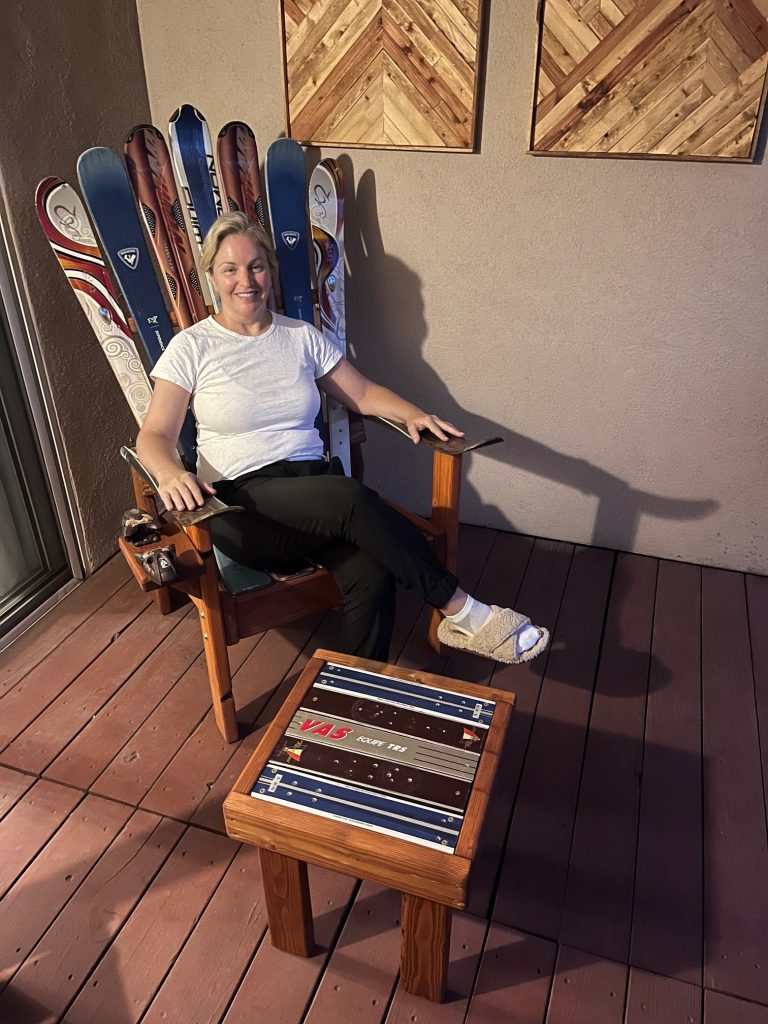
The seat and the back are the interesting part. Those are not boards cut to look like skis. They are skis, retired ones, with the top sheet graphics still readable in places if you lean down and look. The seat slats in particular show their old lives: a stripe of some 1990s neon, a brand name half worn off, the odd core shot from a rock that absolutely was not there. Nobody sands that away, because sanding it away would defeat the entire exercise.
In the arm there is a cup holder made from a repurposed ski binding. It is not a drink holder shaped like a binding. It is a binding, mounted where a cup holder belongs, sized for something with real volume rather than an espresso. Small detail, but it is the detail everybody touches first.
The base is where the two tone idea lives. The frame stays grey so the painted back has something to push against instead of disappearing into the wood. Hold a bright blue panel against a redwood stain and it fights. Hold it against grey and it reads like a flag on a pole. That choice is deliberate and it is the reason this particular configuration exists as its own listing rather than as a color note in the order comments.
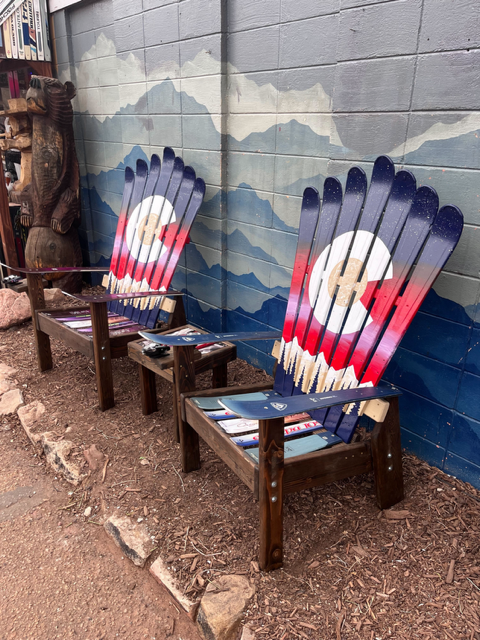
Price is $505, SKU 528938, in stock and built to order. One chair. The photo shows two because people keep ordering them in pairs, which the shop is happy to do, but the listed price is per chair.
Why the Rocking Part Matters More Than You Think
A stationary chair and a rocking chair do different jobs. A stationary chair holds you in one position and your body eventually files a complaint. A rocker gives you somewhere to put the restless part of yourself, which is why a ten minute coffee on a rocker turns into forty five minutes and nobody notices it happening. The shop’s own product page says it plainly, and in fairness, nobody in the history of that shop has complained about it.
What makes an outdoor rocking chair made from skis work is the geometry underneath. The runners have to be long enough to give real travel without tipping you out the front, and they have to be flat enough on the bottom to work on a wood deck as well as a stone patio. The pictured pair sits on runners that extend behind the back legs, which is why they rock through a long arc instead of a nervous little twitch.
Here is something worth saying straight. The product description for this chair calls it a rocker build, while the option list on the same page prices rocking as a $75 add on with a No option alongside it. Those two things cannot both be the default. The photographed pair clearly sits on rocker runners. If you are buying this specifically because it rocks, call 303.775.7273 and confirm what your chair ships as before you pay. That takes one phone call and it beats guessing based on a listing that argues with itself. When the rocker is built, the runners come from repurposed oak wine barrel slats, which is a nice touch nobody asks about and everybody likes once they hear it.
One practical note on floors. Rockers and soft wood do not always get along over the course of years, and a runner on a painted deck will eventually leave two faint arcs where it lives. That is not a defect, that is physics. A couple of felt pads or an outdoor rug solves it for anyone who cares. Most people on a stone patio or a gravel fire pit ring never think about it at all.
The Colorado on the Back, and What the Listing Says Versus What the Photo Shows
This is the part where honesty beats marketing copy, so here it is in plain terms.
The written description for this chair says the seat back carries the blue field, the red C and the gold center, which is the full Colorado state flag. The photograph on that same listing shows something different and, frankly, better looking: pale cream ski slats with a large blue Colorado C painted across them, a white disc inside the C holding a dark tree line and peak, a soft layered mountain range painted across the lower half of the back, and ski arm rails with their old blue and white top sheet graphics still showing. All of it over a grey frame. No red C, no gold field, no blue background. The thumbnail description attached to that photo agrees with the photo, calling it a blue Colorado C back.
Two possibilities exist. Either the written description is boilerplate carried over from a full flag version of this chair, or the shop paints both treatments under the same listing and the photo happens to show the C version. The shop knows which. A blog post does not get to decide, and inventing an answer would be worse than useless to somebody about to spend $505. So: the pictured build is the blue C with the mountain inside it on pale skis over a grey base. If you want the full three color flag with the red C and the gold center, say that out loud on the phone and get it confirmed in writing on your order.
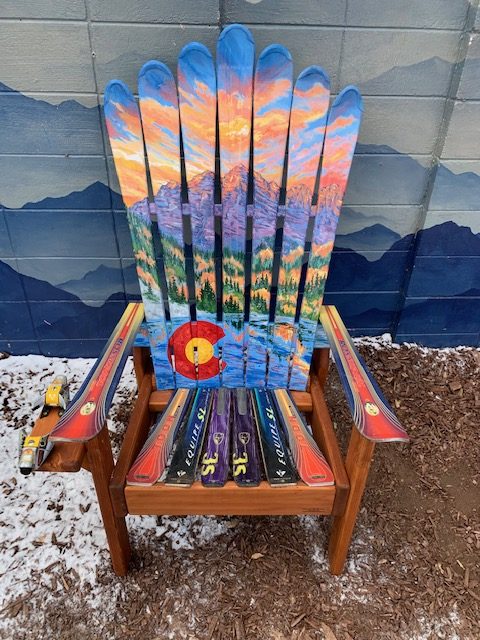
Either way, the flag and the C are both hand painted in exterior oils, and both are fair game, because a state flag is a public symbol rather than somebody’s trademark. That distinction matters in this shop and it comes up again further down.
Worth noting what hand painted actually buys you here. The ski backs are different widths, because retired skis are different widths. That means the C does not land in exactly the same place on any two chairs, and the mountain inside it crosses the gaps between slats a little differently every time. A machine printed graphic would hide that. A brush does not, and after a week nobody wants it to.

How Many Skis It Actually Takes
People hear ski chair and picture one pair of skis becoming one chair, maybe two chairs if you are clever with the cuts. That is not how the math works, and the shop is unusually blunt about it.
A single Adirondack ski chair takes four to five pairs of skis. A matched set of two takes eight to ten pairs. A snowboard chair needs at least three boards. A hockey stick chair runs twelve to fifteen sticks. A golf club chair takes one full set, eleven or twelve clubs. Those numbers are not padding. Skis are narrow, they taper, and a seat back wide enough to hold a painted Colorado C needs a lot of narrow tapering pieces to cover it.
Which leads to the part almost nobody expects. Almost no household owns four to five retired pairs. One pair, sure. Maybe two, if somebody in the family skied hard for a decade. So the standard arrangement for a sentimental build is this: you send the pairs that actually mean something, those go into the visible parts of the chair where you will see them every time you sit down, and the shop matches the rest from its own stock of vintage and retro skis. The shop confirms condition from photos before anything gets cut, because a delaminated ski that has spent fifteen winters in a shed is sometimes past saving and it is better to know that before it ships.
If the original skis are already long gone, which happens more often than you would think, tell the shop the brand and the era and they will source something close. They will also tell you plainly that it is a match rather than the original pair. Nobody here is going to hand you a chair and let you believe your father’s Rossignols are in it when they are not.
The listed Blue CO Flag rocker is not a sentimental build. It comes out of the shop’s own retired stock, which is why it has a price on it and a lead time rather than a conversation. If you do want your own gear in it, the Sentimental Ski Chair is the listing built for exactly that, and it takes four to five pairs per chair as advertised.
Three Backs and Five Stains, Which Is the Real Decision
The configuration options on this chair are not cosmetic trim. They change what the piece is.
The back comes three ways. All Skis gives you narrow slats with many thin gaps between them, a vertical rhythm that reads almost like siding, and it is the version in the photo. All Snowboard swaps that for two or three wide panels, which gives a painted scene far more uninterrupted room and loses the slat texture entirely. Hybrid Ski and Snowboard mixes both widths for an irregular rhythm that looks handmade from across the yard, because it is.
For a graphic like the Colorado C, there is a real trade here. The slatted ski back breaks the C into segments as it crosses the gaps, which looks great in person and slightly strange in a tight photograph. The snowboard back holds the C whole. Neither is wrong. If the chair is going on a patio where people sit in it, the ski back is the more interesting object. If the chair is going somewhere it gets photographed a lot, a rental listing or a lobby, the wider panels are the safer bet.
The stain list runs Blue/Grey, Gray, Ebony, Redwood and Walnut. The pictured build uses the grey, and that is the configuration this listing is named for. Ebony makes a painted blue almost glow and turns the whole chair into a graphic object. Redwood and Walnut do the opposite, settling the chair into a cedar deck until you half forget it is there, which some people want very much. A quick word of advice from watching these go out the door: match the stain to what the chair sits on, not to what it sits next to. A grey chair on grey composite decking disappears. A grey chair on warm cedar pops.
The base height has exactly one setting, Compact Chair, Alpine, no ski tips. That is the whole Alpine idea. You trade the dramatic ski tips arcing up over the back of the full size chairs for 26 inches of width, which fits a condo balcony, a standard doorway, and a fire pit circle where a full size Adirondack would hog two people’s worth of room. The compact footprint is why you can put two of these plus a small table where one oversized chair used to sit by itself looking lonely.
Not a Chairlift, and an Honest Word About Logos
Colorado Ski Chairs sells three distinctly different things and they get confused constantly, so here is the clean version.
There are genuine retired lifts, which actually came off a mountain. The refurbished original lift from Loveland Ski Resort is one of those, a real three person chair that worked up where I-70 starts running out of oxygen, now on a welded stand up base. Two exist in the shop. That is the entire supply.
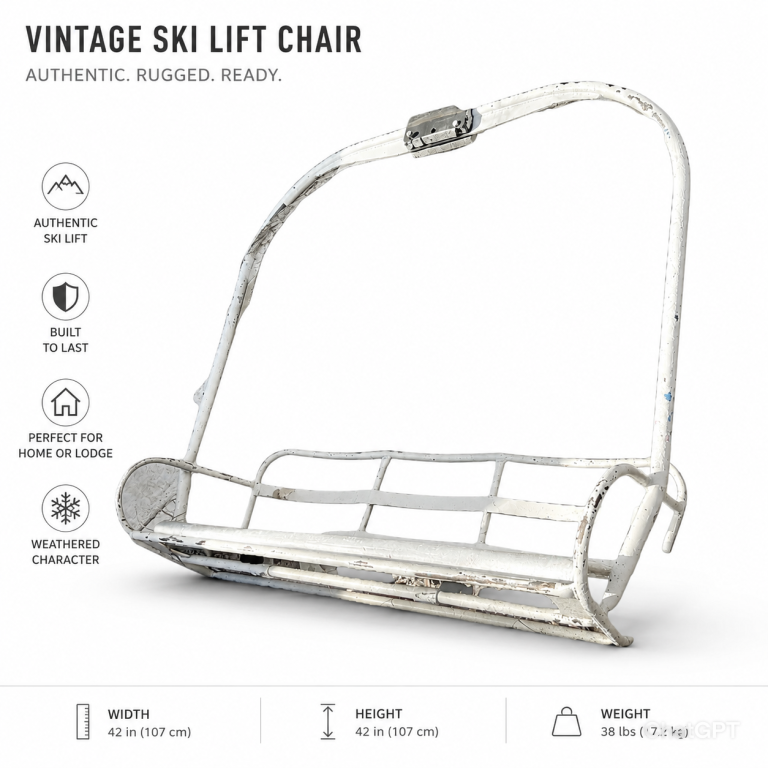
There are handcrafted replicas, like the two person replica ski chairlift bench, which are welded steel recreations built to order in Colorado with a wrap around bar and a stained wood seat. Beautiful pieces, and not off any mountain. The product name says replica because it is one.
And then there is ski furniture, which is what this rocker is. Nobody knows which mountains these particular skis rode, and nobody at the shop is going to invent an answer so a blog post sounds better. They are retired skis. They came from garages and ski swaps and the back of somebody’s van. That is the honest story and it is a good one.
On logos, since business readers always ask: a hand painted scene is fine, and a state flag, a Colorado C, a ridgeline, a cabin name or a date all get painted in exterior oils by hand. A company logo never does. A logo goes on as a decal floated onto the painted background, so the mark holds its exact shape, proportion and brand color instead of being approximated by a brush. Aluminum appliques and plastic appliques are the alternatives, priced differently, and they can go on the front or the back. Branded and bulk pricing is quoted on a call at 303.775.7273, and if you are going that route, send vector art rather than a screenshot pulled off your own website.
Where This Chair Actually Ends Up
Three places, mostly, and they are more specific than you would guess.
The first is a fire pit setup. Someone builds the ring, buys the gravel, gets the wood stacked, and then realizes the seating is four camp chairs from a big box store with cup holders full of pine needles. A pair of these replaces them and the whole area stops looking temporary. The compact Alpine width is what makes the pair work in a circle that would otherwise fit one full size chair and a cooler.
The second is a mountain rental. Property managers have figured out that guests photograph furniture, and a hand painted Colorado chair on a deck generates more free social posts than any amount of neutral wicker. An outdoor rocking chair made from skis does double duty there: it is comfortable, and it is the thing in the photo that tells somebody scrolling where the property is before they read the listing.
The third is the one that comes up quietly on the phone. The kid left for college, or moved out for good, and there is a porch or a room that could use something with some life in it. Mountain towns are full of people in their fifties sitting in a house that got quiet faster than they expected. A chair built from retired gear, painted with the state they chose to live in, is not a bad way to fill that.
Office patios show up too, and they are worth a line. A company that re-buys cheap resin chairs every other summer is telling its people exactly how much the break space matters. A few real chairs out there says the opposite, and they outlast the lease.
Weather, Paint, and the Long Haul
The finish is high quality exterior oil paint and the piece is built to live outdoors. Worth knowing what actually wears a hand painted outdoor chair down, because it is not what people assume.
It is not rain. It is ultraviolet light. Colorado sits high and thin and the sun up here is brutal on pigment in a way that coastal sun is not. A chair under a covered porch or a deep overhang will hold its blue saturated for a very long time. A chair in the middle of a fully exposed south facing deck will soften over years. That is true of every hand painted surface ever made, including the trim on your house, and it is not a knock on the paint.
The thing to actually avoid is standing water. Not rain, not snow sitting on the seat in February, but a chair parked in a low spot where water pools against the base for days. Wood is fine getting wet and drying. Wood is less fine staying wet. Move it six inches onto higher ground and the problem evaporates, literally.
Snow is a non issue. These chairs sit through Colorado winters. Brush it off, sit down, be slightly cold, go inside. That is the expected use pattern and it is also, for a lot of people, the whole point of owning one.
When something does eventually need attention, the 3 year hassle free warranty covers the first stretch and after that the shop charges materials cost only. A small shop in Manitou Springs offering cost-only repairs for the life of the chair is not a standard furniture warranty, and it is worth weighing against a $505 price tag when you are comparing this to a $150 chair you will replace three times.
How Ordering Actually Works
Short version: you place the order, you note the configuration, somebody builds it.
Longer version worth knowing. This is made to order, which means the chair that shows up is the one somebody built after you paid, not one pulled off a shelf. Note your back type, your stain and whether you want the rocker in the order notes, and call 303.775.7273 if any of it is ambiguous, which given the rocker wording on this listing it currently is. The shop would rather field a two minute phone call than build the wrong chair.
If you want a matched pair, or a different two tone combination than blue on grey, that is a phone call rather than a checkbox. The same goes for a custom painted scene on the back instead of the C, or a company logo, or a bulk order for a property with eleven decks that all need the same thing.
Everything is built in Manitou Springs and ships nationwide. Lead times on painted made to order work run longer than a warehouse item, which is obvious, but worth saying out loud in November when somebody is thinking about a holiday gift. Order painted furniture in late fall and it arrives in time. Order it on December 10 and it does not. That is not a sales tactic, that is a paint drying schedule.
Browse the rest of the chairs if you want to see how the Alpine frame compares to the full size Adirondacks, or the ski lift benches and swings if the chairlift end of the catalog is more your speed.
Frequently Asked Questions
How many skis does it take to make a ski chair?
A single Adirondack ski chair takes four to five pairs of retired skis, and a matched set of two takes eight to ten pairs. A snowboard chair needs at least three boards, a hockey stick chair twelve to fifteen sticks, and a golf club chair one full set of eleven or twelve clubs. One pair of skis does not make a chair, and it does not make two.
Is this a real ski lift chair?
No. It is ski furniture, an Adirondack style outdoor rocking chair made from skis on a Douglas Fir base. Colorado Ski Chairs also sells genuine retired lifts, which say so in the product name, and handcrafted welded steel replica chairlift benches, which say replica. This rocker is neither of those.
Does the chair actually rock, or is that an add on?
The product description calls it a rocker build and the pictured pair sits on rocker runners, while the option list prices rocking as a $75 add with a No option available. Call 303.775.7273 and confirm what your chair ships as before paying, because the listing is inconsistent on this point.
Can you put our company logo on one?
Yes, but never hand painted. A logo goes on as a decal floated onto the painted background, or as an aluminum or plastic applique, so the mark keeps its exact shape and brand color. Hand painted scenes, flags and lettering are fine. Branded and bulk pricing is quoted on a call at 303.775.7273.
Will it survive a Colorado winter outside?
Yes. It is finished in high quality exterior oil paint and built for outdoor use. Ultraviolet light, not snow, is what eventually softens hand painted color, so a covered spot keeps it most saturated. Avoid parking it where water pools against the base for days at a time.
One Last Thing
A $505 chair sounds like a lot until you count the camp chairs it replaces and the number of evenings it gets used. An outdoor rocking chair made from skis is not really furniture shopping anyway. It is the thing on the deck that makes a visitor stop, lean in, and say wait, are those actual skis, every single time. They are. Take a look at the Blue CO Flag with Grey Base Alpine Rocker, or call 303.775.7273 and have one built in whatever two tone combination you have been picturing.