The Wall Art Made From Snowboards You Could Not Throw Out
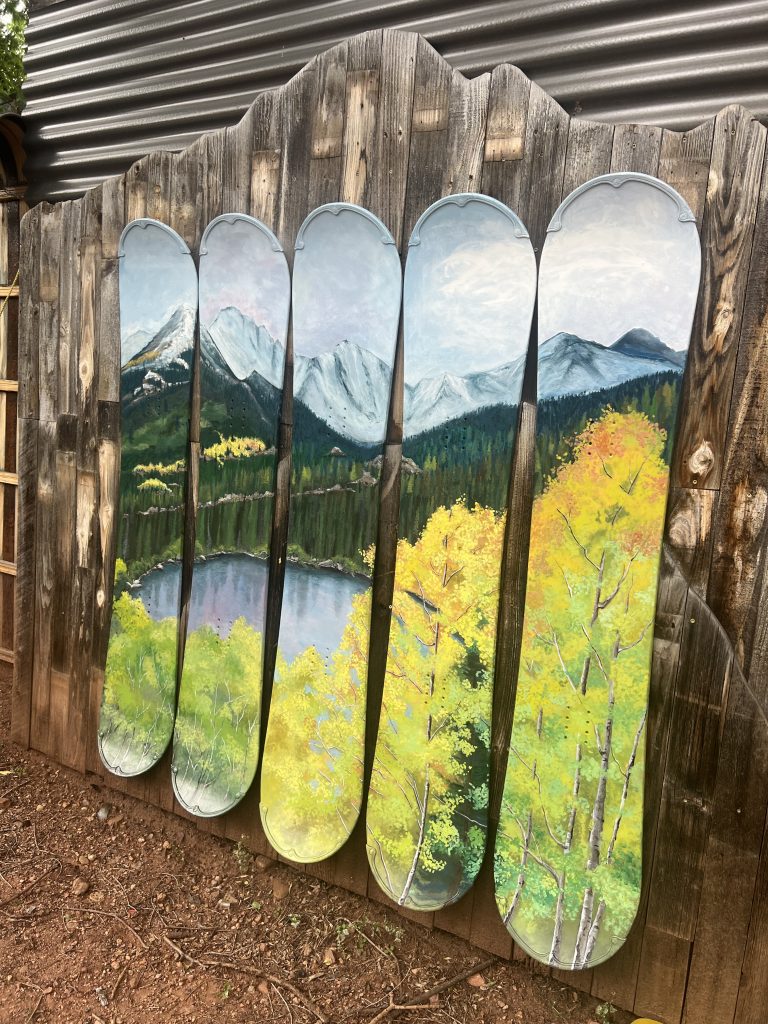
There are five snowboards in a garage somewhere in Colorado right now that nobody is ever going to ride again, too beat to sell and too good to haul to the dump, leaning in the same corner since the last time anyone bothered to check the bindings. Wall art made from snowboards is what happens when somebody finally admits that and does something about it instead. The piece pictured here is a mountain lake with golden aspens, hand painted across five real upcycled boards, photographed hanging on a weathered fence because that is genuinely where it can live.
What Five Old Snowboards Look Like After a Month in the Shop
Every board that comes through the shop in Manitou Springs shows up carrying a history nobody wrote down. Topsheet graphics from a company that folded two decades ago. A core shot near the tail that somebody filled with P-Tex in a parking lot and never sanded flat. Edge rust. A sticker peeled halfway off in 2009 and left that way ever since. The first stage is the unglamorous part: bindings come off, hardware goes in a bucket, and every board gets scrubbed down, because fifteen years of wax, pine sap and chairlift grit is not a surface anybody can paint on.
Then comes the stage that decides what the finished piece actually looks like. The boards get laid out on the bench and shuffled around like a hand of cards, because a snowboard is not a rectangle. It has sidecut, it has taper, it has a nose and a tail at different widths, and it has a waist in the middle that pulls in. Line five of them up side by side and you do not get a tidy grid. You get a shape with a wavy outer edge and gaps between the boards that open and close as they run up the panel. You can fight that or you can use it. We use it. The boards get arranged so the wide points land where the painting needs mass and the narrow waists fall where the scene wants air, and then the whole set gets mounted to a frame on the back so it hangs as one object and goes up with a handful of screws rather than five separate installations and a level and a bad afternoon.
The gaps stay. That is a deliberate choice and it is worth saying plainly, because it is the detail people either love on sight or need about ten seconds to come around to. This is not a canvas. It is five real boards with daylight between them, and when afternoon sun crosses the wall those gaps throw thin shadow lines straight across your lake. Some customers see that and ask whether it is a flaw. It is the opposite. It is the only honest proof that the thing used to be snowboards.
How Wall Art Made From Snowboards Gets Painted
Here is the part that takes the skill. A mural painted across five separate boards has to read as one continuous scene from eight feet back, which means every ridgeline, every shoreline and every tree trunk has to pick up on the far side of a gap exactly where it left off. There is no undo. The paint goes on by hand, in exterior grade oils, over a base coat, and a ridgeline that lands a quarter inch high on board four will bother you every single day for the rest of the time you own it.
So the panels get laid out flat and painted as a set, in order, as one surface. Big shapes first: the water, the far range, the sky. The scene gets blocked in across all five boards before any detail happens anywhere, which is the only way to keep the horizon honest. Then the painting moves forward in layers, the back range softened and washed out to sit back in the distance, the near peaks sharpened up, and the water given its reflections last because reflections are where a lake either works or goes flat. The aspens go in near the end, trunk by trunk, and the dark knots and eyes in the bark are the final marks on the whole piece. Those get done by hand, one at a time, which is slow and which is also the reason the grove never lands the same way twice.
Boards are not blank, either, and that matters to the painting. Some topsheets are glossy, some are matte, some have a texture pressed into them, and a few have graphics loud enough to ghost through if you are not careful about coverage. The shop reads each board before a brush touches it and adjusts, which is a thing you can only do when there is a person standing there instead of a printer. If you want the old graphics left showing through in places, that is a conversation worth having up front, because it is a real option and it looks terrific on the right board. Just say so before the base coat goes on, not after.

The mountain lake and golden aspen version pictured here is painted across five upcycled snowboards and is in stock at $695.
The Mountain Lake, and Why the Aspens Are Gold
The scene on the pictured piece is a high mountain lake with a range behind it and a stand of aspens in gold. Anyone who has driven a Colorado pass road in the third week of September knows exactly which two weeks of the year that is, and knows how fast they go by. The gold is the whole point. Paint those same aspens in summer green and you have a pleasant landscape. Paint them gold and you have a specific fortnight that people plan vacations around and then talk about for the rest of the winter.
The water carries most of the work. A lake painted flat looks like a blue floor, so the reflections get broken up, the far shore gets a soft edge where it meets the surface, and the near water gets the darker, more saturated color because that is how water actually behaves when you stand at the edge of it. The back range goes in pale and low contrast so your eye puts it miles away. The near peaks get the sharp edges and the hard shadow. None of that is a trick, it is just how depth works, but it is the difference between a mural you glance at and one somebody stands in front of at a party for a full minute without realizing they stopped talking.
And none of it is fixed. This is the scene on the version that is in stock, which is a real convenience if it is the scene you want. If it is not, the shop paints what you describe. People send photos of the view from a deck, a specific lake they got engaged at, the ridgeline visible from a kitchen window, a stretch of coastline that has nothing to do with Colorado at all. The palette shifts, the animals come in or stay out, the season changes. One customer wanted the same lake at dusk instead of midday and that is a different painting entirely even though the shapes barely moved. More painted work hangs in the wall art collection, and the one off builds live under custom designs.
Ten Sizes, Because Walls Do Not Come in One Shape
This is the part most people underestimate, and it is the part that decides whether the finished piece looks intentional or looks like a picture frame that got lost. The Mountain Lake Wall Mural is offered in ten sizes, and they are not small increments of the same square. They run from roughly 36 by 36 inches up through 36 by 48, 36 by 60 and 36 by 72, then 46 by 46, 46 by 60 and 46 by 72, then 60 by 60, 60 by 72 and finally 60 by 96 inches, which is eight feet wide and genuinely commands a room.
Ten options exist because a wall mural is architecture, not decor. A 36 by 36 panel over a bench in an entryway is a different job than a 60 by 96 spanning the blank stretch above a staircase in a great room, and buying the wrong one is a mistake you look at every day. The honest guidance is simpler than people expect: measure the wall, then measure the furniture that sits under it, and let the mural run wider than the furniture rather than narrower. A piece that stops short of the sofa arms reads as undersized no matter how good the painting is. A piece that overhangs it slightly reads as deliberate.
The number of boards follows the size, which is the mechanical reason the sizes step the way they do. Five boards make the pictured panel. A wider build takes more, a narrow vertical build for a stairwell or a nook takes fewer, and the shop works that out from the dimensions rather than from a fixed recipe. Nobody is going to quote you a board count off a phone call before the size is settled, because that number is an output, not an input. If the wall is an odd shape, or there is a window or a thermostat in the middle of it, say so. That is a design problem and the shop has solved it before. Call 303.775.7273 with the measurements and it goes faster than any amount of staring at a size dropdown.
Skis, Snowboards, Both, or Barnwood: Pick the Base
The pictured version is all snowboards, but the base material is a choice and there are four of them. All skis, all snowboards, a hybrid of skis and snowboards mixed together, or reclaimed barnwood. They are not interchangeable, and the one you pick changes the piece more than the paint does.
All snowboards gives you wide panels, big uninterrupted areas of paint, and relatively few gaps. It is the cleanest canvas of the four and it is why the mountain lake version is built that way. All skis is the opposite character: skis are narrow, so the same wall takes a lot more of them, and you end up with a vertical pinstriped surface with many thin gaps running through it. A scene painted across all skis reads as more fractured and more graphic, closer to a slatted sign than a painting, and for the right scene and the right room that is the better looking option by a mile. The hybrid mixes both widths on purpose and gives you an irregular rhythm across the panel, which suits a busier scene and looks genuinely handmade in a way that a uniform grid does not.
Reclaimed barnwood is the one that surprises people, because there is no ski or snowboard in it at all. It is salvaged barn board, with its own weathering, nail holes and grain, and it makes the warmest and most rustic of the four. If the room is already full of mountain gear, or if the mural is going somewhere the snowboard thing would be one reference too many, barnwood is usually the right call. It is also the option to ask about if the piece has to sit next to existing woodwork and not argue with it. Either way, the base material gets settled before anything is painted, because the painting is planned around the surface it is going on.
Where It Goes, Including Over the Breaker Box
The listing says the quiet part out loud, which is refreshing in a product description: these panels exist partly to conceal breaker boxes and smooth over wall imperfections. That is how the whole product line started. Somebody had an ugly gray metal door in the middle of an otherwise finished wall, and the choices were to live with it, build a cabinet around it, or hang something over it that looked like it was supposed to be there. The third option turned out to be the good one.
So yes, it goes over breaker boxes, access panels, patched drywall, the ghost of a doorway that got framed over, and that one section of wall where the previous owner did something nobody has been able to explain since. It also goes where there is nothing wrong at all. Lobbies and reception walls, because a lobby either has character in the first eight seconds or it does not. Boardrooms and conference rooms, where it is the thing people look at on a video call and ask about. Great rooms and stairwell walls at home, which are the hardest walls in any house to fill because they are large, tall, and brutal to anything undersized. Finished basements. Home bars. Covered patios and outdoor kitchens, which is the case most wall art cannot take and this one can.
Short term rentals are worth calling out separately. A hand painted mural made from real snowboards is the single most photographed object in a lot of the rental properties it ends up in, and photographs taken by guests are the only marketing nobody has to pay for. It is also, practically speaking, nearly impossible to damage by accident, which matters more in a rental than anyone wants to admit. Hotels, lodges and resort properties order these the same way, usually in multiples, and that brings up a conversation about logos.
Logos, Branding, and an Honest Word About the Gaps
This is where the shop will tell you something most vendors will not, so pay attention to it, because it will save you money or save you a disappointment.
The scene is hand painted. A logo is not. A logo never is. A company mark has exact proportions, exact colors and exact edges, and the moment a human being paints one freehand it is no longer your logo, it is a nice painting of your logo, and your brand team will spot the difference from across the room. So the mark goes on as a vinyl logo applied to the finished, painted panel, which holds its shape and its color exactly. That option is listed at $385 on top of the mural.
And here is the honest part. A vinyl logo applied straight onto the boards will show the gaps between them. The listing says so in the option name itself, which is unusually candid for a product page. The vinyl follows the surface, and where the surface has daylight running through it, so does your logo. For some marks that is a non issue and even looks deliberate, especially simple wordmarks and bold shapes. For a detailed logo, or a logo with thin lettering, a gap landing in the wrong place looks like a mistake.
Which is what the second option solves. A vinyl logo appliqué affixed to an aluminum backer, listed at $585, puts the mark on a solid aluminum plate that is then mounted onto the mural. The backer bridges the gaps, so the logo sits whole and continuous on top of a surface that is not. It costs two hundred dollars more than the plain vinyl and for a detailed mark it is the difference between a branded wall and an apology. Plastic appliqués are an alternative at a different price, and laser cut logos made from upcycled skis and snowboards are the showiest option of the group, which is the one to ask about if the point is for people to walk up and touch it.
Integrated backlighting is also available and does a lot for a dark lobby wall. Branded and bulk pricing beyond the two listed logo options gets quoted on a call, because it depends on the mark, the size and how many walls are involved. Call 303.775.7273 and send the vector art, not a screenshot off a website.
Paint, Weather, and Why It Can Hang Outside
The finish is the reason this piece can live on a covered patio instead of only in a hallway. It is painted in weatherproof exterior grade oil paint, the kind formulated for things that stay outdoors through a full year rather than the kind meant for a guest bedroom. The listing compares it to fire hydrant paint, which is an inelegant comparison and also exactly the right one, because a fire hydrant spends its entire life in the weather being ignored and still looks like a fire hydrant twenty years later.
What that means in practice in Colorado is specific. Ultraviolet light at seven thousand feet is harder on paint than almost anything else, and cheap pigment goes chalky and sad in a couple of summers. Hail happens, usually in July, usually right after somebody washes their truck. Temperature swings of forty degrees in a single day are routine, and anything rigid and brittle eventually quits under that. Snowboards, as it happens, are engineered objects built from fiberglass, wood core and plastic, specifically to flex and absorb impact in the cold without cracking. They were already weatherproof before anyone painted them. That is not a marketing angle, it is just what a snowboard is.
Covered outdoor is still the smart placement for the best possible long term look, and that is true of any painted surface anywhere. A spot under a porch roof or a deep overhang keeps the colors at their most saturated for the longest time. A fully exposed south facing wall in direct sun all day is a harder life and the piece will take it, but it will age faster than the one under the eave, and anybody who tells you differently about any hand painted object is selling something. Indoors, there is nothing to think about at all. Hang it, forget it, dust it once a year if you are the kind of person who does that.
No Skis Were Harmed: What This Takes Versus What a Chair Takes
Since this is a piece built from real upcycled gear, the question that always comes up is how much gear it eats, and whether a customer can supply their own. Worth answering straight, including the part where the answer changes depending on which product you are asking about.
A wall mural is built from the shop’s own stock of retired skis, snowboards and salvaged wood, so nobody has to donate anything to get one. The count follows the size of the wall, and for the pictured panel it is five boards. That is a very different appetite from the seating in the catalog, and the numbers there surprise people every time. A single Adirondack ski chair takes four to five pairs of skis. A matched set of two takes eight to ten pairs. A snowboard chair needs at least three boards. A hockey stick chair runs twelve to fifteen sticks. A golf club chair takes a full set, eleven or twelve clubs. Almost nobody has that much retired gear sitting around, which is why those builds work the way they do: the customer sends the pairs that actually mean something, and the shop matches the rest from its own inventory of vintage and retro gear, putting the customer’s own equipment into the visible parts of the piece.
A mural is friendlier on that front than a chair, because the surface area per board is high and the shop can work a specific board or a specific pair into the panel where it will be seen. If somebody’s own board is going into the piece, the shop confirms from photos first, because condition matters and a board that has delaminated along one edge is a different conversation than a board that is just scratched. And if the gear in question is long gone, which happens, the shop sources a close match by brand and era and says so plainly. It will never be described as the original board. That distinction is not negotiable and it is the reason people trust the sentimental builds in the first place.
Not a Chairlift, and Not a Replica of One
One clarification, because the catalog contains three genuinely different categories of thing and people mix them up constantly.
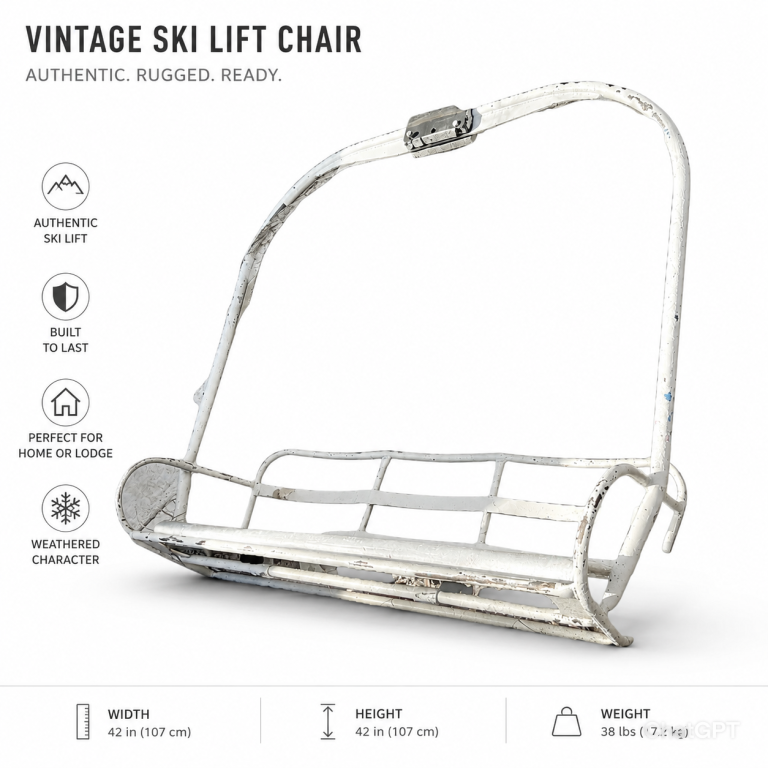
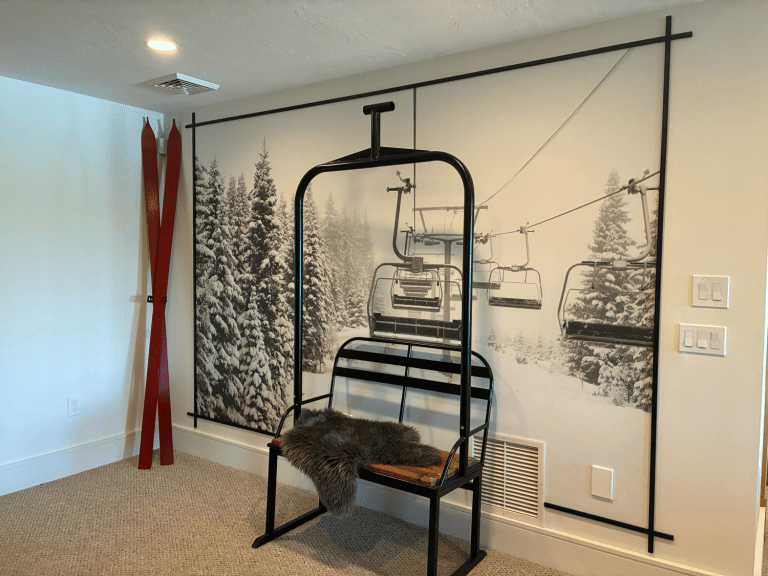
Colorado Ski Chairs sells a small number of real retired chairlifts, actual lifts that carried actual skiers up actual mountains and then came down when the resort replaced them. Those say so in the product name, like the original three person lift from Loveland Ski Resort, and there are only ever a couple of them around at a time. The shop also builds handcrafted replica chairlift benches, which are welded steel recreations made to order in Colorado, beautiful and accurate and not a lift that ever hung from a cable. Those say replica right in the name too.
This mural is neither. It is wall art, built from upcycled snowboards and painted by hand. It never hung on a mountain and it is not pretending to. The boards rode hills, certainly, and nobody knows which ones, and nobody is going to invent an answer to make the story better. The story is already fine: somebody’s gear got a second life as the thing that fixes a blank wall, which is more than most retired snowboards manage.
Bulk Orders, Multiple Locations, and the Procurement Reality
For the business readers, there is a practical layer here that the consumer version of this conversation never touches, and it is the reason this product shows up in multi site orders.
If a company has eleven locations and wants the same branded wall in all eleven, consistency becomes the entire problem. Hand painted work is by definition not identical from piece to piece, which is a feature in a home and a complication across a portfolio. The way that gets handled is by separating the two layers: the painted scene is allowed to vary, because that is what makes each one feel like it belongs to that location, while the branded element stays mechanically identical because it is a vinyl logo or an aluminum backed appliqué cut from the same art file every time. The Denver lobby and the Boise lobby end up with different mountains and the exact same mark. That is usually what the brand team wanted and did not know how to ask for.
The budget side is similarly concrete, which facilities and procurement people appreciate. The mural carries a listed price, the logo options carry listed prices at $385 and $585, and the sizes are published rather than quoted, so a line item can be built before anybody gets on a call. What does need a call is quantity, lead time and anything unusual about installation. Hand painted work takes real time, and eleven of them takes eleven times that time, so a rollout planned in the fall is a different experience than a rollout that becomes urgent in December. That is not a sales line, it is just how paint and a two person shop work. Start the conversation at 303.775.7273 earlier than feels necessary.
How Ordering Works
The version pictured, the mountain lake with the golden aspens on five snowboard panels, is in stock and listed at $695, which means it is a piece that already exists rather than a build that starts when you order. If that is the scene and the size works, that is the simplest transaction available here.
Anything customized follows a different path and it starts with a conversation rather than a cart. Pick the size from the ten offered, pick the base material from skis, snowboards, hybrid or reclaimed barnwood, describe the scene or send a photograph of the view you want painted, and decide whether a logo is involved and which of the mounting methods suits your mark. If backlighting is part of it, that comes up early because it affects how the panel is built, not just how it is finished. Everything is made to order in Manitou Springs, Colorado, and ships nationwide.
For a custom build, send photos of the actual wall, with something recognizable in the frame for scale. A door, a chair, a person. A photo of a blank wall with no reference in it tells nobody anything about how big it is. The shop will tell you honestly if the size you picked is wrong for the space, which is a conversation worth having before the paint goes on rather than after the crate arrives.
Frequently Asked Questions
Is this really made from old snowboards?
Yes. The pictured Mountain Lake Wall Mural is hand painted across five real upcycled snowboards mounted together as one panel. The base material is a choice, and the four options are all skis, all snowboards, a hybrid of both, or reclaimed barnwood.
Can my company logo be painted on it?
No, and that is on purpose. A hand painted logo loses the exact shape and color of your mark. Logos go on as a vinyl logo applied to the finished panel at $385, or as a vinyl appliqué affixed to an aluminum backer at $585, which bridges the gaps between the boards so a detailed logo stays continuous. Plastic appliqués and laser cut logos made from upcycled skis and snowboards are alternatives, and branded or bulk pricing is quoted on a call at 303.775.7273.
What sizes does it come in?
Ten, running from approximately 36 by 36 inches up to approximately 60 by 96 inches, including 36 by 48, 36 by 60, 36 by 72, 46 by 46, 46 by 60, 46 by 72, 60 by 60 and 60 by 72. The number of boards follows the size you choose rather than the other way around.
Can it hang outside?
Yes. It is painted in weatherproof exterior oil paint and the boards themselves are engineered to handle cold and impact. A covered spot like a porch or a deep overhang keeps the color at its best for the longest, and a fully exposed wall in constant direct sun will age faster, which is true of any hand painted surface anywhere.
One Wall, One Afternoon, Done
Wall art made from snowboards solves two problems in one hang: the wall that has been blank or ugly since the day you moved in, and the gear nobody could bring themselves to throw out. Take a look at the Mountain Lake Wall Mural if the lake and the gold aspens are already what you were picturing, or call 303.775.7273 and describe the view out your own window instead. Worst case, you finally find out what those boards in the corner were waiting for.