Adirondack Ski Chairs for the Garden Corner Nobody Leaves
Every yard has a corner that gets ignored. Yours is probably the far one, past the hose reel, where the light goes gold around seven and nobody ever stands because there’s nothing to stand there for. Put two chairs in it this week and watch what happens by Sunday. That corner becomes the place people carry their drink to without being asked twice.
The Reason That Corner Sat Empty for Six Years
It wasn’t the landscaping. Plenty of gardens have beautiful beds and a lawn cut to within an inch of its life and still nobody stops moving through them. A garden without seating is a garden you look at. A garden with seating is a garden you’re in, and those are two entirely different things to own.
The trouble is that most people try to solve it with a folding chair, or a bench they bought in a hurry, or one of those bistro sets with a table the size of a dinner plate. Those all fail for the same reason. They’re built for short sits. A folding chair tells your body it’s temporary. A bistro chair puts you upright at ninety degrees, which is a posture for eating, not for staying. And a bench with no back is a very polite way of asking someone to leave in fifteen minutes.
What a garden corner actually needs is a chair that makes it hard to get up. That’s the whole design brief and it’s the one an Adirondack chair was built to answer a hundred years ago. Reclined back, low seat, arms wide enough to hold everything you carried out with you. It’s not a chair you perch in. It’s a chair you land in.
Add a pair of them and you’ve done something more than furnish a corner. You’ve created a destination inside your own property, which is a strange thing to be able to buy, and cheaper than the patio you were thinking about pouring.
What Makes the Shape Work Outdoors
The geometry is old and it’s been tested by about a century of people sitting in it. The back leans, so your weight goes into the frame rather than your lower spine. The seat slopes down toward the back, which sounds like it would slide you out and instead does the opposite, it settles you in. The arms run wide and flat, which is why nobody who owns one has ever needed a side table for a coffee cup.
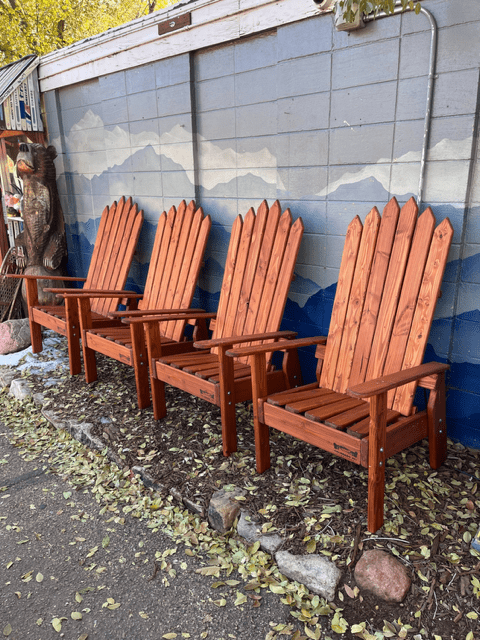
Scale matters more than people expect. These run around 45 inches tall by 36 deep and 32 wide, with some builds going up to 55 inches tall and others, like the alpenglow pair below, sitting a little lower at 35 tall by 36 deep and 27 wide. They’re rated to 400 pounds and they’re comfortable for people from about three feet up to six foot ten. If you’ve got a tall friend who’s spent his adult life apologizing for his knees in patio furniture, this is the chair where he stops.
The other outdoor advantage is weight. A garden chair that a gust can move is a garden chair you’re constantly resetting. These are heavy enough to stay where you put them through a Colorado summer, which includes the kind of afternoon where the sky turns green and the neighbor’s umbrella ends up two yards over.
One more thing the shape does well in a garden specifically. Because you’re reclined, you’re looking up. At the trees, at the sky, at whatever you planted that’s finally taller than you are. Upright chairs point you at the fence. That’s a real difference and it’s the reason these end up in flower beds and under trees rather than pushed against a wall.
Retired Skis, Douglas Fir, and Why the Pair Is the Real Unit
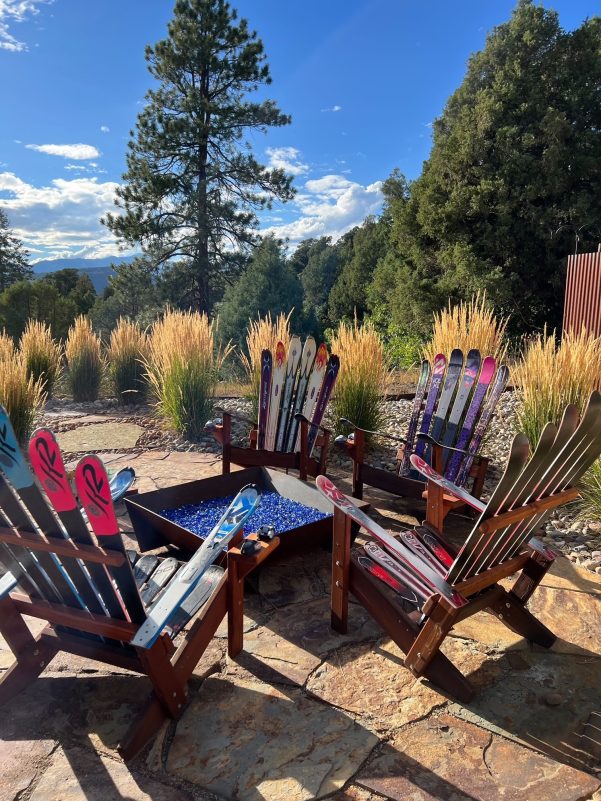
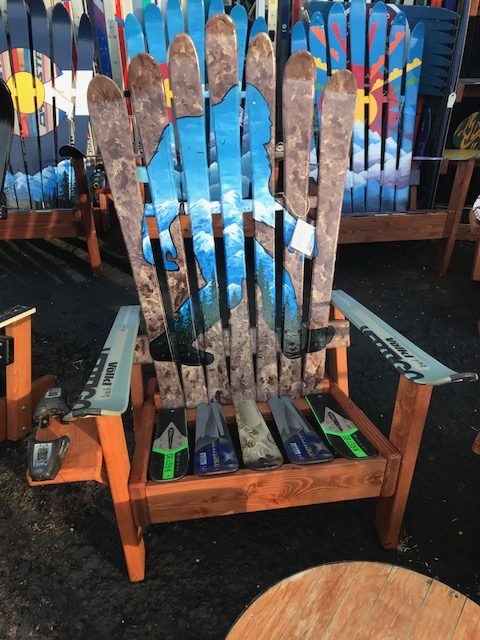
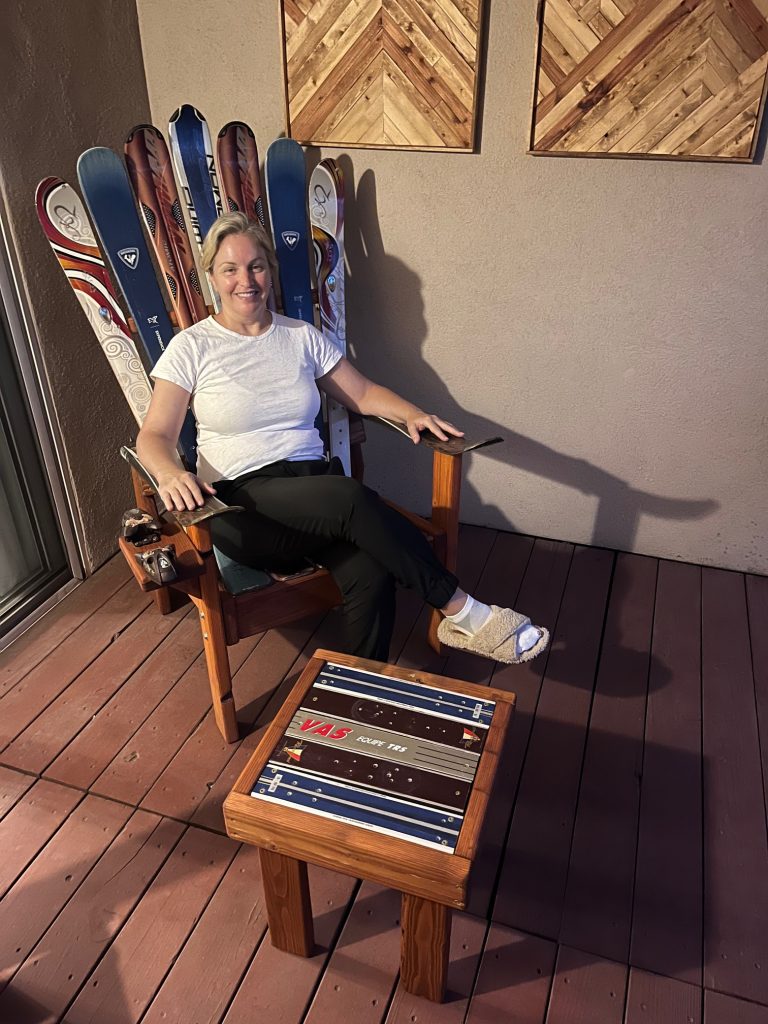
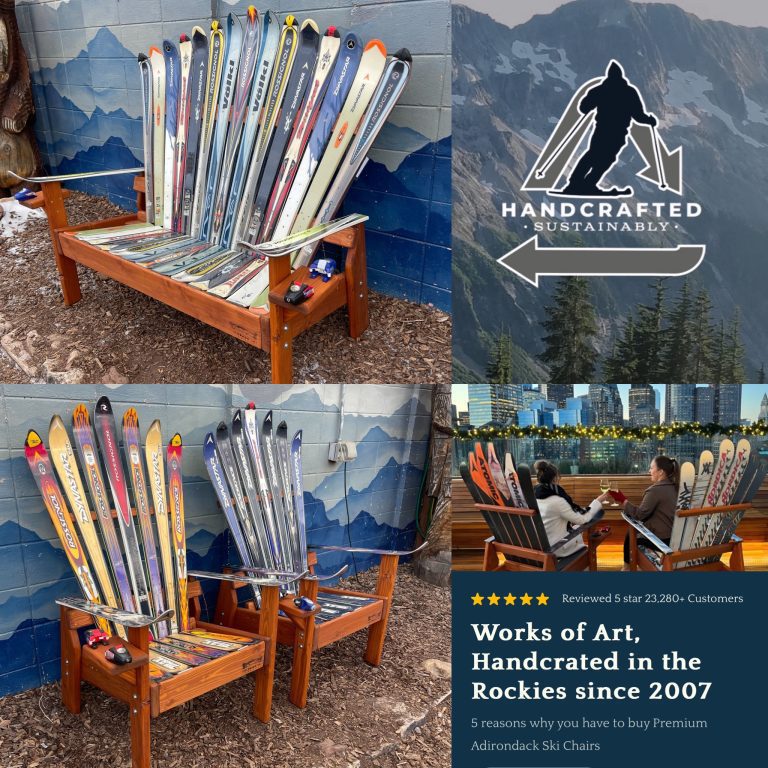
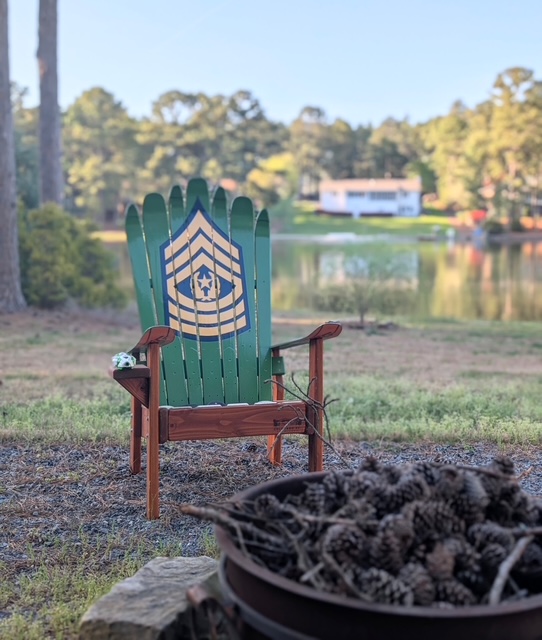
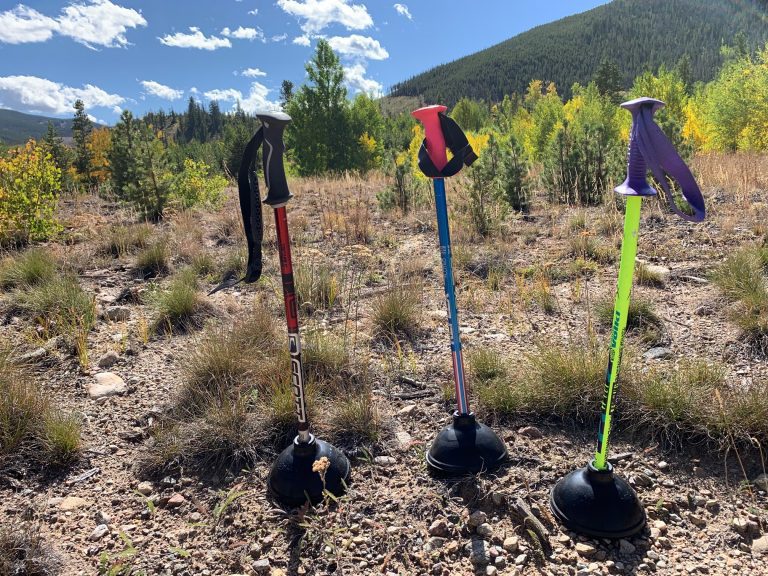
Here’s what’s actually holding you up. The seat and back slats are retired downhill skis, real ones, previously skied, pulled from resorts and shops and garages. One chair takes four to five pairs. A set of two takes eight to ten pairs, which is a genuinely large pile of skis when you see it stacked before anyone starts cutting.
Skis are a great material for garden furniture and almost nobody thinks of it. They’re laminated wood, metal and composite, engineered to flex under a person’s full weight at speed and to shrug off water, cold and ultraviolet for a decade of weekends. Lay that flat as a slat and it’s already weatherproof, already stiff, and already accustomed to hard use. It never has to be treated like precious wood, because it isn’t.
The base is Douglas Fir, cut and joined to carry the load and hold the chair square. There’s a cup holder in the arm made from an actual ski binding, which is the kind of detail that makes people laugh the first time and then use constantly for a decade.
Buy them as a pair rather than one at a time. This is my honest opinion and it holds up. A single chair in a garden corner reads as a spot for one person to go be alone, which is fine and occasionally the point, but two chairs read as an invitation. Nobody has ever walked past two empty chairs facing a sunset without thinking about it. The set of two also lets a mural run across both, which is a thing a single chair simply cannot do. If the mural is not what you’re after and you just want two good chairs in the corner, the Set of 2 Alpine Ski Chairs start at $881 with the colors picked by you, and the Set of 2 Ski Chairs start at $997 and let you call the ski colors on the slats. The rest of the pairs are under set of 2.

Where to Actually Put Them, and the Angle Nobody Gets Right
Start by watching your own yard for a couple of evenings before you commit. Find where the light lands at the hour you’re most likely to be outside. That’s the spot. Not the spot that’s most convenient to the back door, and not the flat spot, the spot with the light. People will walk fifty feet for good light and they will not sit in a badly lit corner ten feet from the kitchen.
Now the angle, which is where most people go wrong. Do not set two chairs parallel and facing the same direction. Parallel chairs mean two adults staring at a fence and speaking to each other sideways, which is a posture nobody enjoys for more than ten minutes. Turn them toward each other by fifteen or twenty degrees, with about three feet between the inside arms. That’s close enough to talk at a normal volume and open enough that neither person feels cornered.
If there’s a view, split the difference. Angle them slightly toward each other and slightly toward the thing worth looking at. You want conversation to be possible and silence to be comfortable, and that angle does both.
Backdrop is the other half of it. These look their best with something behind them that has height, a hedge, a fence with a vine on it, a tree trunk, the corner of a shed. Chairs floating in the middle of a lawn look temporary no matter how heavy they are. Chairs with something at their back look placed.
Ground matters less than people fear. Flagstone, gravel, decomposed granite, mulch, packed dirt or straight lawn all work. On soft ground the wide rear legs spread the load, so they don’t sink the way a four post chair does. If you want the corner to feel finished, a four by six foot patch of gravel under the pair is a two hour Saturday project and it changes the whole read of the space. Building out something larger? The patio sets pair chairs with matching tables and ottomans if the corner is going to grow.
The Murals Are Hand Painted. Logos Are Not.
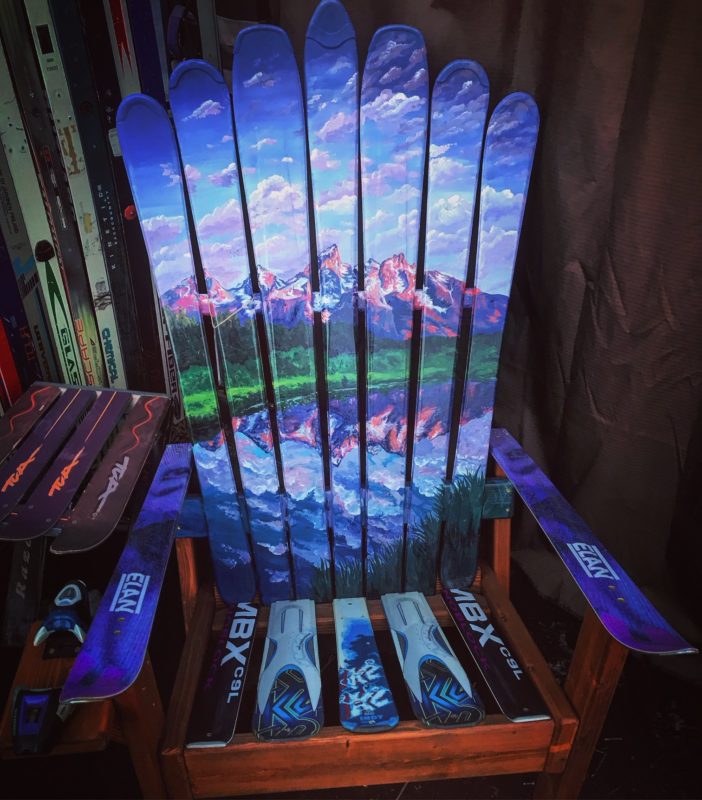
Anything painted on these chairs is done by hand, with a brush, in exterior oil paint. That’s a slow method and it’s the reason the finish survives a garden. Oil paint on a prepped surface moves with the wood and the weather instead of sitting on top of it and flaking off in year two.
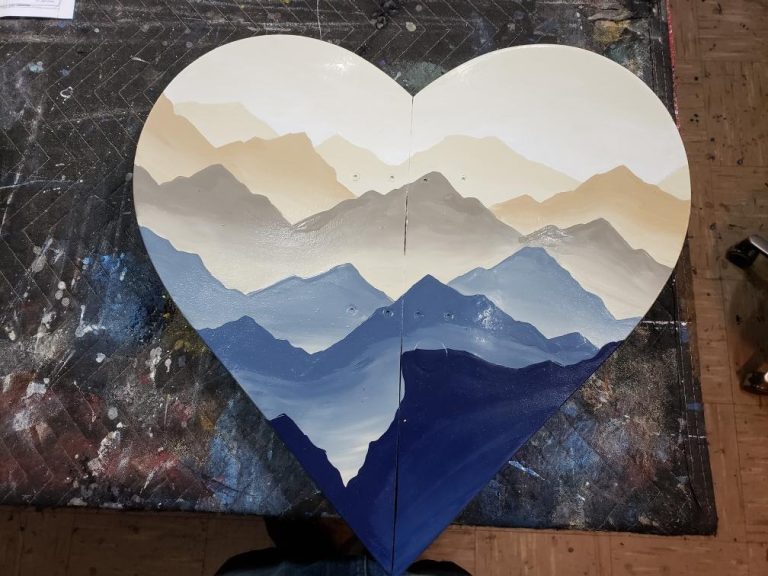
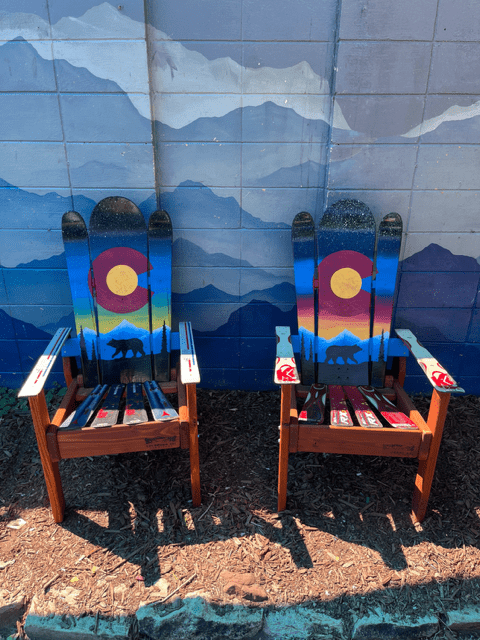
The Set of 2 Alpenglow Mountain Mural Moose & Bear Ski Chairs shows what the pair format makes possible. Alpenglow lasts about fifteen minutes a day, which is why everyone keeps trying to photograph it and keeps failing. Painted in oils across two chairs, the peaks run pink and orange with a moose on one and a bear on the other, and the range continues from one chair to the next so the whole thing reads as a single scene. Set them apart and you have two nice chairs. Set them side by side and you have one painting you can sit in. Each chair is 35 inches tall by 36 deep and 27 wide, and the ski slats show through the paint, so the scene has a grain and a break to it that a flat printed panel would never give you.
Wildlife is the most requested mural category by a distance, and moose and bear are the two animals nobody has to explain. Elk, foxes and somebody’s actual dog come up constantly too. Custom hand painting is billed at $75 an hour, so a simple subject and an involved landscape price differently, which is the straightforward way to handle it. The pieces where the painting is doing most of the work are grouped under fine art chairs and benches.
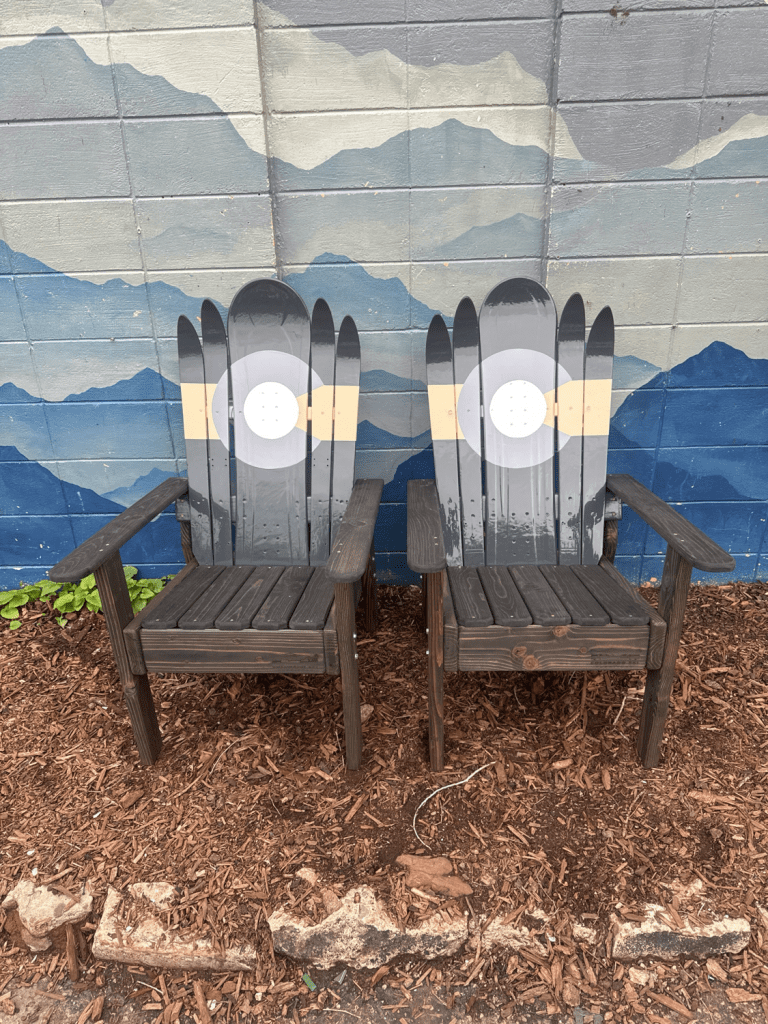
A logo is a different process entirely, and this is worth stating plainly because people assume otherwise. A logo is never painted. The background gets painted and the logo goes on as a decal floated onto it, with aluminum and plastic appliques as alternatives when you want more physical presence. A brand mark has to be exact, and a hand brushed approximation of one looks wrong to everybody who knows the mark. Branded pricing gets quoted on a call.
Who Ends Up Buying a Pair
More gardeners than skiers, which surprised the shop. Somebody who has spent four years building beds and moving perennials around eventually realizes there’s nowhere to sit and look at the result, and a pair of chairs is the last thing the project needed. Those buyers care about color matching the base to the house trim and they care about scale against the planting, and they’re usually right about both.
Then the mountain house and cabin owners, who want the pair on a deck or flanking a door where guests see them on arrival. Then the lake and river crowd, who put them at the water’s edge and leave them there through October.
A steady stream of anniversary and housewarming orders come through, because two chairs is an obvious gift for two people and it doesn’t require knowing anybody’s size or taste in dishware. They live in gift items along with the smaller pieces, and pairs are the single most common thing bought for a couple.
And a fair number go indoors, which nobody predicts until they see it. Sunrooms, front rooms with a window worth pointing at, finished basements, ski condos. The paint and the build don’t care which side of the wall they’re on. A mural pair flanking a fireplace does more design work than most sofas manage, and there’s a whole section of indoor decor furniture for people who went that direction.
The common thread is that none of these buyers wanted furniture that could have come from anywhere. They wanted a specific object with a story already attached.
Midsummer Through the First Snow
The maintenance list is short, which is the entire point of building them this way. Exterior oil paint over ski topsheets on a Douglas Fir base is weatherproof, and it’s meant to sit outside through a full year with nobody doing anything about it.
Midsummer, the job is sitting in them. That’s it. If a mural pair lives in full unshaded sun from morning to night, the colors stay deeper for longer under a tree or a porch roof, or under a cheap cover during a week when you’re traveling. Not required. Just true, and most owners with an involved mural figure it out on their own.
Fall is the one season that actually asks something of you, and it’s thirty seconds. Leaves and pine needles collect in the gaps between the seat slats, and packed wet debris is the only thing that keeps moisture sitting against the frame instead of running off it. Clear the slats out when you rake. Done.
Winter, your call. Plenty of these sit under two feet of snow all season and come out in April looking like they did in October. If you’ve got easy garage space, using it costs you nothing and buys you a little paint life. If you don’t, leave them. They were built by people who watch it happen every year.
Spring is the five minute reset. Hose them down, wipe the arms, and check that the hardware is snug, because wood moves through a freeze and thaw cycle and a quarter turn on a couple of fasteners in April keeps everything tight for the season. And if something goes genuinely wrong in the first three years, there’s a 3 year hassle free warranty. Yup. You call, it gets made right, and there’s no claims department engineered to wear you down.
Making the Pair Yours
The small requests are the ones that pay off most. Ask for a specific ski brand on the slats and the chairs stop being generic. If you learned on Rossignol, or K2, or a shop brand from the town you grew up in, say so when you order. The shop keeps a lot of retired skis sorted and can usually match a brand if you ask early enough.
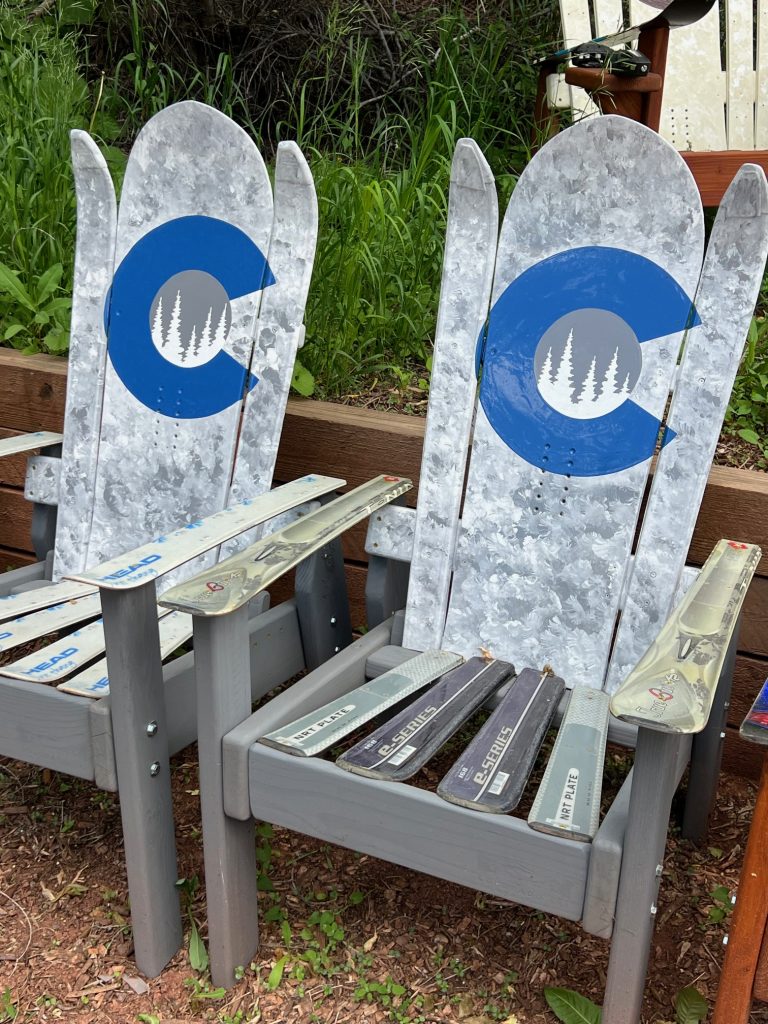
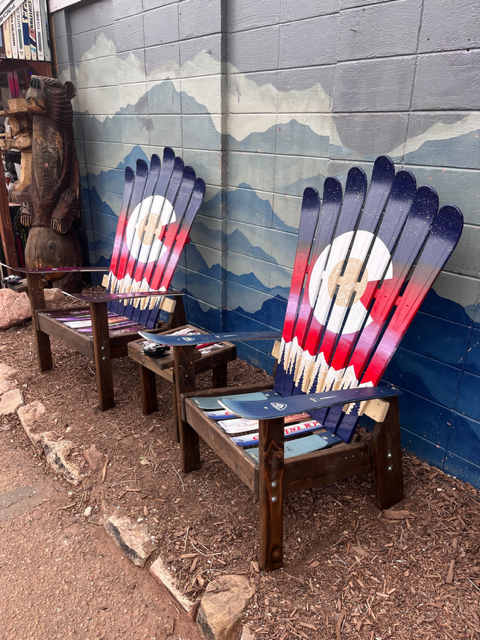
Color is the next lever and it’s wide open. Base color, front board, accent stripes, all of it. Colorado flag treatments are the most requested by a mile, but for a garden a base painted to match your house trim or your fence stain is the quieter and honestly better looking choice. It makes the pair look like it belongs to the property rather than visiting it.
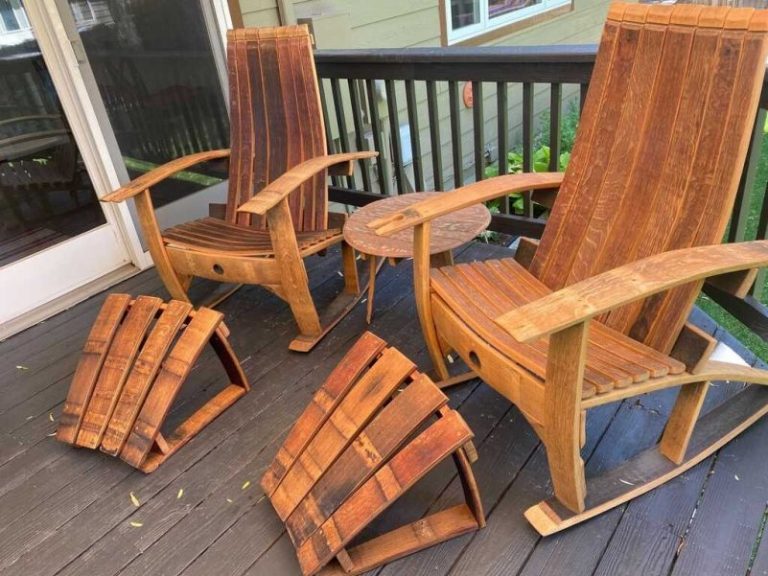
The rocker conversion is $75 more per chair and it’s built on repurposed oak wine barrel slats. Oak from a barrel, shaped into rockers, under chairs made of skis. For a garden corner where the main activity is sitting still and watching the light go, the rocker is the upgrade worth talking yourself into. If you would rather buy the pair already built that way, the Ski Rocking Chairs come as a set of two starting at $1,191.
Swapping the wildlife is straightforward. Want elk instead of moose, a fox instead of a bear, or your own dog painted in? All of that gets done. Bigger changes go through custom designs, where the one off commissions live. Hand painting is $75 an hour, so ask for what you actually want, get a number, and decide from there. The shop is upfront that it can usually get creative to land inside a budget, which is a better conversation than pretending prices are fixed.
Ordering, Delivery and How Long It Really Takes
Two routes. Most chairs are made to order, which runs two to four weeks of production time and sometimes longer through the busy spring and early summer stretch. If you’re aiming at a specific date, a party, an anniversary, a weekend when family’s in town, build in margin or call and ask directly.
The other route is ready to ship, which is finished chairs sitting in the shop right now with no production queue in front of them. The selection turns over constantly because it’s real inventory, so what’s listed today may be gone Thursday. If the date is close, start there and work backward.
Most chairs ship free to the lower 48, with $49 shipping on some, and they go nationwide. Inside Colorado there’s local delivery covering most of the state, from Colorado Springs and Denver out through Breckenridge, Vail, Aspen, Crested Butte, Glenwood Springs, Salida, Durango and a long list of towns between them. If you’re in Colorado, ask about delivery instead of assuming freight, because it’s often the better answer for a pair.
Everything is made in Manitou Springs, Colorado, in a shop at the base of Pikes Peak, by people who will pick up the phone. If you want to talk through colors, wildlife, sizing against your garden or whether a set of two fits the corner you have in mind, call 303.775.7273.
Frequently Asked Questions
How many skis go into a pair of chairs?
A set of two Adirondack ski chairs takes eight to ten pairs of retired downhill skis, since a single chair uses four to five pairs. The skis are real and previously skied, and they’re sorted by length and condition before anything is cut.
Can they stay out in the garden all year?
Yes. The Douglas Fir base and exterior oil paint finish are weatherproof and built for four season exposure, and many sit under snow all winter without issue. Owners with an involved hand painted mural often keep them under a tree or a porch roof anyway to keep the colors deeper for longer.
How far apart should two chairs go?
About three feet between the inside arms, turned toward each other by fifteen to twenty degrees rather than set parallel. That spacing lets two people talk at a normal volume while still leaving silence comfortable, and it keeps nobody staring at a fence.
Will they sink into a lawn or a flower bed?
Generally no, because the wide rear legs spread the load rather than concentrating it on four small posts the way most patio chairs do. On very soft ground a small patch of gravel or a couple of pavers under the back legs settles the question permanently.
Can the mural be changed to different animals or a different mountain?
Yes. Elk, foxes, a specific peak or your own dog all get painted regularly, and hand painted custom work is billed at $75 an hour. Call with what you have in mind and you’ll get a real number before anything starts.
That corner isn’t going to furnish itself, and another summer of walking past it would be a shame. Have a look through chairs for single pieces, or go straight to the Set of 2 Alpenglow Mountain Mural Moose & Bear Ski Chairs if the pair is what the corner is asking for. Questions about color, wildlife or timing get answered fastest on the phone at 303.775.7273. Built in Manitou Springs, Colorado, delivered across the state, shipped to the lower 48, and covered for three years.