Why an Adirondack Ski Bench Beats Every Patio Bench You Own
There is a specific twenty minutes in July, somewhere between when the light goes gold and when the mosquitoes find you, that is the whole reason people build patios. Most of us spend it standing near the grill holding a plate. The households that get it right have one thing in common, and it is not a pergola or an outdoor kitchen. It is a bench, in the right spot, that two people can drop into without discussing it first.
The Bench Is the Piece People Actually Use
Walk through any backyard and count the furniture that gets sat in. Not the furniture that exists, the furniture that gets used. It is usually one or two pieces, and the rest is decoration you paid full price for.
Benches win because of how people behave, not because of how they look. A chair is a decision. You pick a chair, you commit to a chair, and if somebody else wants to talk to you they have to go find their own chair and drag it over. A bench is an open invitation. You sit down, somebody else sits down next to you, and neither of you had to do any furniture logistics to make it happen. Conversations start on benches that would never have started across a four foot gap between two Adirondacks.
It is also the most efficient seating you can put on a deck. Two chairs eat more square footage than one bench that seats the same two people, and they look busier doing it. On a narrow porch, where you have maybe seven feet of usable width, a bench against the wall is the difference between a porch you use and a porch you walk through.
Then there is the visual job. A bench gives a space an anchor. Somewhere for the eye to land. Set one at the end of a path, or facing a fire pit, or under the window on the front porch, and suddenly the yard reads like it was designed rather than accumulated. That is a lot of work for one object, which is why picking the right one is worth more than twenty minutes of thought.
What an Adirondack Ski Bench Is, and Why It’s Not a Park Bench
The park bench you are picturing is a right angle. Vertical back, flat seat, slats, probably wrought iron, definitely uncomfortable after nine minutes. It was engineered so people would not sleep on it. That is not a joke, that is literally the design brief for public benches, and you can feel it in your spine.
An Adirondack is the opposite design brief. The seat slopes back, the backrest reclines, the arms are wide enough to set an entire dinner on. It was drawn up in 1903 by a guy who wanted somewhere to sit on a hillside, and the shape has barely changed since because it was right the first time.
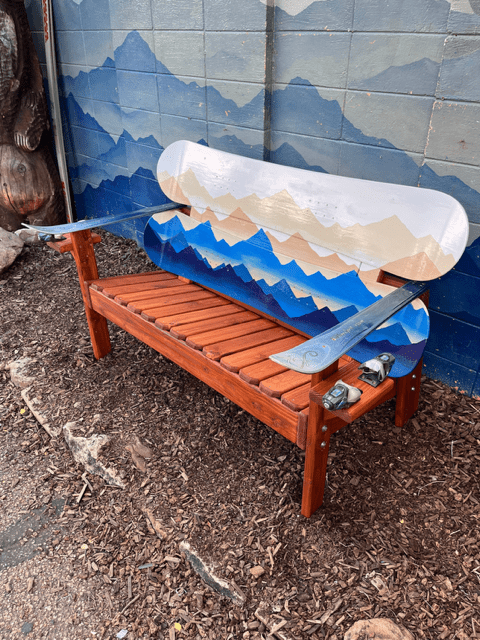
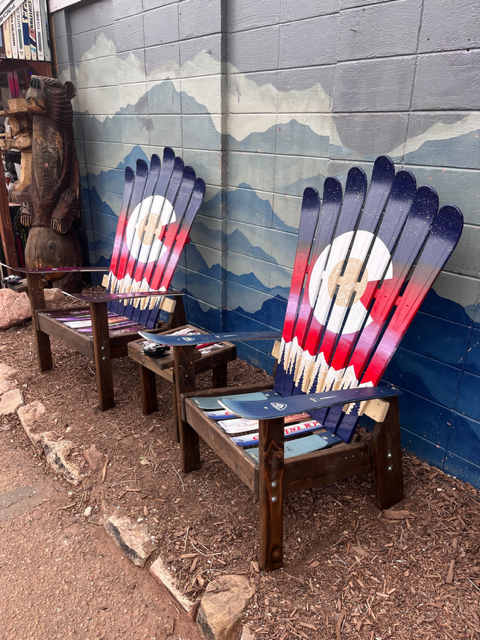
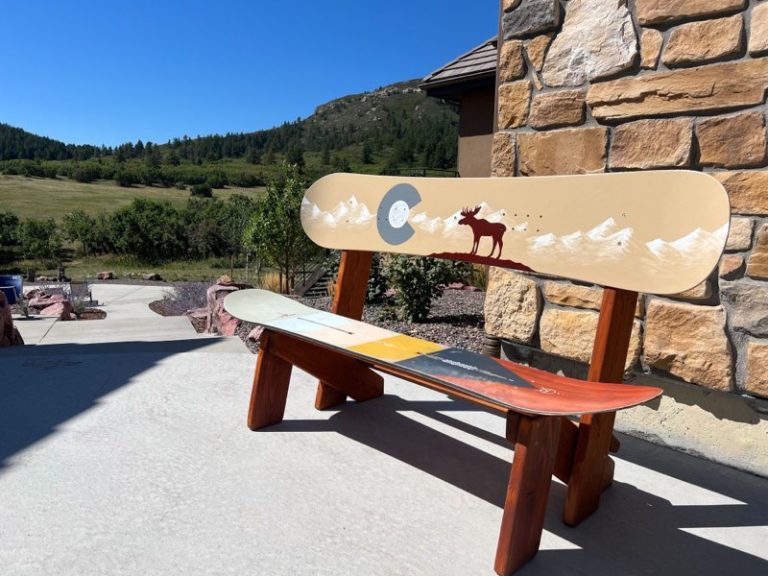
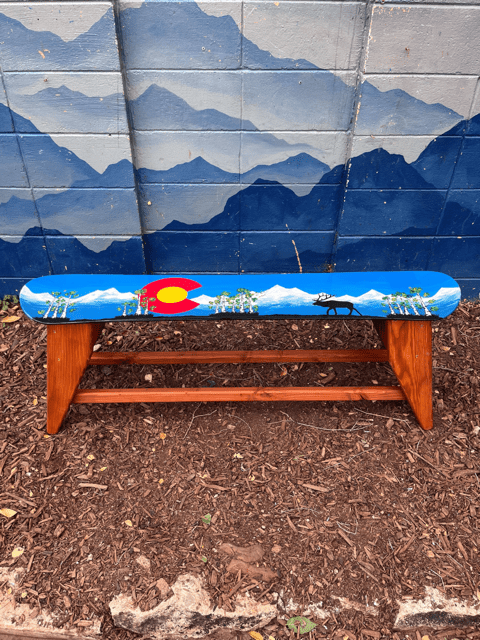
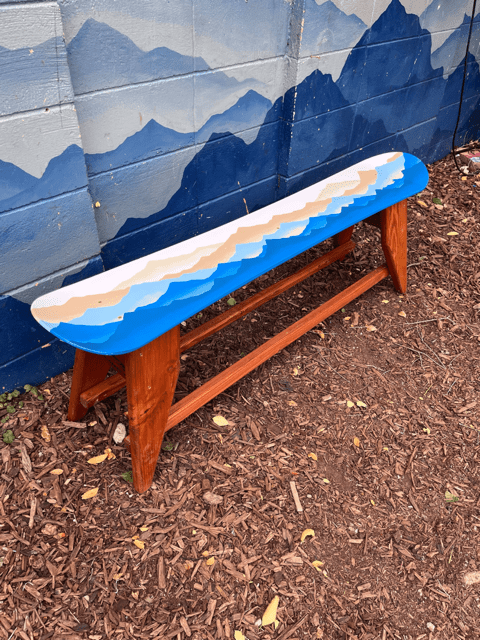
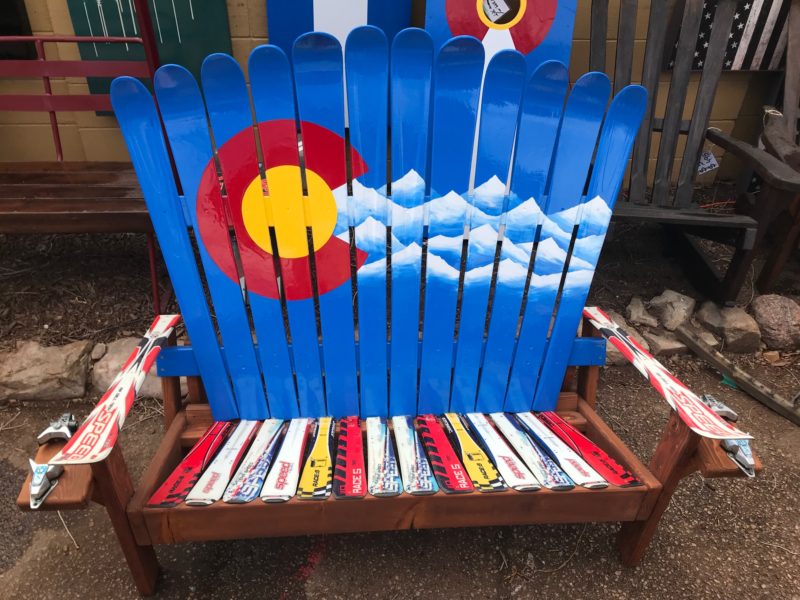
An Adirondack ski bench takes that geometry and widens it. The Colorado Mountain Adirondack Ski Bench measures 47 inches tall, 62 inches wide and 36 inches deep. It runs $1,591. Two adults sit on it easily, plus one dog who has decided the middle spot is his and will not be reasoned with. If that is more bench than the budget wants, the Sunset Mountain Single Snowboard Bench does the same job at $475 off a single board, and the Colorado Flag Double Snowboard Bench at $595 puts two boards across the seat instead of one.
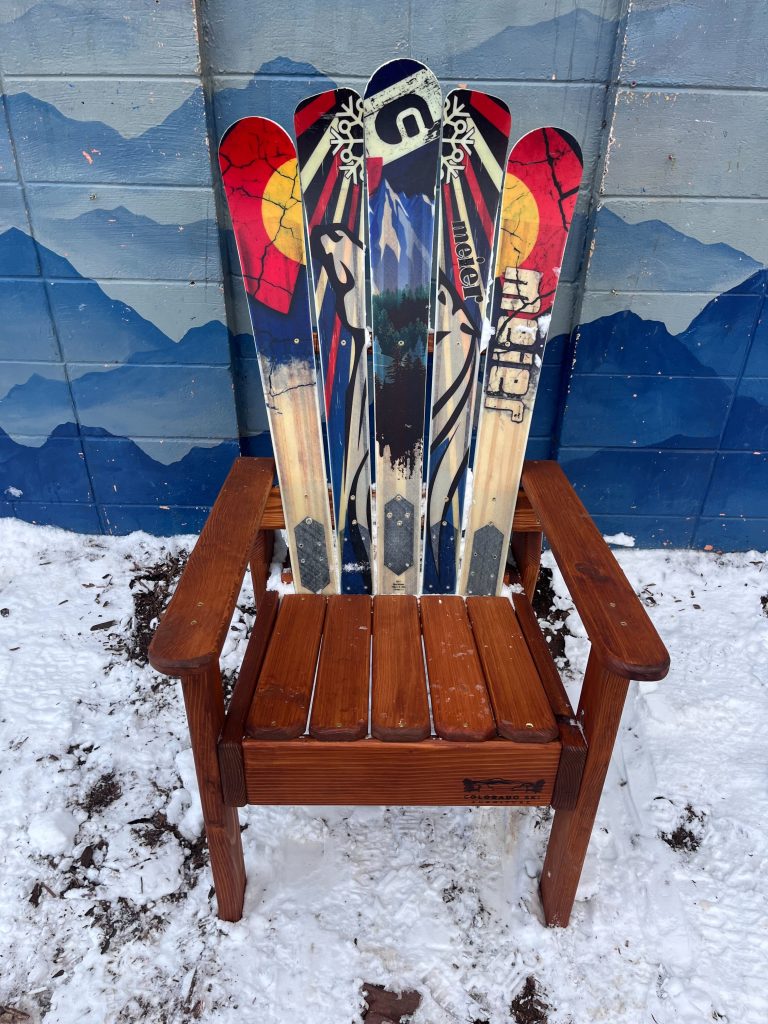
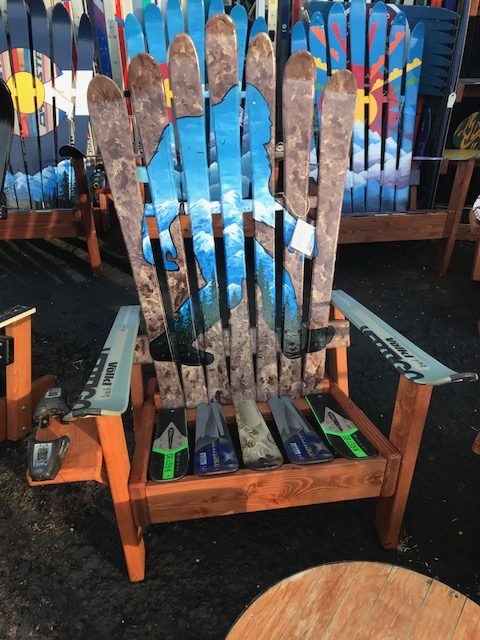
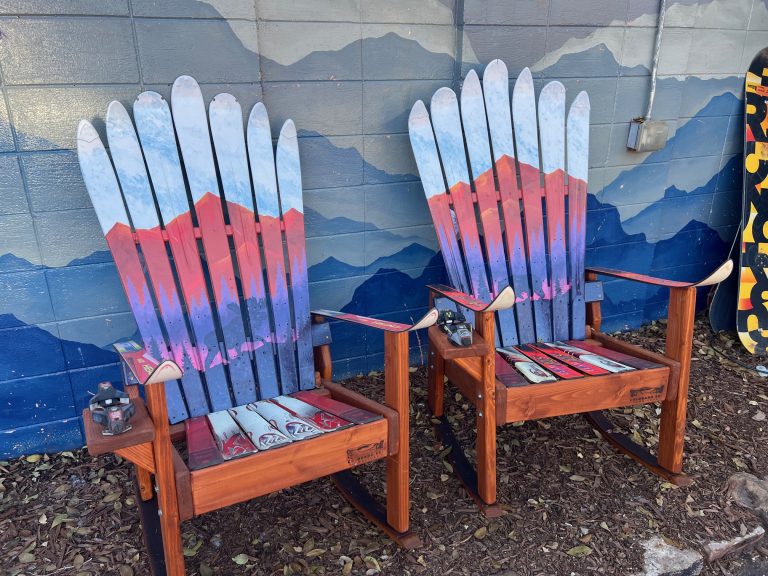
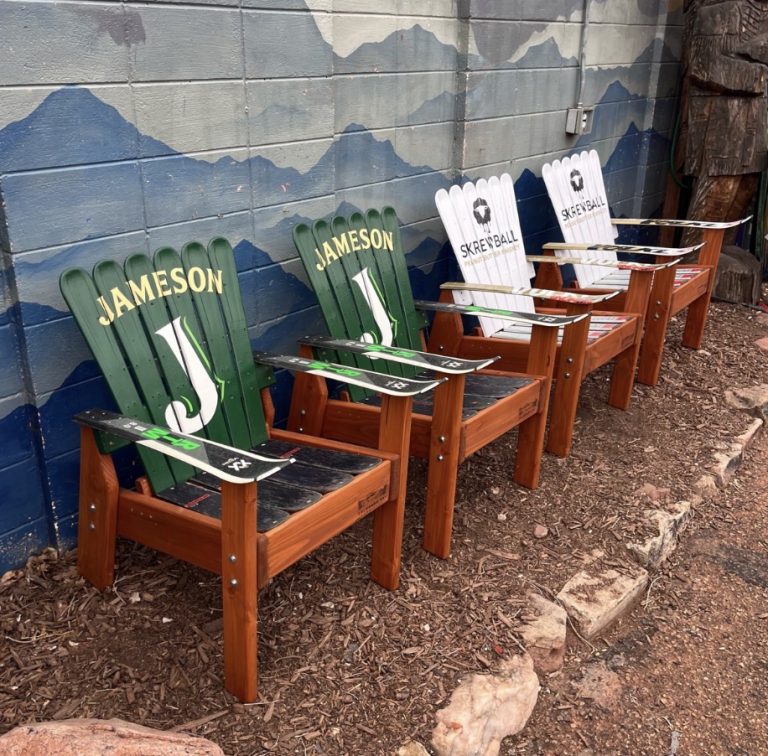
The seat back is built from repurposed downhill skis, laid in as a fan, on a Douglas fir base. Real skis with real topsheets, retired off real mountains. And across that full 62 inch span is a hand painted Colorado mountain mural in exterior oil.
Which brings up the actual argument for a bench over a chair, at least around here. Paint a mountain range on a chair back and you get about 20 inches of ridgeline, which is enough for a couple of triangles. Paint it on a bench and you get 62 inches, which is enough for the range to look like a range. Three year hassle free warranty. Yup.
How It Gets Built, and From What
The shop is in Manitou Springs, at the foot of Pikes Peak, and the raw material shows up in the back of pickup trucks. Retired skis come from rental fleets being cycled out, from garages being cleaned, from people who kept a favorite pair for twenty years and could not put them in the trash.
Every ski gets inspected. Delaminated ones get culled. The survivors get washed, measured and cut, then laid into the frame. A bench takes considerably more skis than a chair does, for the obvious reason that it is nearly twice as wide. For reference, a single Adirondack ski chair takes four to five pairs, and a matched set of two takes eight to ten pairs.
The frame is Douglas fir. It is not a glamorous wood and that is the point. It is stiff, it holds a fastener, it takes paint, and it does not mind being outdoors. Every piece is rated to 400 pounds, and the fir is why.
Then the mural. Hand painted, exterior oils, one person and a brush, across the full width of the seat back. There is no way to speed that up, which is why lead times are what they are and why every one comes out slightly different from the last one. The oils are the durability story as well as the looks story. Exterior oil paint on a prepped surface does not flake off in sheets after two winters. It fades slowly and it can be touched up years later.
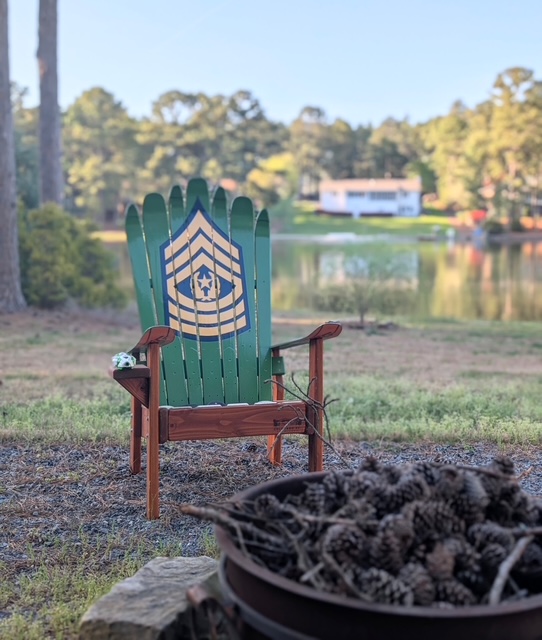
Worth stating plainly since it comes up on every branded inquiry: a logo is never painted. Company marks, team crests and unit insignia go on as a logo decal floated onto a painted background, with aluminum and plastic appliques as alternatives. Branded pricing gets quoted on a call.
Comfort Is Geometry First, Cushions Second
Most advice about comfortable outdoor seating goes straight to cushions. Buy better cushions, layer your pillows, add a throw. That advice is backwards, and it is backwards because it is easier to sell a cushion than to fix a bench.
Cushions are a patch. If the seat angle is wrong, a three inch foam pad will not save it, it will just raise you up to a slightly higher wrong angle. If the seat depth is too shallow, no amount of pillow work will stop the front edge from cutting into the back of your legs. Geometry comes first. Get the recline and the depth right and you can sit on bare wood for two hours without noticing.
That is what a 36 inch depth buys you. Your thighs are supported to the knee, your back is supported past the shoulder blades, and the recline puts your weight into the backrest instead of your lower spine. It is the same reason people fall asleep in Adirondacks and do not fall asleep on park benches.
Now, cushions on top of correct geometry are great. If you want them, get outdoor-rated fabric with a solution-dyed acrylic face, because it will still be the color you bought in year four. Cheap outdoor fabric goes chalky in one season. And bring them in when it rains, or accept that they will be wet until Thursday.
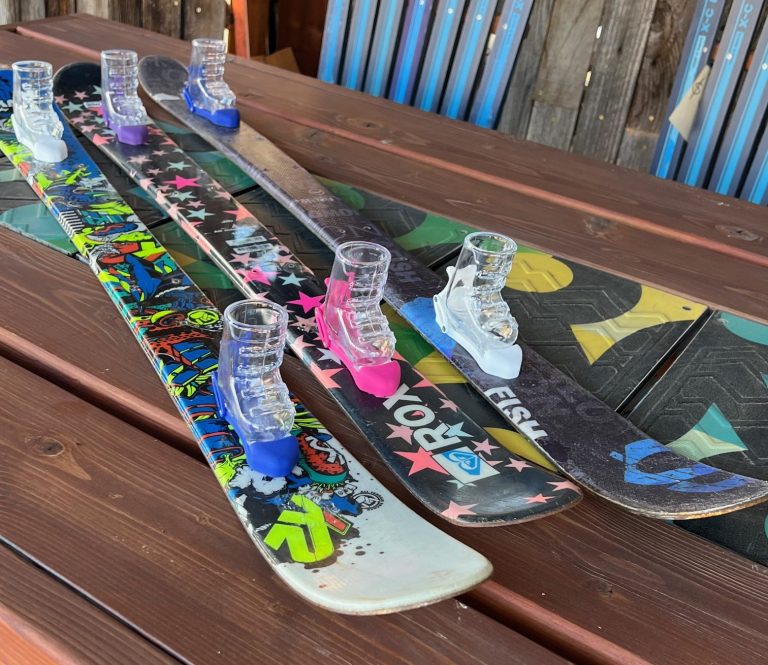
The other comfort upgrade nobody mentions is a place to set a drink. On the ski chairs that is a ski binding mounted on the arm, which is both funny and genuinely the best cup holder in outdoor furniture. On a bench, the arms are wide enough to hold a mug, a book and a phone at the same time, which is usually enough.
Where It Belongs
Three placements work almost every time.
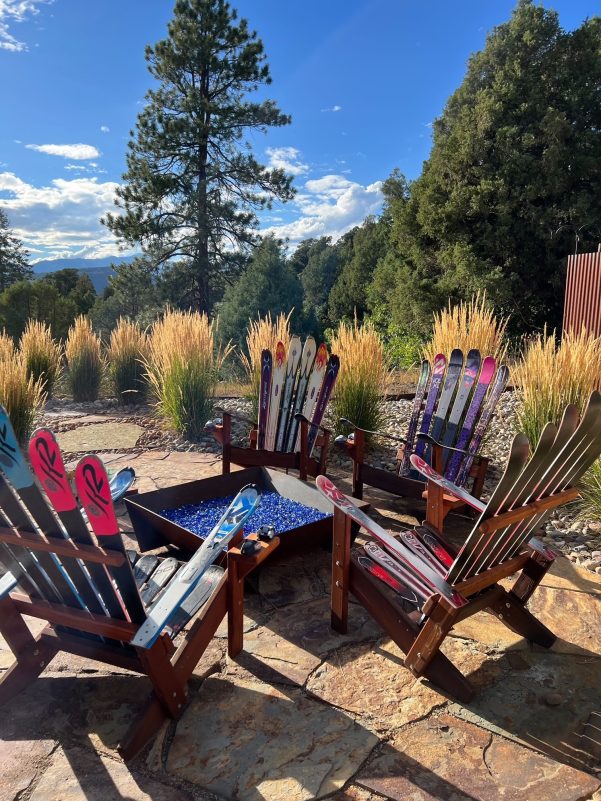
Facing a fire pit is the first. A bench at a fire pit does something two chairs cannot, which is let people shift closer as the night gets colder without anyone having to move furniture. Set it at a slight angle rather than dead square to the fire, and leave four to five feet of clearance so nobody’s shins are getting cooked.
Second is the front porch, against the house, under a window. This is the placement people underestimate. A bench on a front porch changes how a house presents itself from the street, and it is the single easiest way to make a place look lived in rather than staged. Bonus: on a covered porch it can live outdoors year round without a thought.
Third is the end of a sightline. The far end of a lawn, the top of a path, the spot with the view. Nobody sits there as often as they imagine they will, and it does not matter, because it earns its keep by giving the yard a destination. When people do walk out to it, they stay longer than they meant to.
One measurement people skip. Before you commit to a spot, chalk out 62 by 36 inches on the ground and stand back. A bench takes up more visual room than the tape measure suggests, and it is far easier to discover that with a piece of chalk than with the finished bench already sitting there. Then leave two or three feet of clear floor in front of it, because the recline is the entire point and your legs need somewhere to go.
What does not work: shoved against a railing with no legroom, or dropped in the middle of an open deck with nothing behind it. Benches want a back. A wall, a hedge, a fence, a row of aspens, something. Seating with open space behind it makes people subtly uncomfortable and almost nobody can tell you why.
If you want the bench matched to seating around it, that is what the patio sets exist for, and there are plenty more shapes in ski benches.
Who Buys One
Backyard builders, mostly. People midway through turning a yard into a place, who have figured out that they need one piece that sets the tone and everything else can follow it. A bench does that job better than a table or a fire ring, because it tells you where the room is.
Cabin and mountain home owners are the second group, and they buy for a specific reason. Their place sits empty for weeks at a stretch through the winter, and they need furniture that survives being unattended in the snow. Exterior oil paint over Douglas fir does that. Wicker does not.
Then there are couples who have been looking at our chairs for a year and finally worked out that what they actually wanted was to sit next to each other. That is a more common realization than you’d guess. Two chairs is two people in the same yard. A bench is two people in the same conversation.
Ski shops, lodges and restaurants order them for entry seating, where the thing has to look good and take abuse from strangers at the same time. Short-term rental owners buy them because a hand painted mountain mural ends up in the listing photos and in the guest photos, which is worth more than the bench costs.
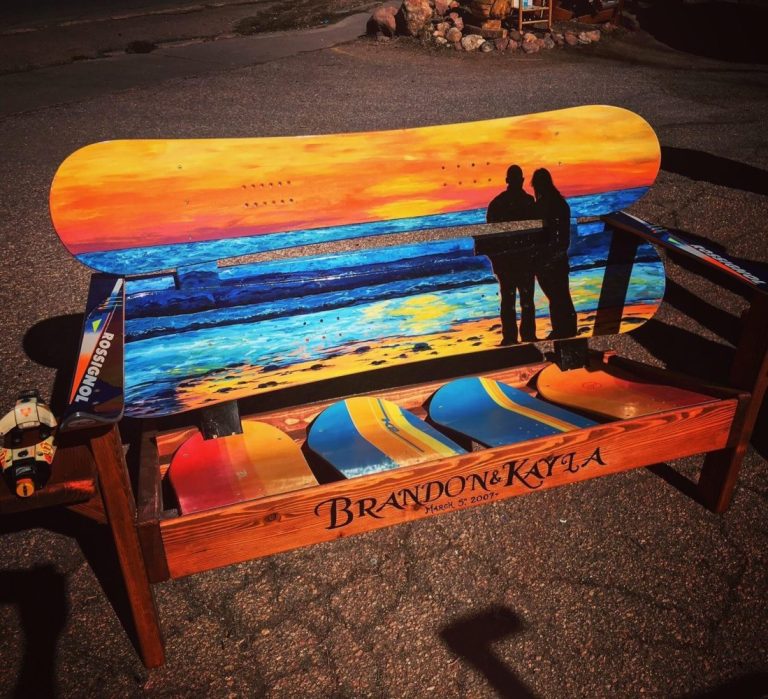
And a fair number are memorial pieces. A bench with a name on the front board, set at somebody’s favorite view. Those orders come in quietly and they are the ones we take the most care with. The Sentimental Ski Bench at $1,441 is built for that, from your own old skis or from ours, and the rest of that work sits in sentimental.
What none of these buyers have in common is a hunt for the cheapest option. Anyone shopping purely on price bought a big box bench three summers ago, replaced it two summers ago, and is currently deciding whether to replace it again. The people who call us have usually done that cycle once or twice already and have run the math on what a piece that lasts twenty years actually costs per year. It is a smaller number than the sticker suggests, and it is the argument that closes most of these conversations without anybody having to make it out loud.
Setting Up the Space Around It
The bench does the heavy lifting. Everything else is support, and the most common mistake is doing too much of it.
Plants are the best money you can spend. Not a landscaping project, just three or four large pots close enough that people brush past them. Big pots, not small ones. A cluster of three fourteen inch pots looks intentional where nine six inch pots look like a garden center clearance rack. In Colorado, plant things that do not mind being forgotten for a week in August.
Lighting: warm white, low, and more of it than you think. String lights overhead at eight or nine feet, or a couple of solar path lights at ankle height. What you are avoiding is a single bright fixture aimed at people’s faces. Also, warm bulbs render hand painted oil colors correctly after dark and cool LEDs turn a sunset mural gray, which is a genuinely annoying way to lose a mural you paid for.
An outdoor rug under a bench defines the area and makes a deck feel like a room. Pick one bigger than you think you need. A rug that only reaches the front legs looks like a bath mat.
You want a surface within arm’s reach. A small side table, a stump, a snowboard coffee table. A single snowboard does make a coffee table or a bench, and one of those next to a ski bench keeps the material story consistent without matching everything perfectly, which would look like a showroom. The Customizable Single Snowboard Coffee Table is $397 and you pick the colors, which is the easy version of that.
What to skip: wind chimes, garden gnomes, anything with a solar panel and a color-changing LED. You bought a hand painted bench. Let it be the interesting thing.
Care Through the Seasons
These are built weatherproof, and people do leave them out all winter at 9,000 feet. Still, a few habits stretch the good years out.
Summer’s problem is UV. All-day direct sun will slowly fade any paint on earth. If there is a spot with afternoon shade, use it, not because the bench will fail otherwise but because the mural stays saturated longer.
Cleaning is a bucket of warm water, a drop of dish soap and a soft brush, twice a season. That is the whole routine. Do not use a pressure washer. A pressure washer will take hand painted detail off in seconds, and no one has ever finished pressure washing a mural and felt good about it.
Fall is the one that actually matters. Clear leaves and pine needles out of the gaps between the ski slats before the snow arrives. Wet organic material sitting against wood all winter is how rot starts on any outdoor furniture, anywhere. Two minutes with a shop vac in October and you are done.
Winter is easy. Snow lands on it and melts off. If you cover it, use a breathable cover instead of a plastic tarp, because a tarp seals moisture in and does more harm than the snow it is blocking. On an exposed deck, angle it against a wall so snow load slides off rather than piling in the seat.
Spring, walk out and look it over. Check the fasteners, wash off the winter, and if a spot wants a touch-up after several years, call. Oil paint touches up cleanly, which is a large part of why it gets used in the first place.
Ordering, Lead Time and Delivery
You can buy straight off the product page. Most benches and chairs ship free to the lower 48, and where shipping applies on chairs it runs $95.
If you want something changed, and most people do, call 303.775.7273. Ten minutes on the phone beats four rounds of email, every time. Tell us the design you want, the deadline you are working against and the budget you have. Nobody here is offended by a budget. It is usually the fastest route to a piece you are happy with.
The most common custom request on a bench is the mural. Tell us the range you want across those 62 inches, or send a photo of the actual view off your deck and we will paint that instead. Additional paint fees may apply, and customization runs $75 an hour, so a small change is small money and a full custom landscape is not.
Production is typically two to four weeks, occasionally longer in the busy stretch. If you need it faster, the ready to ship collection is already built and cured, and it goes out quickly.
Delivery runs local across Colorado, from Colorado Springs and Denver through Breckenridge, Vail, Aspen, Winter Park and Crested Butte, and we ship nationwide to the lower 48. Local delivery arrives assembled and gets set exactly where you want it, which on a 62 inch bench is a service worth having. Everything carries the three year hassle free warranty.
Frequently Asked Questions
How many people fit on an Adirondack ski bench?
Two adults sit comfortably on the 62 inch width, with room left over for a dog or a stack of blankets. The bench measures 47 inches tall and 36 inches deep, and is rated to 400 pounds.
Can it stay outside all winter?
Yes. The Douglas fir base and exterior oil paint are built for year round outdoor use in snow, rain and sun. Clear leaves out of the slat gaps in fall, and if you cover it, use a breathable cover rather than a plastic tarp.
Do I need cushions to make it comfortable?
No. The recline and the 36 inch seat depth do the comfort work on their own, which is the whole advantage of Adirondack geometry over a flat park bench. Cushions are optional, and if you add them, use solution-dyed outdoor fabric.
Can I get a different mountain range or my own view painted on it?
Yes. Send a photo of the view from your deck or name the range you want and it gets hand painted in exterior oils across the full width. Additional paint fees may apply depending on the detail involved.
How long does it take to get one?
Made to order pieces typically run two to four weeks in production plus transit. If you have a firm date, call 303.775.7273 and we will tell you honestly whether it is doable or point you toward a ready to ship piece.
If you know the spot in your yard where a bench belongs, and you probably do, call 303.775.7273 and describe it. Or start with the Colorado Mountain Adirondack Ski Bench and tell us what you want painted across it. Then go sit down. That twenty minutes of gold light is coming around again tomorrow.