Manitou Incline Wall Art for the Steps You Actually Climbed
There is a moment near the top of the Manitou Incline, somewhere past the false summit, where your legs stop asking questions and just do the work. You are hauling yourself up 2,768 railroad ties bolted into the side of a mountain, your lungs are filing a complaint, and the person ahead of you has stopped pretending to check their phone and is just openly resting. That feeling is hard to hang on a wall. This Manitou Incline Walnut-Stained Wall Art is our best attempt at it, and unlike the real thing, it does not require calf muscles.
The Incline, For People Who Have Actually Done It
If you live anywhere near Colorado Springs, you already have a Manitou Incline story. Maybe you did it once on a dare in your thirties and swore never again. Maybe you do it every Saturday and have opinions about the best time to start. Maybe you drove up, looked at it, had a breakfast burrito instead, and called that a win. All of those are valid, and this piece is for every one of them.
The Incline is an old cable car railway that used to haul tourists up the mountain until a rockslide in 1990 ended that chapter. What was left behind became one of the most punishing and beloved workouts in the state. It gains about 2,000 feet in under a mile. The grade hits 68 percent near the top, which is a number that means nothing until you are standing on it and your hands are suddenly involved. People train for marathons on it. People propose at the top of it, presumably because if someone climbs that with you they are probably a keeper.
Our shop sits in Manitou Springs, close enough to the base that we watch people stagger back down the Barr Trail every single day. So when we made a piece of Manitou Incline wall art, we were not designing a generic mountain graphic pulled off a stock site. We were putting a landmark we can see from the neighborhood onto a plank of wood. There is a difference, and the people who have done the climb tend to spot it right away.
What This Piece Actually Is
Let us be plain about it, because plain facts are the whole point of a good product page. The Manitou Incline Walnut-Stained Wall Art is a carved wood sign that shows the Incline running up the face of the mountain, with the “2,768 steps” callout that anyone who has counted them (or given up counting them around 900) will recognize. It is made from kiln-dried Thermory wood, precision cut, stained a deep walnut, and sealed so it can live outside for years without turning gray and sad.
It is not a chair. It is not a bench built from old skis. It is not a replica of anything mechanical. It is wall art, flat and ready to hang, and that keeps things simple. There is no cushion to worry about, no assembly, no “some tools required.” You pick a size, we ship it, you put a couple of screws in the wall, and you are done. For anyone who has ever spent a Sunday afternoon fighting flat-pack furniture, that alone is worth something.
The walnut stain does a quiet bit of heavy lifting here. It lets the natural grain of the Thermory wood show through the carved mountain and the lettering, so the piece reads as handmade rather than printed. Up close you can see the wood is real, the cut is clean, and someone actually made this. It has warmth. A poster of a mountain has a lot of things going for it, but warmth is not usually one of them.
Why Thermory Wood and Walnut Stain
Here is where we get slightly nerdy about lumber, and we make no apologies for it. Thermory is thermally modified wood, which is a fancy way of saying it has been baked at high heat to pull the moisture and sugars out of it. That process makes the wood far more stable and far less interested in warping, cupping, or rotting when the weather turns. In Colorado, where a July afternoon can go from ninety degrees and sunny to hail in about twenty minutes, that stability matters.
What it means for you is that this Manitou Incline wall art is genuinely outdoor-rated. You can hang it on a covered patio, next to the hot tub, on the wall of an outdoor kitchen, or in a mountain cabin that sits empty and unheated half the year, and it will hold up. Kiln-dried and sealed, it shrugs off the humidity swings that would twist a lesser board like a potato chip. It also looks perfectly at home indoors, so you are not locked into one plan.
The deep walnut finish is not just for looks either, though it does look sharp. A good stain and seal is the wood’s sunscreen and raincoat. It slows down UV fading and keeps water from soaking in and lifting the grain. We build these to be around for a long time, which frankly is more than the Incline promises you on the way up.
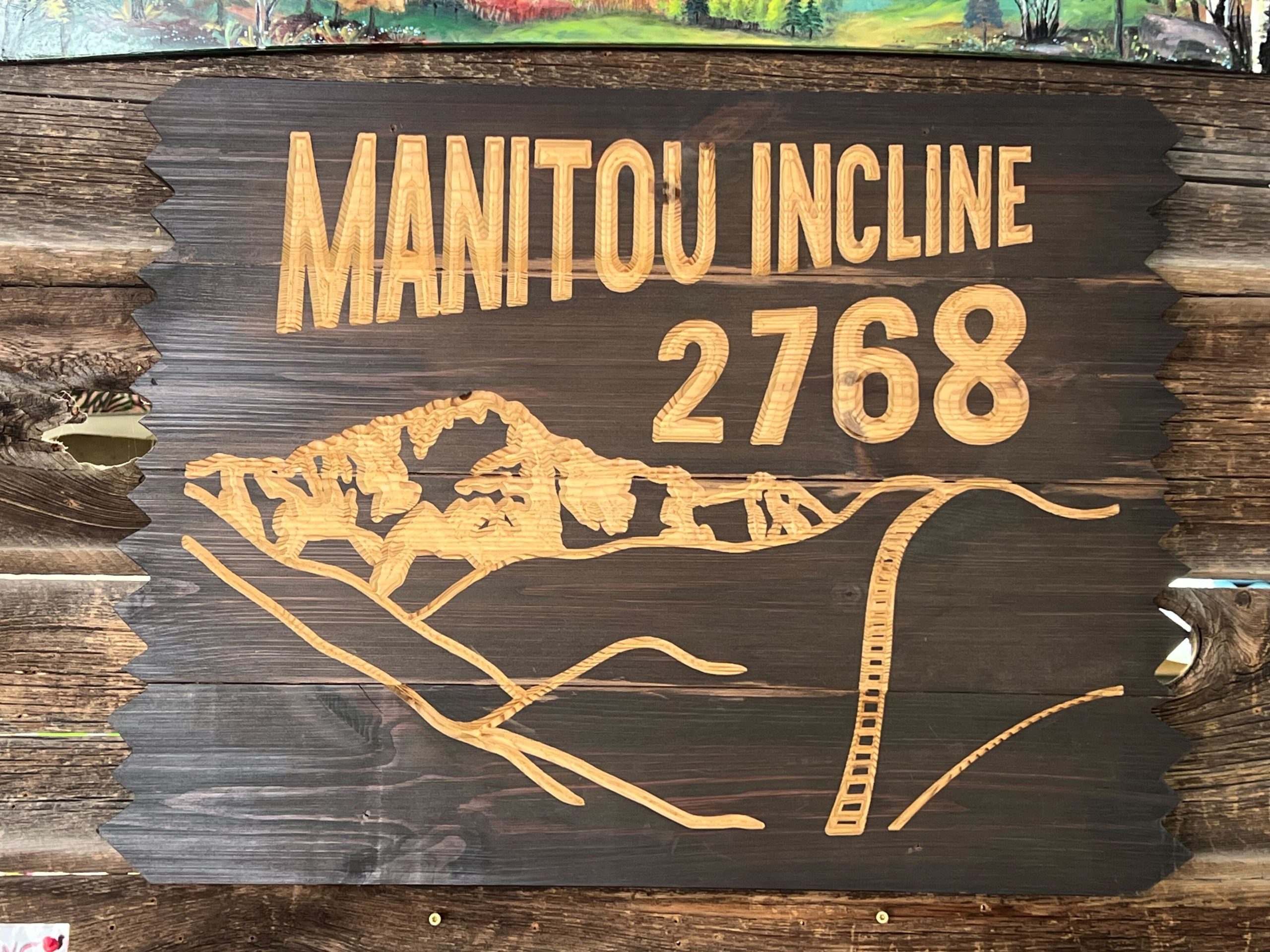
Manitou Incline Walnut-Stained Wall Art
Where This Belongs
The easy answer is a mudroom, and it is easy because it is right. A mudroom is where the boots, the trekking poles, and the guilt about not going more often all live. A piece of Manitou Incline wall art over the bench is a nice daily nudge, the kind that says get out there without actually nagging you. It fits the room’s whole personality, which is “we do outdoor things here and we track a little dirt inside as proof.”
But we have seen these go all over the house. Above a home bar, where it starts conversations, because there is always someone at a party who did the Incline once and needs to tell you about it. In a home gym, where it is a little bit of motivation and a little bit of a threat. In a home office, where it sits behind you on video calls and quietly tells everyone you are a person with a life outside the spreadsheet. In a kid’s room, hung by a parent who is not so subtly hoping the kid grows up to love the mountains.
Then there is the second-home and rental crowd. Owners of cabins and short-term rentals around Manitou Springs, Woodland Park, and the wider Pikes Peak region love a piece like this because it grounds the place in its actual location. A guest walks in, sees the local landmark on the wall, and immediately feels like they are somewhere specific rather than in Anytown Rental Number Four. If you list your place on the usual sites, that kind of detail is the difference between a five-star review that mentions the vibe and a shrug. We hear about this a lot from our indoor decor and furniture customers who furnish for guests.
And plenty of them never go outside at all. They hang indoors as a piece of art that happens to be about a place the owner loves, especially for folks who moved away from the Front Range and want a little piece of home on the wall side of the window. Homesick Colorado transplants are some of our most loyal buyers, and this is exactly the sort of thing they reach for.
Three Sizes, and Which One You Actually Want
This comes in three sizes, and picking one is less complicated than it looks. The small runs 11 by 15 inches, which is the right call for a tight spot: a gallery wall, a spot between two windows, the wall of a powder room where you want people to notice it while they wash their hands. The medium is 24 by 16 inches and is the crowd-pleaser, big enough to anchor a space without taking over. The large is 28 by 21 inches, and that is your statement piece, the one that goes over the couch or the bar and becomes the thing people comment on.
The trick most people miss is measuring the wall before they fall in love with a size. Painter’s tape is your friend here. Cut a rectangle of tape to the size you are considering, stick it on the wall, and live with it for a day. You will know. A large piece on a small wall feels crowded, and a small piece on a big wall looks like a postage stamp that got lost. When in doubt, most folks are happier going one size up than they expect, because art almost always looks smaller on the wall than it did in your head.
Pricing starts at $129, and shipping is free to most of the lower 48. No surprise crating fee, no oversized-freight sticker shock, none of the stuff that makes you close the browser tab. It is flat, it is light, and it ships like it should.
The Gift Nobody Quietly Regifts
We will be honest about gifts, because everyone reading this has both given and received the wrong one. The Manitou Incline wall art is a good gift for a specific and surprisingly large group of people: anyone with a Manitou Incline story. And once you start looking, that is a lot of people. The friend who trains on it. The coworker who finally did it and would not stop talking about it. The parent who used to do it and now watches their kids do it. The person who just moved away and misses the mountain more than they will admit.
It also lands well as a milestone gift, which is a category most gifts fail at completely. Someone finish their first Incline? This marks it better than a medal that ends up in a drawer. Someone retiring after a long career of the same daily climb, metaphorically speaking? A send-off gift built around a mountain they conquered step by step has a lot more dignity than another engraved paperweight. We have made pieces for exactly that occasion, where the Incline stood in for a career that was one long uphill grind with a genuinely great view at the top. It is the rare retirement gift that actually gets hung up rather than politely stashed.
The reason it works as a gift is the same reason it works as decor. It is specific. Generic gifts fail because they could be for anyone. This one is for someone who did a particular hard thing in a particular place, and specificity is what makes a gift feel like it was chosen rather than grabbed. If you want more ideas in this vein, our gift items section is full of Colorado-rooted pieces that pass the same test.
Made in Manitou Springs, a Mile From the Steps
Here is the part that we think actually matters, and not just because it is our shop. We build this in Manitou Springs, roughly a mile from the base of the Incline itself, a stone’s throw from Garden of the Gods and in the long shadow of Pikes Peak. When we carve the mountain into the wood, we are not working from a photo we bought. We are working from the thing out the door.
That local grounding shows up in small ways. We know the Incline is 2,768 steps and not some rounded-off marketing number, because people around here argue about the exact count the way other towns argue about pizza. We know which false summit gets people, and we know that the view from the top on a clear morning is the reason anybody does it twice. That knowledge does not change the wood, but it changes the care, and care is the thing you cannot fake.
Buying from a shop that is actually in the place it depicts is getting harder to do, and we do not take it for granted that people go out of their way to do it. When you buy this piece, you are getting Colorado craftsmanship from the exact zip code the art is about, made by people who have almost certainly climbed the thing you are hanging on your wall. That is not a small thing, and it is a big part of why we are proud of our full wall art collection.
How Ordering and Customizing Works
Ordering the standard piece is about as simple as it gets. Pick your size, add it to the cart, check out, and we ship it free. Most people are hanging it within the week. There is no long build queue on the standard walnut-stained version, which is a nice change from the custom furniture we make, where good things genuinely take time.
If you want something more personal, that door is wide open too. We do custom work all day long. Want a summit date carved into the corner, the day someone finally topped out? We can do that. Want a different Colorado landmark entirely, a peak that means something to your family, or a logo for a business that wants its lobby to feel like it belongs to the region? That is what we do. Branded and corporate pieces are handled a little differently, and pricing on those gets sorted out on a quick call rather than through the cart, because every logo job is its own animal.
The easiest way to start a custom conversation is to call us at 303.775.7273. A real person answers, usually someone with sawdust on their sleeves, and we will talk through what you are picturing. No pressure, no hard sell, just a conversation about turning a mountain and a memory into something you can hang on a wall.
Frequently Asked Questions
Is the Manitou Incline wall art safe to hang outside?
Yes. It is made from kiln-dried Thermory wood, then stained and sealed for long-term outdoor use, so it holds up to Colorado’s temperature swings and weather without warping or rotting. Covered spots like porches, patios, and outdoor kitchens are ideal, and it looks just as good indoors.
How many steps does the Manitou Incline actually have?
The Incline has 2,768 steps, gaining roughly 2,000 feet of elevation in under a mile, with a grade that reaches about 68 percent near the top. That number is carved right into the piece, which is why locals who have counted them recognize it instantly.
What sizes and price should I expect?
It comes in three sizes: small at 11 by 15 inches, medium at 24 by 16 inches, and large at 28 by 21 inches. Pricing starts at $129, and it ships free to most of the lower 48.
Can you customize it or add a date?
Yes. We can carve in a summit date, adapt it to a different Colorado landmark, or produce branded and logo versions for businesses. Custom and corporate pieces are quoted on a quick call at 303.775.7273 rather than through the standard cart.
The Last Word
Not everyone is going to climb the Manitou Incline this year, and honestly, most of the people who love it the most have earned the right to sit one out. But a piece of the mountain on the wall is a good compromise. It is a small, well-made, Colorado-built reminder of a place that asks a lot and gives back a view worth the ache. Hang it in the mudroom, over the bar, or in the cabin, and let it do its quiet job of making the room feel like it belongs to the mountains. When you are ready, come take a look at the Manitou Incline Walnut-Stained Wall Art, and if you want it to say something more personal, you know the number.