
A Golf Club Chair Made From Real Clubs, Even Your Old Set
The bag has been standing in the corner of the garage since his last round, and nobody left in the house plays. It gets moved at Christmas so the tree fits, then moved back. Nobody is willing to carry it to the curb either, so it just stands there like a piece of furniture with no assigned job. That is the phone call we get more than any other.
What a Golf Club Chair Made From Real Clubs Actually Is
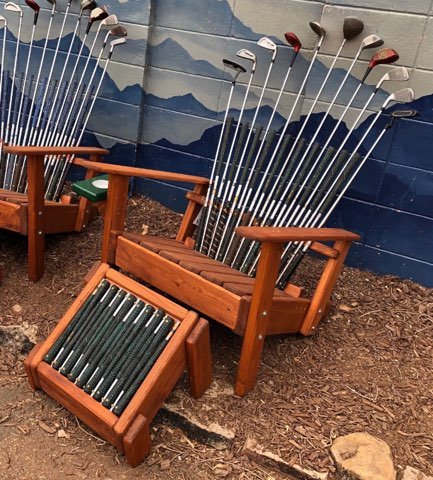
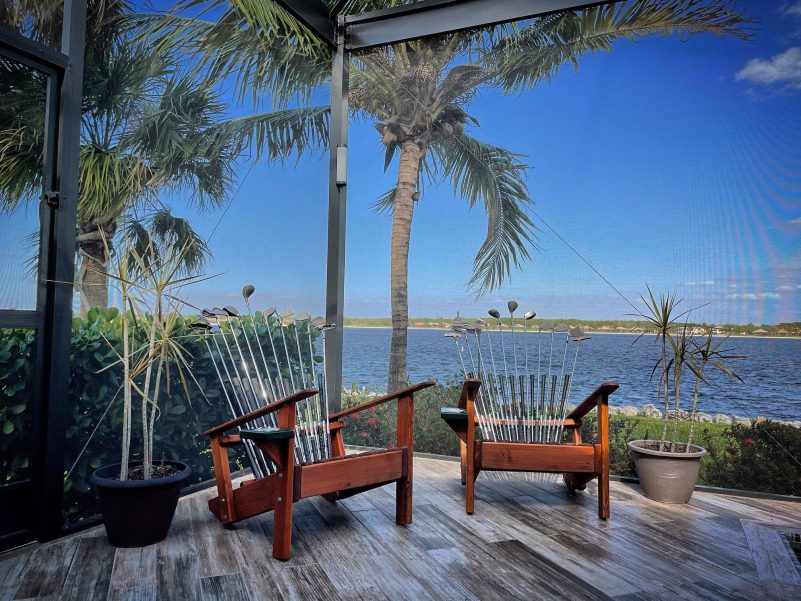
Let us clear up the thing the internet keeps getting wrong. A golf club chair is not a leather club chair from a country club lounge. There is no button tufting, no nailhead trim, no plush anything. It is an Adirondack chair whose back and seat are built from actual golf clubs, shafts and grips visible, arranged so you can still tell a five iron from a wedge from ten feet away.
One chair takes one full set, eleven or twelve clubs. That is the whole bag, more or less, which is why this works so cleanly as a project. You do not need to source a strange quantity or come up two short. If somebody played, they left behind roughly one chair’s worth of material.
The chair measures 46 inches tall, 46 inches deep and 35 inches wide, so it is a full size seat and not a decorative prop. The base is stained Douglas Fir, built in our shop, water and weather proof, meant to live outdoors or in a den without complaint.
There is a putting green cup holder set into the armrest, because a cup holder made from actual turf on a chair made from actual clubs is either the best idea we ever had or the most obvious one. Possibly both.
And it rocks, quietly, which matters more than you would think. A rocker that announces itself every time you shift is not relaxing. This one does not.
One more thing worth saying plainly, since we get asked. These are not clubs pulled from some warehouse of anonymous inventory and dressed up with a story. If the chair is built from your set, it is built from your set. If it is built from ours, we tell you that too. We do not invent history for a piece of furniture, and you should be wary of anybody in this business who does.
Whose Clubs End Up in the Chair
Most people who order one already know exactly which clubs are going in before they finish the first sentence.
A dad’s set that has been in the garage since 1998. The irons somebody swung for thirty years at the same municipal course, walking, carrying, refusing a cart on principle. A grandfather’s persimmon woods that are far too old to play and far too loaded to donate. The clubs from the round where a hole in one happened and everybody agreed it deserved better than a certificate in a drawer.
A good share of these are memorial pieces. A family sends us a father’s clubs after he passes and asks for something the grandkids can actually sit in, which is a very different request than a plaque. Those builds get handled carefully and we send photographs along the way, because you only get one chance to do it right. Those orders live in our Sentimental collection for a reason.
Retirements are the other big category. Forty years at a company, a corner office cleared out, and somebody on the committee has the sense to ask what the guy actually cares about. It is rarely the crystal bowl.
Then there are people who just like golf and want a good chair. No story required. Their clubs got replaced two upgrades ago and the old set has been quietly depreciating in the basement. That set becomes a chair, and the basement gets its floor back.
One more group worth mentioning: clubs, courses and event organizers who want a piece for a clubhouse porch or a tournament auction. Those get quoted on a call, since branding and quantity change the math, and our branded items category shows how a decal or an applique sits on a finished piece.
How We Build One, Club by Club
The set arrives and the first job is sorting. We lay the clubs out and look at shaft lengths, head shapes and how the grips have worn, because a chair back reads as one composition once it is assembled. A set that was played hard looks different from a set that sat in a closet, and we build to whichever one showed up.
Heads and shafts get positioned so the chair is comfortable to sit in and still obviously made of golf clubs. That balance is the actual craft here. Push too far toward sculpture and it becomes something you look at instead of sit in. Push too far toward furniture and you may as well have bought a chair.
Underneath it all is the base, built from Douglas Fir in our shop and stained rather than painted, so the wood grain stays part of the picture. The base is the boring half of the job and the half that determines whether this thing still sits level on a flagstone patio in five years. We spend more time on it than anybody notices, which is roughly the definition of doing it right.
The putting green cup holder goes into the arm. The rocker runners, if you want them, are repurposed oak wine barrel slats and add $75 to any chair or bench we build. A matching ottoman is available if you would like somewhere to put your feet, and most people who add one are glad they did.
Then the finish work, then a final sit test, then it goes out the door. Everything is built in Manitou Springs, Colorado, by a small crew. No factory, no container ship, no drop shipper in between.
The Cup Holder and the Other Small Decisions
The decisions on this build are few, which is deliberate. You should not need a spreadsheet to buy a chair.
First, whose clubs. Yours, or ours. If you send a set, that set goes in. If you do not have one, we keep plenty of clubs waiting on a second career and will build from stock.
Second, stain color on the base. Lighter stains let the shafts do the talking. Dark walnut makes the chrome pop and looks sharper on a covered porch, and the Dark Walnut Golf Club Chairs, Set of 2 at $1,191 shows what that looks like on a finished pair. There is no wrong answer, but there is a right one for your house, and we are happy to talk it through.
Third, rocker or fixed. Add $75 and it rocks on repurposed oak wine barrel slats. For a porch, we usually push people toward the rocker. For a patio around a fire, fixed is fine.
Fourth, ottoman or not. If the chair is going where somebody intends to fall asleep in it, get the ottoman.
Fifth, and this only applies to businesses: branding. A logo never gets hand painted on these. It goes on as a logo decal floated onto a painted background, with aluminum and plastic appliques as alternatives. Hand painted logos always look hand painted, and no marketing director has ever been thrilled about that. Branded work is quoted on a call.
What you do not have to decide is whether the cup holder is included. It is. Every one of these gets the putting green cup holder in the arm, and it is sized for a real drink.
Where a Golf Club Chair Belongs
The covered porch is the classic. One chair by the door, or two facing the driveway so you can watch the neighborhood happen. If you go with two, look at the Golf Club Adirondack Chairs with Putting Green Cupholder, Set of 2, which is the version that ends up in the family photos.
The patio is next, usually near a fire pit or a grill. These sit low and lean back, which is the posture a fire asks for, and the chair does not care about rain, snow or sun.
Then there is indoors, which is more common than you would guess. A den, a basement bar, a home office with a putting mat in it. The Grey Base Golf Chair with Putting Green Cupholder in particular reads well against a painted interior wall, and a chair that lives inside will look new for a very long time.
Clubhouses and pro shops are their own category. A chair made from real clubs in a clubhouse entry does something no framed course map can do, which is give people something to sit in while they wait for a tee time. We have built plenty of these, and they tend to get photographed by strangers.
Where it does not work is a cramped balcony. At 46 inches deep this is a substantial chair, so measure the space before you order. A tape measure question on the phone takes two minutes. A chair that will not fit through the door takes considerably longer to resolve.
Sending Us Your Set, or Using Ours
If you are shipping clubs, this is easier than it sounds. They go in a long box, the same way people ship clubs to a tournament every day of the week. Call us first and we will tell you exactly what to include and where to send it.
If you are in Colorado, you can drop the set off at the shop in Manitou Springs, and in some cases we can arrange a pickup. People often prefer this for memorial builds, because handing the clubs over in person tends to matter to them.
If the clubs are long gone, or the family split them up years ago, we can supply a set from our own stock. Tell us the era and the type of player, and we will match the feel. A bag of 1970s blades has a completely different look than a set of 2005 cavity backs, and we can go either direction.
You can also mix. Some families send four or five clubs that carry the meaning, the driver, the putter, a favorite wedge, and let us fill the rest from stock so the chair still gets a full set. That is a very common request and a good compromise when clubs got scattered among siblings.
One practical note. Once the clubs are cut and built into a chair, they are a chair. There is no undo. So if there is a single club in the bag somebody wants to keep and hang on a wall, pull it out before you ship. We have never had anyone regret keeping one back.
Worth knowing before you order: a golf club chair is heavy. Douglas Fir plus a full set of steel adds up, which is exactly what you want in wind and exactly what you do not want when you decide to rearrange the porch by yourself on a Sunday. Grab a second person. The chair will outlast your back either way.
Weather, Care and the Long Haul
Care on this piece is close to nothing, which is how it should be.
It is water and weather proof and built to sit outside. Rain, snow, hail and high altitude sun are all fine. You do not need to bring it into the garage every fall, and most owners never do.
Wash it when it looks dirty. Mild soap, water, a soft brush. Skip the pressure washer, which is more force than any finished wood surface needs and will eventually cost you the finish.
The shafts hold up on their own. Chrome and steel spend their entire working lives getting rained on inside a golf bag, so a porch is a step up in living conditions. Older chrome may pick up a little patina outdoors over the years, which most people end up liking.
If the chair sits on ground that stays wet, put it on pavers or feet. Any wood in permanent contact with standing water eventually complains, and this is a five minute fix that buys years.
Stained wood shifts color slightly over time outdoors, the same as any exterior wood. A fresh coat of exterior stain every few seasons puts it right back if that bothers you.
All of it carries a 3 year hassle free warranty. Yup. That covers how it was built, not what a windstorm and your neighbor’s cottonwood do to it in April.
Retirements, Memorials and Gifts That Actually Land
This is one of the better gifts we know of, and the reason is simple. It is impossible to buy by accident. Nobody grabs a golf club chair off a shelf at the last minute, and the recipient knows that the second they see it.
For a retirement, the play is to collect the clubs quietly from a spouse and hand over the finished chair at the party. We have shipped a number of these to offices, and the reaction is reliably better than anything in a gift catalog.
For a memorial, we would gently suggest not making it a surprise. Talk to the family, agree on which set goes in, and let people know it is coming. Grief and surprises are a rough mix. What works beautifully is a chair that shows up months later, when the casseroles have stopped and everybody has gone home.
For a birthday, the easiest version is to give the order rather than the object. Wrap a printout, let them choose the stain and whether it rocks, and you have turned one morning of gift opening into a couple of months of anticipation.
If the budget is smaller, Golf Club Bottle Openers are made from real club heads, ready to ship, and hit the same note at a fraction of the price. They are also very hard to lose in a drawer.
Timing is the one thing that trips people up. Made to order work runs two to four weeks, longer in the holiday rush, and shipping clubs to us adds time on the front end. Start earlier than you think you need to.
And if golf is only half the story, we build the same way from other gear. The Sentimental Hockey Stick Chair is $675 and takes twelve to fifteen sticks. The Sentimental Ski Chair starts at $575 and takes four to five pairs of retired skis. Same shop, same Douglas Fir base, same cup holder philosophy. Families with a garage full of several sports usually end up ordering more than one, which we are not going to pretend we mind.
Ordering, Timing and What It Costs
The Sentimental Golf Club Chair starts at $595 and is the one built from your own set. If you would rather not deal with sourcing clubs at all, the Signature Golf Club Chair is $695 and built from ours. The Deluxe Golf Club Adirondack Chair and Ottoman is $777 with the footrest included, and a matched pair runs $1,191.
Add $75 for the rocker conversion on oak wine barrel slats. Branded work is priced on a call.
Most chairs ship free to the lower 48. If you are sending us your own clubs, return shipping on the finished chair is billed separately, which is the one detail people miss, so we mention it twice on purpose.
Made to order builds take two to four weeks. Some pieces are ready to ship with no wait, which has rescued more than one person who called us in the second week of December sounding a little tense.
Local delivery covers Colorado, and we ship nationwide to the lower 48. Everything is built in Manitou Springs by people you can get on the phone, which is not a small thing when the clubs going into the chair belonged to somebody you loved.
Ready to talk it through, or want to see the rest of what we build? The Golf Club Chairs collection has every version in one place.
Frequently Asked Questions
How many golf clubs does one chair take?
One golf club chair takes one full set, eleven or twelve clubs. That is close to an entire bag, which is why a single retired set is usually all the material a build needs.
Can I send my own clubs, or do you supply them?
Either. Ship your set to us, drop it off in Manitou Springs, or ask about pickup in Colorado, and we will build from your clubs. If your clubs are long gone, we keep our own stock and can match the era and style.
How big is the chair and can it stay outside?
It measures 46 inches tall, 46 inches deep and 35 inches wide, on a stained Douglas Fir base that is water and weather proof. It is built to live outdoors year round and carries a 3 year hassle free warranty.
What does a golf club chair cost and how long does it take?
The Sentimental Golf Club Chair starts at $595, with the Signature at $695 and the Deluxe with ottoman at $777. Made to order builds run two to four weeks, and most chairs ship free to the lower 48.
Does it rock, and can I add a footrest?
Any chair can be made into a rocker for $75 more, using repurposed oak wine barrel slats, and it rocks quietly. Matching ottomans are available if you want somewhere to put your feet.
If that bag is still standing in the corner of the garage, you already know what it is waiting for. Call 303.775.7273 and we will walk you through shipping the set, or start with the Sentimental Golf Club Chair and we will take it from there. Finally, a use for the driver that betrayed you.