The Outdoor Dining Table Made From Skis Everyone Asks About
The first person to sit down at our retro ski table on a Saturday afternoon almost never eats anything. They lean over it, tilt their head sideways, and start reading the sidewalls out loud like a menu. Somebody always finds the exact pair they learned on, and then everybody within earshot hears the story. Dinner happens eventually.
Skis Nobody Skis Anymore, Which Is Exactly the Point
Every outdoor dining table made from skis starts the same way, with a pile of gear that somebody was about to throw out. Straight skis, 205 centimeters of laminated wood and fiberglass, sidewalls printed in typefaces that have not been used commercially since the first Bush administration. They come to us out of garages, off the back walls of ski shops that finally cleaned out the storeroom, from swap meets and estate sales and the occasional guy who pulls into the lot in Manitou Springs with a truck bed full of them and no plan.
Here is the small opinion we will defend all day: old ski graphics were better. Not a little better. The companies making skis in the seventies and eighties were designing for people standing in a lift line, so they went loud. Orange fading into yellow. Racing stripes that meant something. Fonts with attitude. Somewhere in the nineties the whole industry got serious and quiet, and the sidewalls got gray. So when we lay a tabletop out of retired skis, we are not building a nostalgia prop. We are using the best graphic design the sport ever produced, and it happens to be free.
The skis are genuine retired gear with the original graphics left exactly as they came. We do not reprint them, we do not fake the wear, and we do not sand off a scratch that somebody earned. A ding in a topsheet from a rock at Loveland in 1984 stays in the table. That is the whole appeal. You cannot order that finish from a catalog because nobody makes it, which also means no two tables leave the shop the same. The ski supply is whatever came through the door that month, and we work with it.
People ask if we are ever going to run out. Honestly, maybe. There is a finite amount of vintage gear in the world and it is not being manufactured anymore. For now the flow holds steady, but the specific pairs you would want are getting harder to find, and the tables with the best old logos tend to sell before we finish photographing them.
What Actually Holds the Thing Up
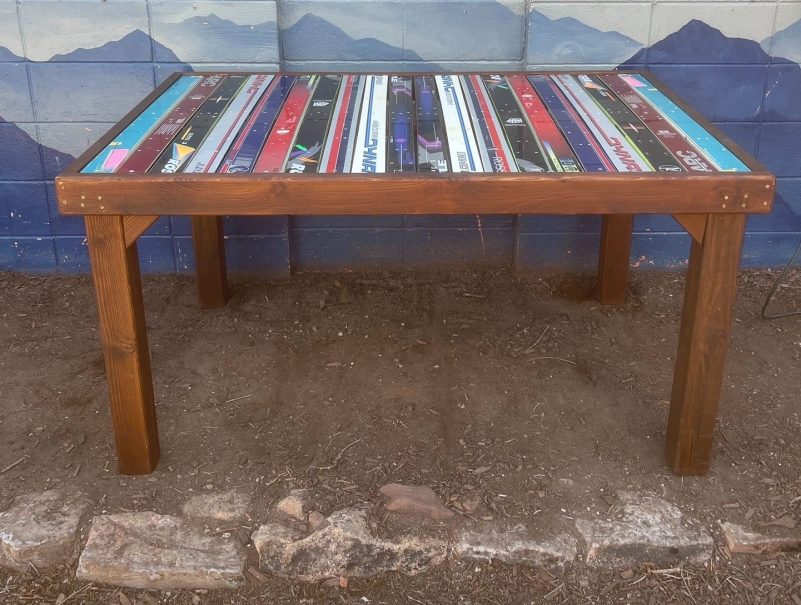
A tabletop made of skis sounds fragile until you look under one. The Outdoor Dining Table with Retro Ski Top runs 40 by 60 inches at full dining height, which is enough surface for six people to eat without anybody having to hold their plate in their lap. The skis are laid across a real frame, not glued to a slab of plywood and hoped for. The base is built and hand painted here in the shop, and the finish work is customizable, so the wood under the skis can be as loud or as quiet as you want it.
The whole table is water and weather proof and made to live indoors or out. That matters more than it sounds. Plenty of ski themed furniture is really indoor furniture with an outdoor photo shoot, and it starts checking and splitting the first spring after it gets rained on. We paint in exterior oils, which soak in rather than sitting on top as a film, so the finish moves with the wood instead of peeling off it in sheets. The table can sit uncovered on a deck in Summit County through a winter and come out the other side looking like itself.
Everything gets built to order in Manitou Springs, Colorado, by people who have to look at each other the next morning. There is no overseas line and no flat pack. That is why lead times run two to four weeks on most pieces rather than two days, and it is also why the tables hold up. Some pieces are finished and waiting, which is what the ready to ship section is for when somebody needs a table before a specific weekend.
At $2,995 it is not an impulse buy, and we would rather be honest about that than dress it up. What you are paying for is roughly a dozen retired skis that had to be found, a hand built base, hand applied finish, and a piece of furniture that is going to outlast the deck it sits on. Amortize it over twenty years of dinners and it looks a lot more reasonable than the aluminum set that lasted four. If that number is more than the deck budget wants to hear, the Grey Stained Outdoor Dining Table with Snowboard Runner is $1,995 and runs a snowboard down the center of a stained top instead of a full ski surface, which is the same dinner table with a quieter face on it.
Who Ends Up Buying One
The clearest buyer is the person who learned on gear that looks like the tabletop. Fifty five years old, started on straight skis and leather lace boots, still remembers what the first pair cost and probably what it cost to get them mounted. That person walks up to the table and does not need the concept explained. They are already reading it.
After that it splits into a few groups. Mountain house owners buy them for the deck or the great room, usually after spending a year looking at generic patio furniture and getting bored of every option. Ski shops buy them for the showroom floor because customers stop and touch them, which is the entire job of showroom furniture. Restaurants and breweries in mountain towns buy them because a room full of tables people photograph does a lot of marketing for free. We have shipped tables into taprooms in three states where the staff now have to answer questions about the skis all night, and they seem fine with it.
Then there is the gift category, which is bigger than you would think. A retirement present for the guy who has skied the same three mountains for forty years. A fiftieth anniversary for a couple who met on a lift. A father who never asks for anything and would never spend this on himself. Those buyers usually call rather than click, because they want to talk through whether we can find a specific brand, and that is a fair conversation to want to have out loud.
The one group we will steer gently away is anybody looking for a matched set of eight identical tables. We are not that. The variation is not a manufacturing tolerance we are apologizing for, it is the product. If uniformity is the requirement, there are places built for that, and they are cheaper.
Where a Ski Table Actually Belongs
The obvious answer is the deck, and the deck is a good answer. A 40 by 60 top needs about 36 inches of clear space on every side for chairs to pull out and people to walk behind, so figure roughly 9 by 10 feet of usable deck. Measure before you order. We have talked more than one customer down to a different piece because the table they wanted was going to turn their deck into a hallway, and nobody enjoys eating in a hallway.
Covered porches are the sweet spot. The table does not need cover, but a roof means you use it more, because the difference between a table you eat at twice a summer and a table you eat at three nights a week is usually shade and shelter rather than weather proofing. If the spot gets hard afternoon sun, aim the long axis east to west so half the seats are not roasting at six o’clock.
Indoors it works better than people expect. Great rooms in mountain houses have the ceiling height to carry a loud tabletop, and the ski graphics do a job that a plain slab cannot, which is give a big room something to look at up close. We have put these in dining rooms, in finished basements next to the ski tuning bench, and in one sunroom where the owner rotates it ninety degrees in winter to catch the light. The rest of the dining and coffee options live under tables, and the full outdoor groupings are under patio sets, with the pieces built to live inside grouped under indoor decor furniture.
The one placement to avoid is directly under a big pine. Sap does not care how weatherproof your finish is, and picking it out of ski bindings is nobody’s Saturday.
What You Put Around It
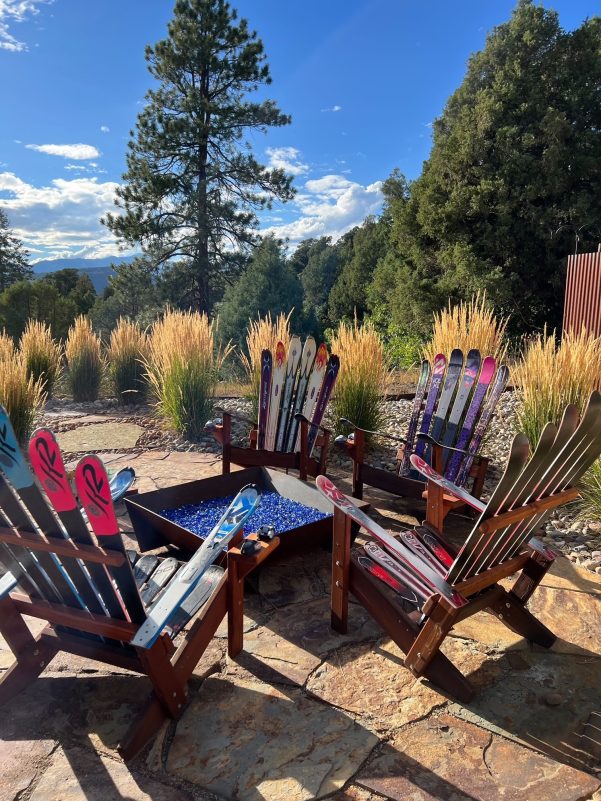
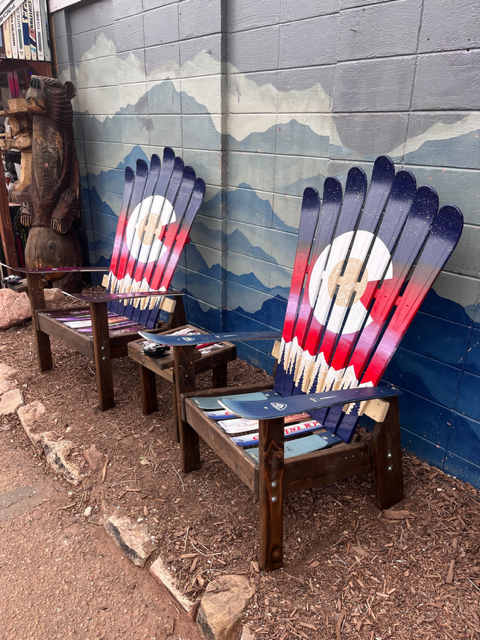
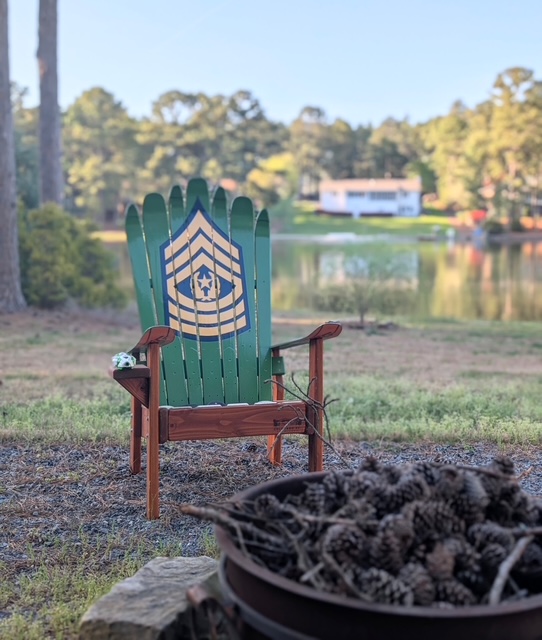
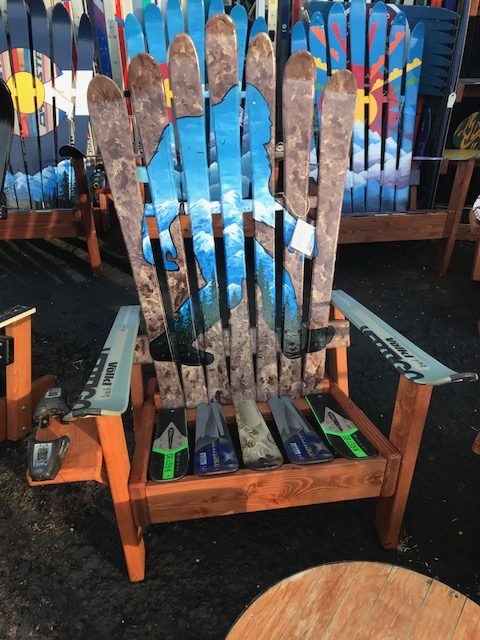
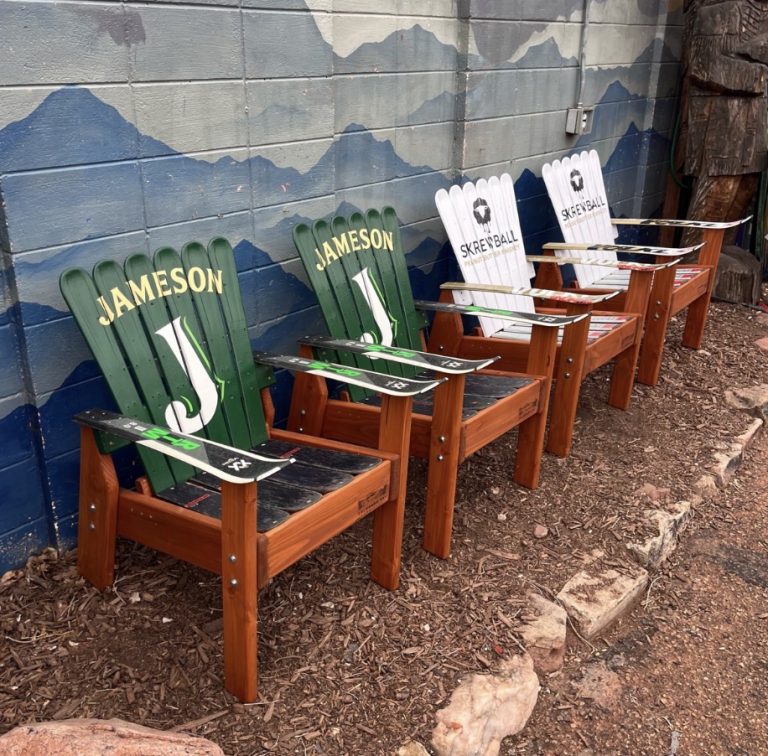
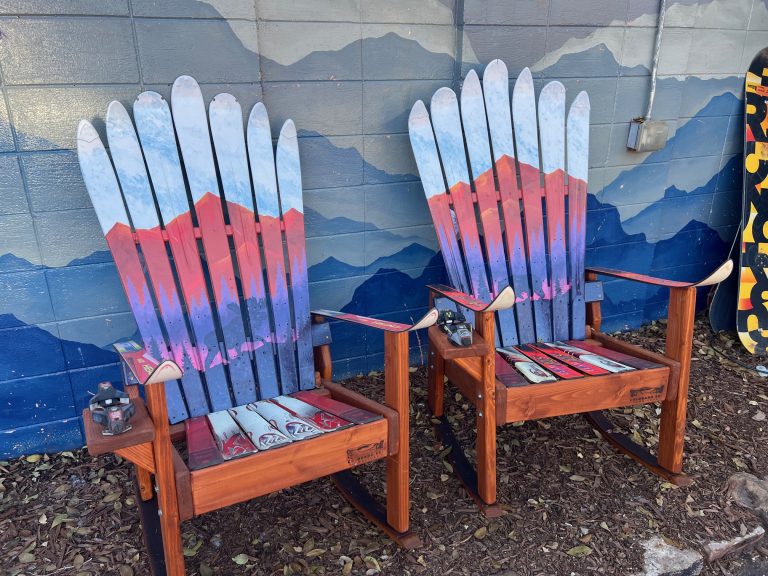
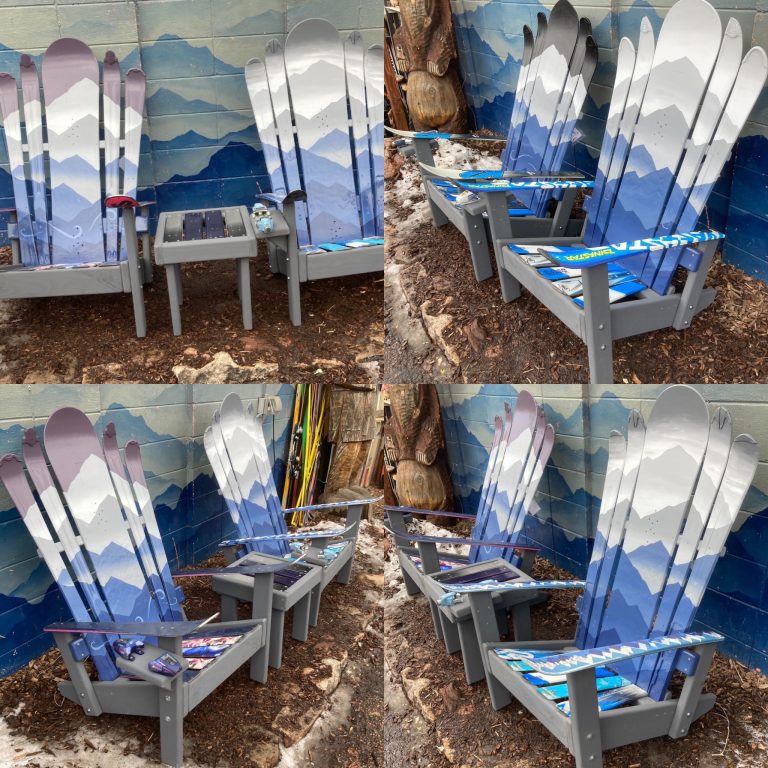
A table only works if the seating works, and this is where most outdoor dining setups fall apart. Our Adirondack ski chairs run 45 inches tall by 36 deep by 32 wide, with some versions built to 55 inches tall for the people who want the high back. They are comfortable for anybody from about 3 feet to 6 feet 10, which covers a grandchild and the tallest guy at the family reunion in the same afternoon. The base is Douglas Fir, the capacity is 400 pounds, and there is a cup holder made from a real ski binding, because we had a lot of ski bindings and it turns out they hold a beer perfectly.
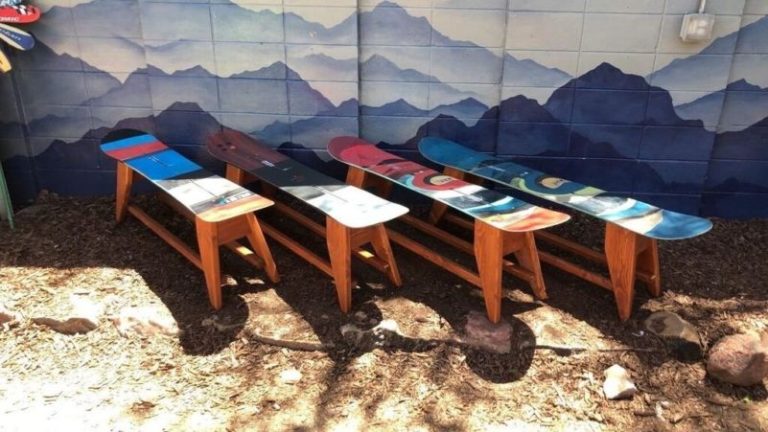
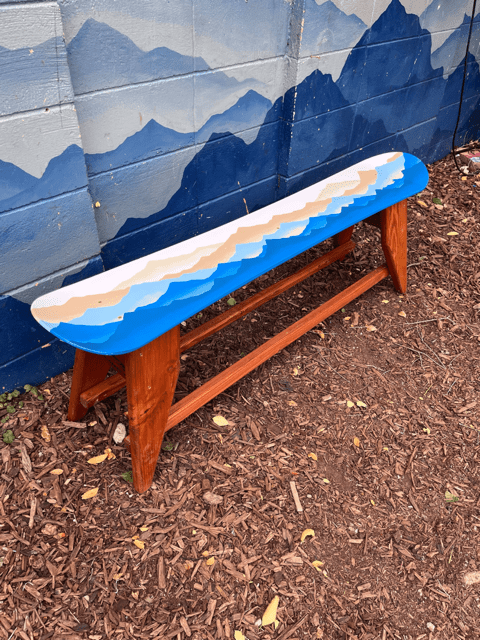
Worth knowing before you plan a whole patio: one Adirondack ski chair takes four to five pairs of skis to build. A set of two takes eight to ten pairs. That is why the chairs are priced the way they are and why we cannot always match a specific color across six of them. A snowboard chair needs at least three boards. A single snowboard, on the other hand, makes a terrific coffee table or bench, so if you have one board and big ambitions, a bench is the honest answer.
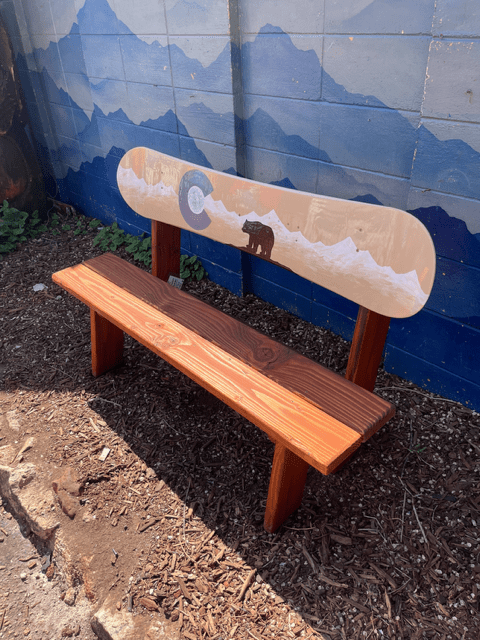
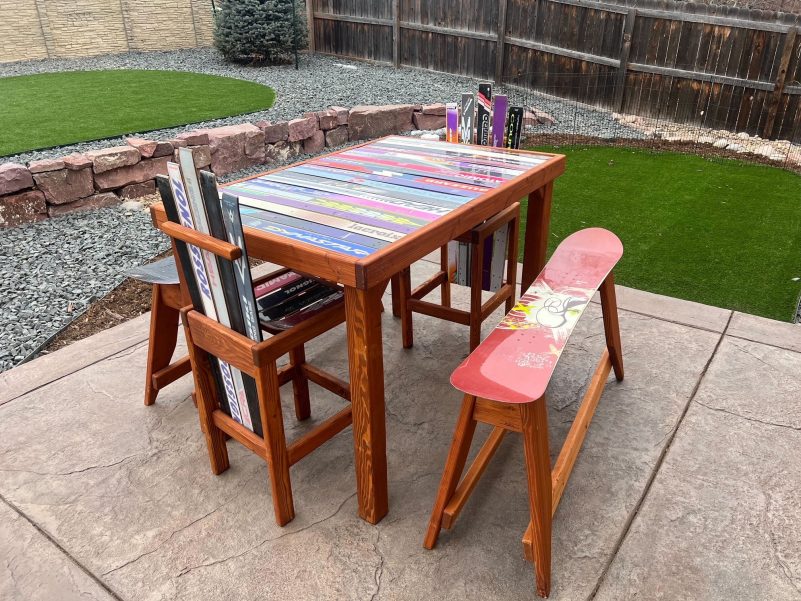
For dining specifically, a lot of people run the table with two ski chairs at the ends and a snowboard bench down one side. Benches seat more bodies per foot than chairs and they slide under the table when nobody is using them, which keeps a small deck walkable. The Colorado Flag Double Snowboard Bench is $595 and is built on two boards rather than one, and if all you need is somewhere to set feet and drinks between two chairs, the Customizable Single Snowboard Coffee Table does that at $397. Browse the seating under chairs and benches. If you want the whole arrangement handled in one order, the Large Patio Ski Dining Table, Ski Bar Stools, and Snowboard Benches set covers a table, stools and benches together. If the stools are the only gap, the Customizable Ski Bar Stools come as a set of two starting at $891.
Rockers are an option worth mentioning even though they are a lounge piece rather than a dining piece. The rocker conversion runs $75 more and rides on repurposed oak wine barrel slats, which is the kind of detail you notice a year in when the rockers still have not developed a squeak.
Customizing Without Guessing
The tabletop is what it is, since the skis dictate the palette. Everything under the skis is open. Base color, stain, hardware finish, and the paint treatment on the frame all get picked by you, and we send photos of the layup before anything is permanent. That step is not a formality. Roughly one customer in five looks at the photo and asks us to swap two skis around, and that is a two minute change before assembly and a very different job after.
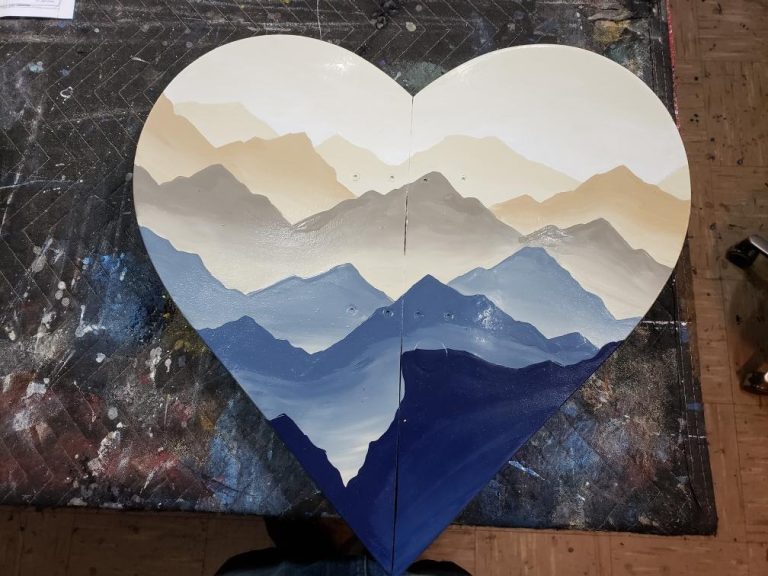
Murals are the bigger customization. They are hand painted in exterior oils, on site in our shop, by a person with a brush. A mountain range, a treeline, a sunset behind a ridge that somebody has been looking at from their kitchen window for thirty years. Because it is oil paint rather than a print, it lives outside like the rest of the piece and it ages at the same rate.
Logos work differently and this trips people up, so here it is plainly. A logo is never painted. It goes on as a logo decal floated onto a painted background, which gives you clean edges and correct brand colors that a brush cannot match. Aluminum and plastic appliques are the alternatives when you want dimension or a metal look. Branded work gets quoted on a call rather than off a price list, because the variables are the size of the mark, the material, and how many pieces you need. Call and describe it and you will get a real number.
If you want a specific ski brand or a specific era on the top, say so early. We can hunt, and we are reasonably good at hunting, but a request for four pairs of a particular 1978 model is a search rather than a checkbox. Custom builds outside the standard catalog live under custom designs.
Living With It Through Four Seasons
Spring is the only season that asks anything of you, and it asks about ten minutes. Wipe the top down with mild soap and water, check that nothing has worked loose over the winter, and look at the base where snowmelt sat longest. That is the whole ritual. No sanding, no annual refinish, no teak oil regimen that you will abandon by year three.
Summer is UV, and UV is the real enemy of any outdoor finish. Exterior oil paint handles it well, and the ski topsheets were designed to sit in high altitude sun all day, so the graphics hold their color better than most printed surfaces would. If the table lives in full exposure at 9,000 feet, expect the reds to soften slightly over many years. It reads as patina rather than damage, and on a table built from forty year old skis, a little patina is not a crisis.
Fall is when to decide about covering. You do not have to. The table is built to sit out. But a cover buys you fewer leaves in the ski bindings and less pine debris in the seams, which mostly saves you spring cleanup. If you do cover it, use something breathable. A sealed plastic tarp traps moisture against the finish and does more harm than the weather it is blocking.
Winter is the easy one. Snow load is not a problem on a table rated the way this one is, and freeze thaw cycles are exactly what exterior oils are formulated for. Plenty of our tables spend January under a foot of snow on a deck in Breckenridge and get dug out in April with no complaints. The three year hassle free warranty covers you regardless. Yup.
Giving One, and the Timing Nobody Plans For
A dining table is an unusual gift and it lands harder than most things people buy for each other. It is not consumable, it does not go in a drawer, and it sits in the middle of the room where the family eats. We have shipped these for retirements, for fiftieth birthdays, for a couple who wanted their wedding gift to be the thing everybody sat around at the reception and then took home.
The one thing gift buyers underestimate is lead time. Made to order runs two to four weeks, and that clock starts after the design conversation, not after the click. If the occasion is a specific Saturday in six weeks, you are fine. If it is next Friday, look at the ready to ship pieces instead and do not let anybody tell you a rushed build is the same thing.
Shipping is the other piece. Most chairs ship free to the lower 48. Larger tables and full sets get quoted, because a 40 by 60 top is a freight item rather than a parcel, and we would rather give you a real number than bury it. Local delivery runs across Colorado and we deliver a lot of these ourselves, which means somebody who built the thing carries it up your steps. Nationwide we ship to the lower 48.
If you are giving one and want the surprise intact, tell us. We can hold the delivery window, keep the crate label vague and coordinate with somebody other than the recipient. It is not our first time.
How Ordering Actually Works
Pick the piece, pick the finish options on the product page, and place the order. Within a day or two you will hear from somebody in the shop with questions, and those questions are real ones. What is the deck made of, what direction does the sun come from, is there a color in the house you want the base to talk to. That conversation is the difference between furniture that fits and furniture that arrives.
Then we build. Two to four weeks for most made to order pieces, sometimes faster in the slow season, sometimes longer in the fall when everybody in the country decides simultaneously that they want a ski chair before the holidays. You get photos before final assembly. If something is off, we fix it then.
Everything carries a three year hassle free warranty. Hassle free means you call, you describe the problem, and we take care of it. There is no claim form and no photograph checklist and no argument about whether hail counts. Ask around about the last piece of outdoor furniture you bought and how that conversation went.
Questions are best handled by phone, honestly. Email works, but a table like this involves five decisions that take two minutes out loud and four emails in writing. Call 303.775.7273 and somebody who has actually built one of these will pick up.
Frequently Asked Questions
How big is the Outdoor Dining Table with Retro Ski Top, and how many people fit?
The top measures 40 by 60 inches at full dining height, which comfortably seats six and can handle eight if two of them are on a bench. Plan on roughly 9 by 10 feet of floor space so chairs can pull out without hitting a railing.
Are the skis real vintage skis or reproductions?
They are genuine retired skis with the original graphics intact, sourced from garages, ski shops and swap meets. Because the supply changes month to month, no two tables come out identical, and we cannot guarantee a specific brand unless we discuss it before the build.
Can this table stay outside all year?
Yes. It is finished in exterior oil paint and built water and weather proof for year round outdoor use, including snow load and freeze thaw cycles. A breathable cover in fall cuts down on leaf and pine debris in the seams, but it is optional.
How long does it take and what does shipping cost?
Most made to order pieces run two to four weeks, and some finished pieces are ready to ship immediately. Most chairs ship free to the lower 48, while large tables and full sets are quoted as freight, and we deliver locally across Colorado ourselves.
Can you put a company logo or a mural on the base?
Murals are hand painted in exterior oils and can be almost anything you describe. A logo is never painted, it goes on as a logo decal floated onto a painted background, with aluminum or plastic appliques as alternatives, and branded pricing is quoted on a call.
If you have been staring at the same round patio table for eleven years and feeling nothing, that is your answer. Take a look at the Outdoor Dining Table with Retro Ski Top, or call the shop at 303.775.7273 and tell us what you skied on. We will find out pretty quickly whether we have your old sidewalls sitting in the rack, and if we do not, we will go looking.