Handcrafted Adirondack Chairs for a Mountain Home, Made Here
Thomas Lee had a problem in 1903. He was up at his family’s summer place near Westport, New York, the ground sloped in every direction, and there was nothing worth sitting on. So he cut eleven boards, angled the seat back into the hill, and handed the design to a friend named Harry Bunnell, who promptly patented it under his own name and sold them for twenty years. Great guy, Harry.
Eleven Boards and a Hillside
The origin story gets told a lot, and most versions skip the part that matters. Lee was not chasing a look. He was solving for uneven ground.
Sit on a normal kitchen chair on a slope and you slide forward, your feet fight for purchase, and your back gives out in ten minutes. Lee’s answer was to lean the whole thing backward, drop the front of the seat lower than the back, and widen the arms enough to actually hold something. The chair stopped fighting the hill. The hill became part of the chair.
He tried something like twenty two versions before he settled on the eleven board layout. His family sat in the prototypes and voted, which is a better product testing process than most companies run today. The version that won got handed to Harry Bunnell, a local carpenter who needed winter work. Bunnell filed the patent in 1904 without asking, called it the Westport chair, and built them out of hemlock for the next two decades. Lee, by all accounts, never sued.
Worth pausing on the hemlock, because it explains the whole design philosophy. Hemlock was cheap, local and easy to mill, and Bunnell was a carpenter looking for work between building seasons. Nobody was chasing a heritage aesthetic. They used what was at hand, cut it into flat boards because flat boards are what a small shop can produce consistently, and let the angles do the work that upholstery would do on an indoor chair. That is why an Adirondack looks the way it looks. It is a low tech solution executed well, which is a category of object that has aged better than almost anything designed to look expensive.
Over a hundred and twenty years later the geometry has barely moved. Contoured seats came along, the fan back showed up, materials multiplied. But the reclined back, the low front edge and those absurdly wide arms are all still there because they were right the first time. Not many pieces of American furniture can say that.
The name drifted too. Westport chair became Adirondack chair because that is the range Lee was sitting in, and the mountains got the credit instead of the town. Mountains usually do.
Why the Slanted Seat Is the Whole Trick
Sit in a good Adirondack chair and something happens in about four seconds. Your shoulders drop. That is not a feeling, it is geometry doing its job.
Three things are working at once. The seat pitches down toward the front, so gravity holds you in the chair instead of you holding yourself in it. The back reclines past vertical by a meaningful margin, so your spine has something to lean against rather than something to sit up straight against. And the arms are wide and flat, so your elbows have somewhere to go and your hands stop hunting for a place to rest.
That last one gets underrated. A narrow armrest gives you a place to grip. A wide armrest gives you a place to put a book, a plate, a phone or a drink, and the difference in how long you stay seated is enormous. The Adirondack is a chair that keeps people outside past the point they meant to go in.
Ours run 45 inches tall by 36 inches deep and 32 inches wide, with some builds going up to 55 inches tall when somebody wants more presence. Comfortable for people from 3 feet to 6 feet 10, which is a range that covers a five year old and the tallest person you know. Weight capacity is 400 lb, so two adults in one chair on a cold night is fine.
The one real tradeoff is honest to acknowledge. This is not a chair you pop out of. Getting up takes a small commitment, especially for anybody with a bad knee. That is the price of the recline, and after a hundred and twenty years nobody has found a way around it without ruining the thing.
What Ours Are Made Of, and Why It Is Not Hemlock
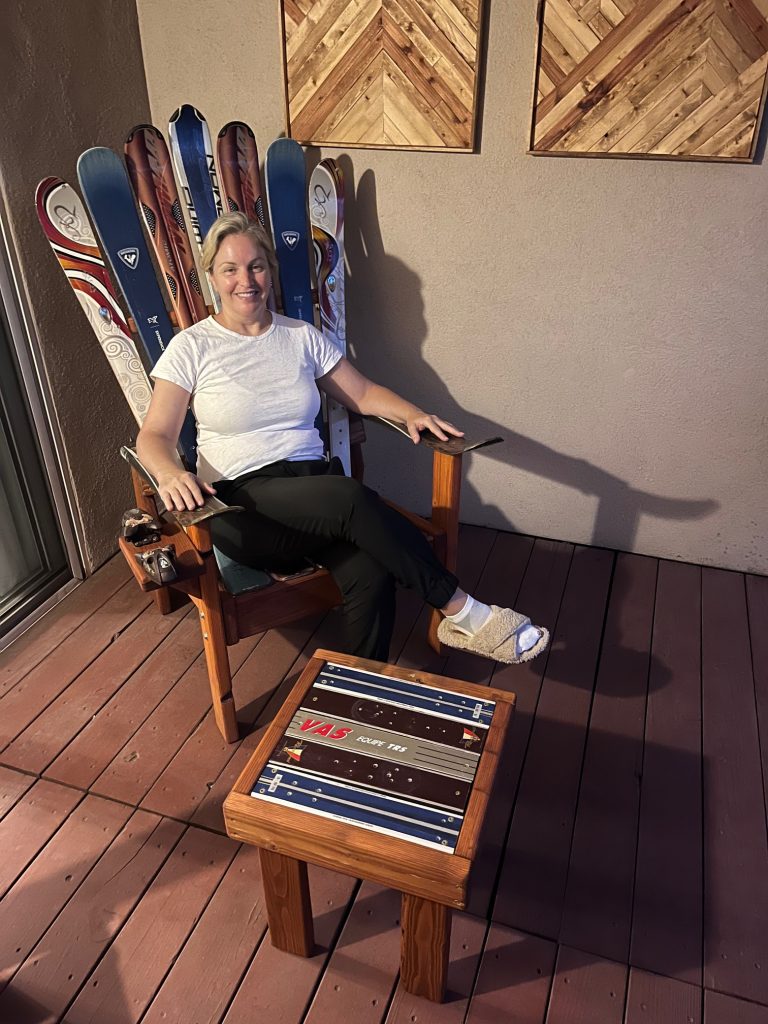
Bunnell used hemlock because hemlock was what grew near Westport. We use retired skis because retired skis are what pile up near Manitou Springs, Colorado.
The logic is the same. Use the material the mountain hands you.
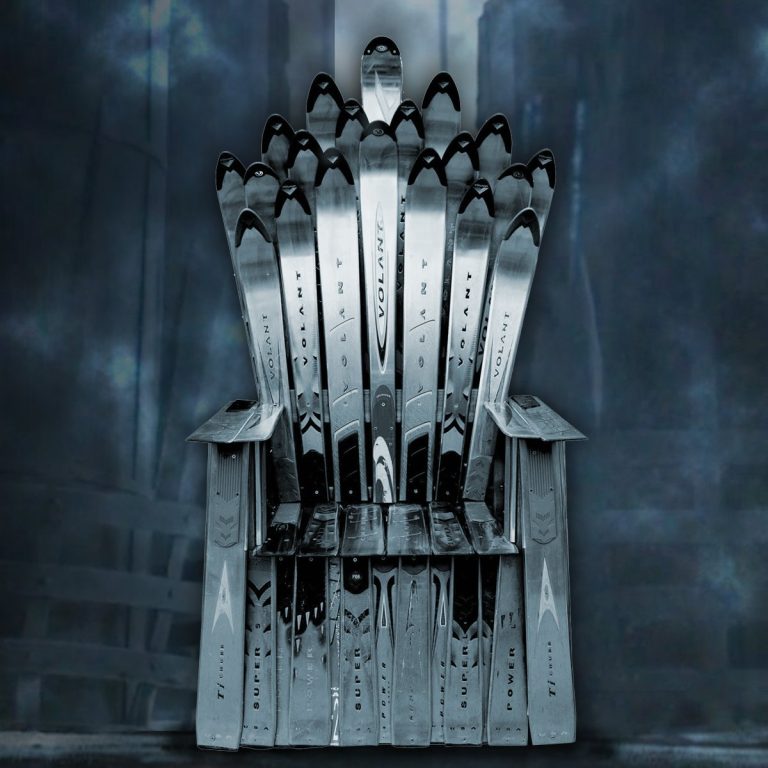
One Adirondack ski chair takes four to five pairs of skis, and a set of two takes eight to ten. Those skis already spent a decade at altitude taking UV, freeze thaw and snow, and their topsheets are laminated to survive it. When they get to us, the hardest part of weatherproofing has already been done by a factory in Austria or Utah.
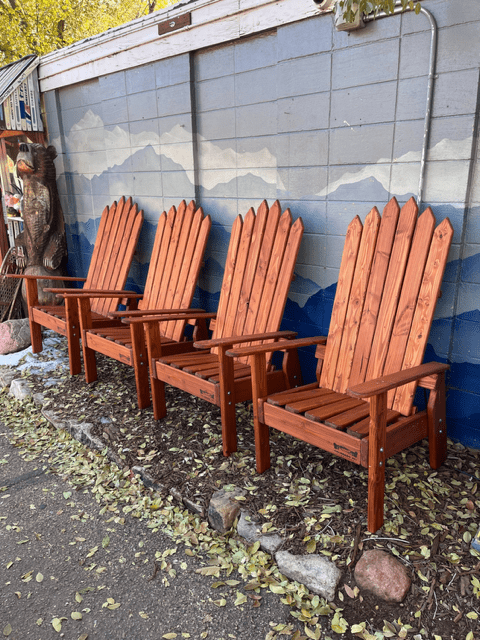
The base is Douglas Fir, cut and built here, and it does the structural work. Everything visible gets high quality exterior oil paint, colorful and weatherproof, because a stain would fade and a house paint would chalk. Murals go on by hand in those same exterior oils, which is why every one is slightly different and why we cannot promise two identical chairs.
The cup holder is a repurposed ski binding. It fits a stein. Nobody asked for that detail and it is the single most photographed part of the chair.
3 year hassle free warranty. Yup. Most chairs ship free to the lower 48, and every chair or bench can be built as a rocker for $75 more on repurposed oak wine barrel slats. If reclaimed barrel wood is the material you actually want, that is its own line under Barrel Chairs and Sets, built from oak whiskey and wine barrel staves.
Who Buys a Handcrafted Adirondack Chair in 2026
You can buy an Adirondack chair for eighty dollars at a hardware store. Plenty of people do, and it works fine for a season or two. So the interesting question is who skips that and orders a handmade one instead.
Mostly it is people who already own the eighty dollar version and watched it go brittle and chalky by year three. They are not buying a chair, they are buying the last chair. That is a specific kind of customer and they ask good questions about weight capacity and warranty before they ask about color.
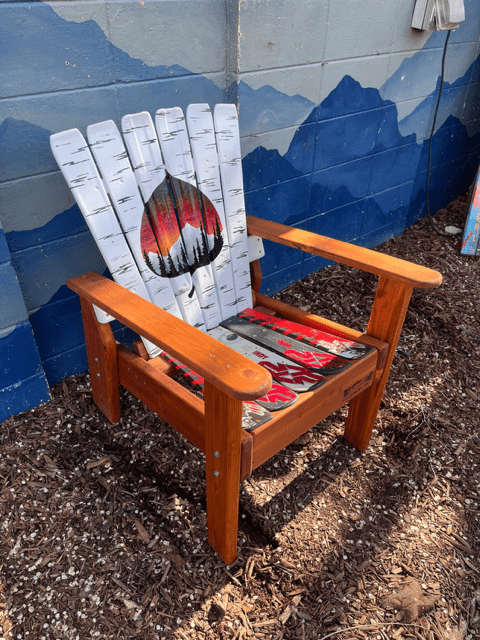
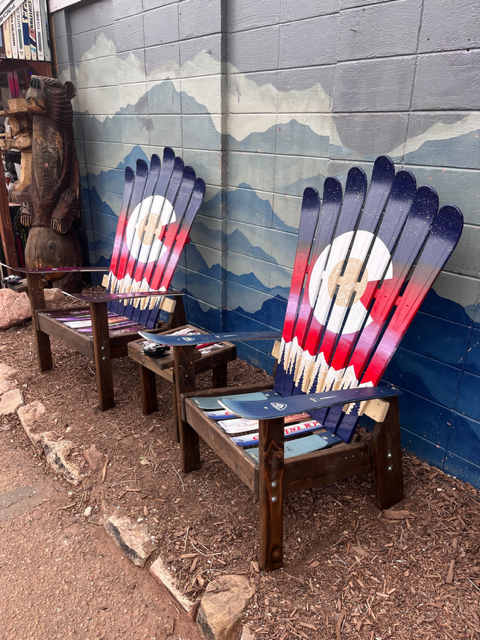
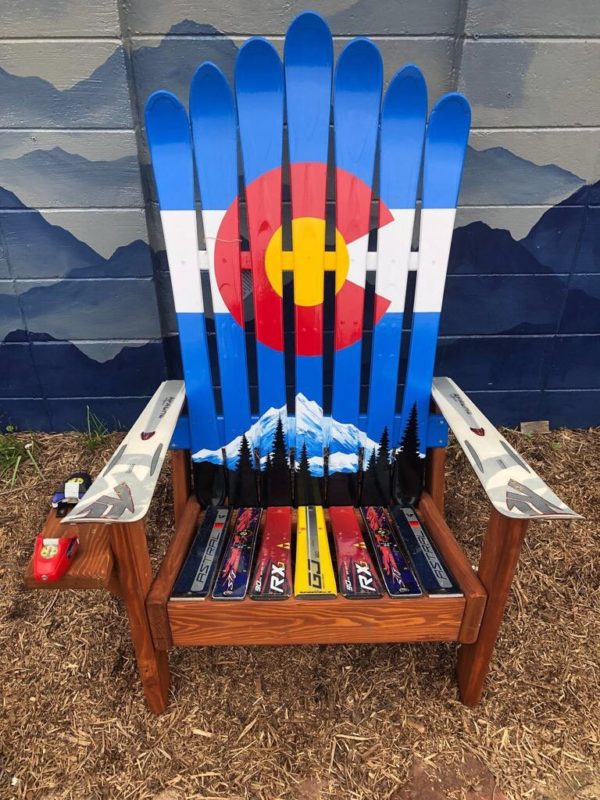
Second group is people with a mountain house, a cabin or a condo who want the outside of the place to match the reason they bought it. A generic resin chair on a deck at 9,000 feet is a small daily disappointment. The Colorado Flag Adirondack Ski Chair with Trees & Mountains ends up on a lot of those decks, and transplants buy it about as often as natives do.
Third group is gift buyers, and they are close to half of all orders. Retirements, milestone birthdays, housewarmings for a first mountain place. More on that further down.
Fourth is skiers who recognize the topsheets. This is a small group and a loud one. Somebody sits down, looks at the seat back and says the model year out loud, and then wants to know where the skis came from. Fair question. They come from shops, ski swaps, resort ops and people cleaning out garages, all of them retired for real reasons. That group usually ends up on the Retro Chair built from all vintage skis, sixties, seventies and eighties, starting at $675. It is the only chair we sell where the customer knows more about the parts than we do.
What nobody in any of those groups is doing is comparison shopping on price alone. If price is the deciding factor, the hardware store wins and we would say so.
There is a fifth group that has grown quietly, and that is owners of cabins and short term rentals. They report the same thing over and over: the chairs show up in more guest photos than anything else on the property. A hand painted mural on a seat back is doing quiet marketing work every time somebody posts a picture of the deck, which is an unusual return to get out of a piece of furniture. Nobody photographs a resin chair on purpose.
Where They Belong Around a Mountain Home
Front porch first. A pair flanking the door is the arrangement that has worked since Bunnell was building them, and it still reads right on everything from a Craftsman in Denver to a cabin outside Salida.
Fire pit is the other classic. Three or four chairs in a loose arc, pointed slightly inward, close enough to talk without raising your voice. The recline matters more here than anywhere, because you are looking up at the sky half the time and the chair already put your head in the right place.
Decks with a view want them angled outward rather than facing each other. This is the mistake people make most. They arrange chairs like a living room, facing in, and then nobody looks at the reason they bought the house. Point them at the mountains and put a small table between.
Docks and lakefronts work beautifully, and the design was born on a lake so that tracks. Poolside works. Gardens work, especially a single chair tucked where the afternoon shade lands.
Indoors is more common than you would guess. A mudroom, a basement bar, a great room with a big ceiling. The exterior oil finish shrugs off a wet jacket, so a ski chair inside is a practical choice rather than a novelty. We keep the pieces meant for interiors under Indoor Decor and Furniture.
One clearance note. These lean, so give the back about three feet of depth. Push one flat against a railing with a few inches to spare and the seat back cannot do its job, and you have essentially bought a very handsome ledge.
What You Can Change About a 1903 Design
The bones stay the same. Everything on top of them is open.
Color is the first fork. Solid base colors, Colorado flag treatments, faded mountain stripes, wood grain effects. All of it in exterior oil paint rather than stain, so the color stays saturated instead of going gray. If you want the color work without a painted scene on the back, the Signature Customizable Ski Chair starts at $595 and is exactly that, your colors and your ski brands, no mural.
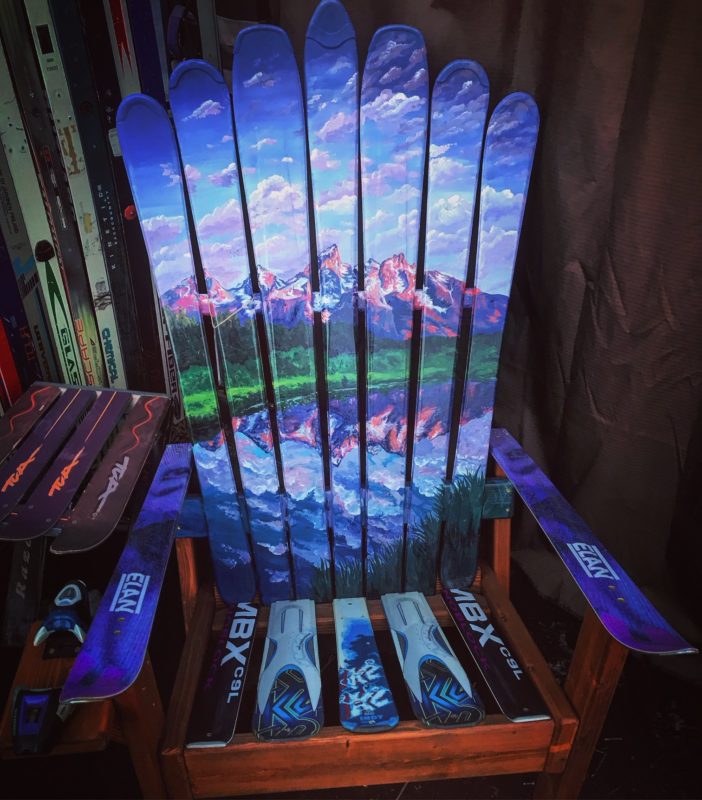
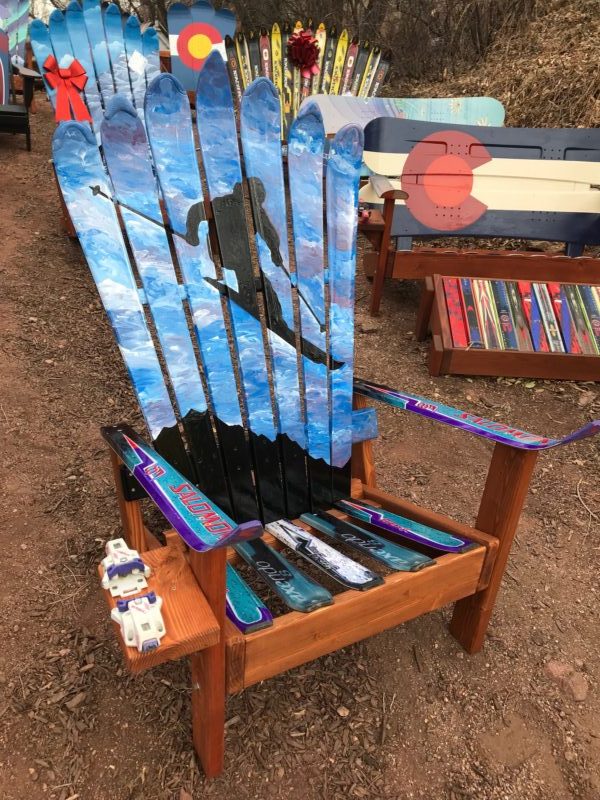
Murals are the second, and this is where most of the custom work happens. Hand painted in exterior oils across the seat back: a specific peak, a treeline, a sunset, a moose, a lake. Name the mountain and somebody paints that mountain. Not a stock silhouette, the actual profile.
Ski selection is a soft option. Ask for particular brands or colors and we will match it if the rack has it, and tell you straight if it does not. We would rather say no than substitute quietly and hope you do not notice.
Structure options are simple. Standard base, rocker for $75 more on oak wine barrel slats, taller 55 inch builds for presence, kid sized versions, matching ottomans, and full arrangements from Patio Sets, where something like the Snowboard Adirondack Chairs, Ottomans and Side Table Set of 5 runs $1,695 and furnishes a whole deck at once. Remember that a set of two takes eight to ten pairs of skis, so bigger sets take longer to source.
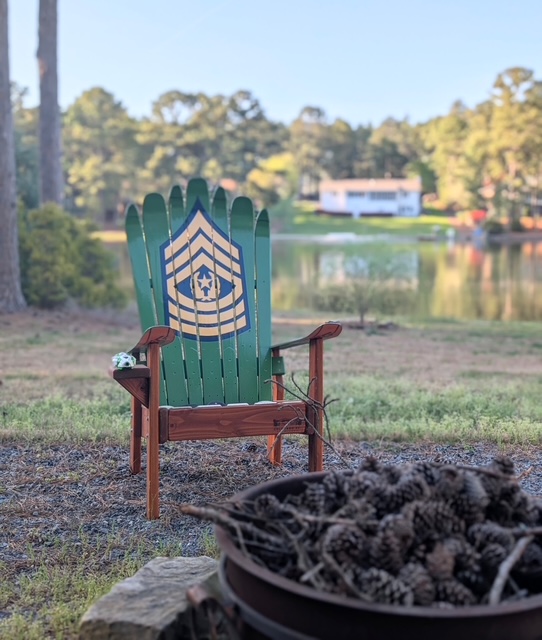
Personalization covers names, dates, coordinates and short lines of text worked into the design. For business orders, be clear on one point: a logo is never painted. The background gets hand painted and then the logo goes on as a logo decal floated onto it, with aluminum and plastic appliques as alternatives. Branded pricing is quoted on a call, since art, quantity and finish all move the number.
The whole catalog of one off work lives in Custom Designs, and a good share of it started with somebody calling to describe an idea they were slightly embarrassed about.
Care Through Four Seasons, Which Is Mostly Doing Nothing
Start with the good news. These live outside year round. No hauling into the garage in October, no covers required, no annual refinishing ritual.
Spring does the most damage and it is not from snow. It is standing water and mud. Set the chair on gravel, pavers or decking so the feet are not soaking for weeks during runoff. That one habit does more for the life of the piece than everything else on this list combined.
Summer is about sun. High altitude UV is hard on any finish, which is exactly why the paint is exterior oil. Above about 8,000 feet in full exposure, a light clear UV sealer every couple of years keeps the colors where you want them. Down on the Front Range most owners never do it and the finish holds up fine.
Fall is a two minute job. Clear pine needles and aspen leaves out of the slat gaps before the first heavy snow, because wet organic matter packed against wood all winter is how rot begins on any outdoor furniture.
Winter, do nothing. Let it snow on the chair. If you want to sit, sweep it with a broom. Do not chip ice off with a metal shovel unless you enjoy removing paint.
Cleaning is mild soap, water and a soft brush. Never a pressure washer. It forces water into every joint and strips finish at the same time, which is a remarkable amount of harm for something that feels so satisfying.
The 3 year hassle free warranty covers the build. Past that, we regularly see photos of chairs eight and ten years old that look like they have another decade in them.
Why These End Up Being Gifts
Close to half of what leaves the shop was bought for somebody else, and gift buyers are solving a different problem than people shopping for their own deck. They want the recipient to know they were paying attention.
A chair is a good vehicle for that because it is permanent and it sits in public. It goes on a porch where everyone sees it, and it stays there for years. A bottle of something nice is gone by March.
The specificity is what does the work. Anybody can send a nice chair. Only somebody who listened knows the mountain has to be Ajax and not Aspen Highlands, or that the anniversary trip was to a particular lake and not the famous one nearby. When the mural shows the right ridgeline, the gift has landed before anyone sits in it.
Occasions repeat in a predictable order. Retirement is the biggest, particularly for people leaving a long career and moving somewhere with a view. Then fiftieth and sixtieth birthdays, housewarmings, group wedding gifts where a pair from Sets of 2 makes more sense than a single, and memorial pieces for a skier who is gone. Those last ones get built with extra care and live under Sentimental Pieces.
Practical note. Made to order runs two to four weeks, and that window tightens badly in December, so a Christmas piece wants to be ordered by early November. If you are already late, the Ready to Ship shelf exists for that exact situation, and smaller pieces live in Gift Items when a full chair is more than the moment calls for.
How to Actually Order One
Simplest path is straight off the site. Pick the chair, pick the options, check out. Something like the Colorado Flag Adirondack Ski Chair with Trees & Mountains is a stocked design, so there is nothing to discuss unless you want a different state flag or a name worked in.
If the idea is more involved, call 303.775.7273 and talk it through. That is the only number we use, and the person answering builds these. Branded and business orders always go through a call, because decals, appliques and quantity change the price and there is no honest way to put that on a product page.
Lead time is two to four weeks on most made to order builds, longer for detailed murals or multi piece sets, and much faster for anything already finished on the shelf. We will tell you where yours stands rather than leaving you to wonder.
Most chairs ship free to the lower 48 and arrive ready to use. Across Colorado we handle local delivery ourselves, which people forget is an option. If you are in state, just ask.
One last honest note about provenance, since it comes up whenever people browse our Ski Lifts category. Most lift benches and swings are handcrafted replicas rather than lifts pulled off a mountain. When a piece really is a retired lift, the product name says so. We are not going to sell you a story.
Frequently Asked Questions
Who invented the Adirondack chair?
Thomas Lee designed it in 1903 at Westport, New York, in the Adirondack Mountains, using eleven boards and a seat angled to work on sloping ground. His friend Harry Bunnell patented it in 1904 as the Westport chair and built them commercially for about twenty years.
How many pairs of skis go into one of your Adirondack chairs?
One chair takes four to five pairs of retired skis, and a matching set of two takes eight to ten pairs. Sourcing those skis is a real part of why made to order builds run two to four weeks.
Are these comfortable for tall people or for kids?
Yes. The chairs measure 45 inches tall by 36 deep and 32 wide, some builds run 55 inches tall, and they are comfortable for people from 3 feet to 6 feet 10. Weight capacity is 400 lb, so two people in one chair is not a problem.
Can they stay outside all winter in the mountains?
They are built for it. Exterior oil paint, sealed ski topsheets and a Douglas Fir base handle snow, sun and freeze thaw, backed by a 3 year hassle free warranty. Sweep snow off with a broom and skip the pressure washer.
Can I get a rocking version?
Every chair and bench can be built as a rocker for $75 more, riding on repurposed oak wine barrel slats. Select it when you order or mention it on the phone.
Pick Your Mountain and We Will Get Started
A hundred and twenty years on, the design still works because Thomas Lee solved a real problem instead of styling one. All we did was change what it is made of. Call 303.775.7273 if you want a specific peak, a state flag or a name on yours, start from the Colorado Flag Adirondack Ski Chair with Trees & Mountains, or look through the rest of the Adirondack Ski Chairs and Custom Designs we build in Manitou Springs.