Outdoor Furniture Made From Recycled Skis, Yours Included
Go look in your garage. Up in the rafters, behind the Christmas bins, there is a pair of skis you have not clicked into since the Bush administration and cannot bring yourself to put on the curb. Everybody has them. The bindings are obsolete, the edges are shot, and the topsheet still has a lift ticket wicket on it from a day you can probably still describe.
Where “Eco Friendly” Usually Goes Wrong
The phrase gets used so loosely it has almost stopped meaning anything. A patio set gets called sustainable because the plastic in it started life as bottles, which is real but is also a factory process that consumed a pile of energy to produce an object destined to crack in four years and go right back to the landfill.
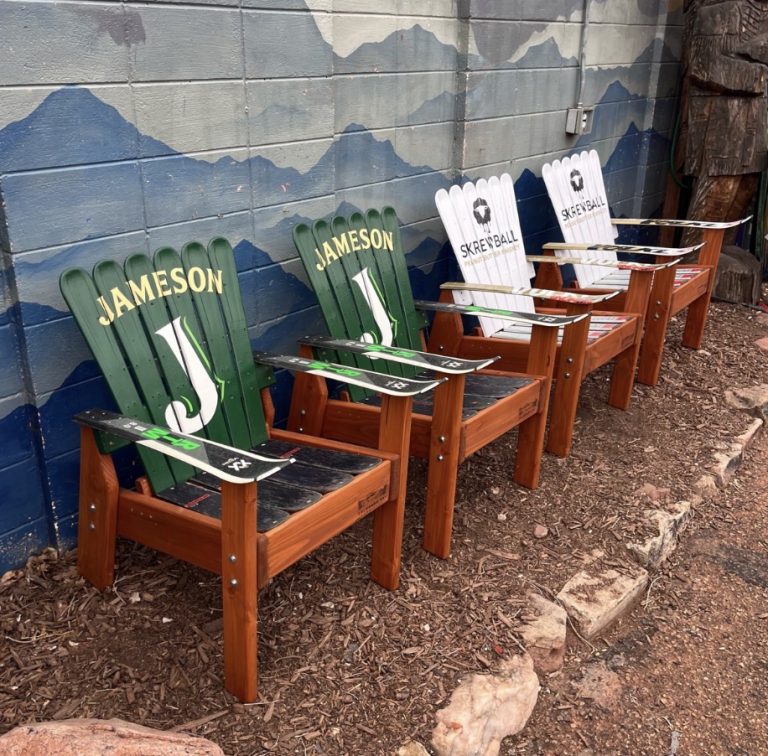
The honest test is not what a thing is made of. It is how long the thing lasts and whether the material had a life before this one. By that standard a chair built from skis that already existed, that would otherwise be sitting in a transfer station, is about as straightforward as it gets. Nothing was extracted to make it. Nothing was melted down and reformulated. The skis were cut, shaped and rebuilt into something with a second job.
Skis are also a genuinely bad recycling candidate through normal channels, which is the part most people never learn. A modern ski is a laminate sandwich. Wood or foam core, fiberglass or carbon layers, steel edges, plastic base material, epoxy holding all of it together. Separating those materials at scale is not economical, so almost nobody does it. Skis do not really get recycled. They get buried.
That is the actual environmental argument for this kind of furniture, and it does not require any hand waving. A chair takes gear that has no other decent ending and gives it thirty more years above ground, in a spot where somebody sits in it with a beer. That is a better outcome than a landfill and a much better outcome than a new object made from new material.
Everything in the Sentimental collection works on that principle. It is not a marketing angle bolted onto the product. It is the product.
How Many Skis a Chair Actually Takes
This is the question everybody asks second, right after “can you really do that,” and the answer surprises people. It takes more gear than you think.
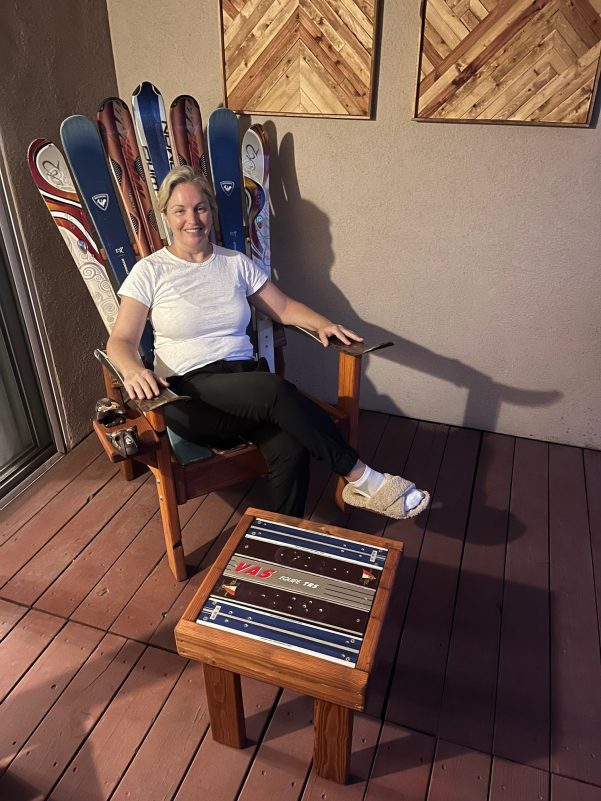
One Adirondack ski chair takes four to five pairs of skis. Not one pair. Four to five. So if you were picturing your old Rossignols becoming a chair all by themselves, adjust the picture. A single pair is roughly a fifth of a chair.
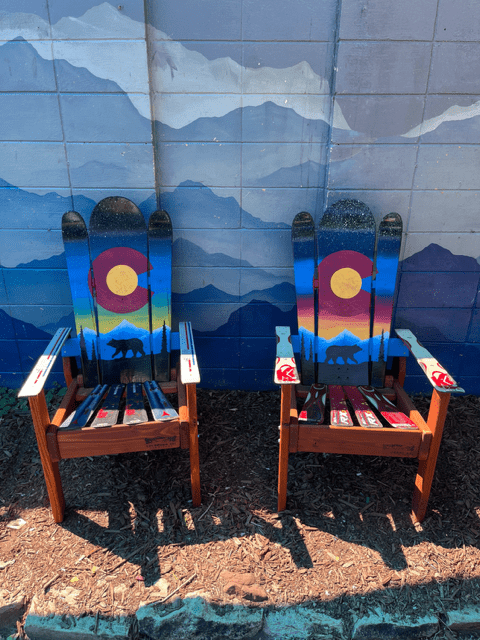
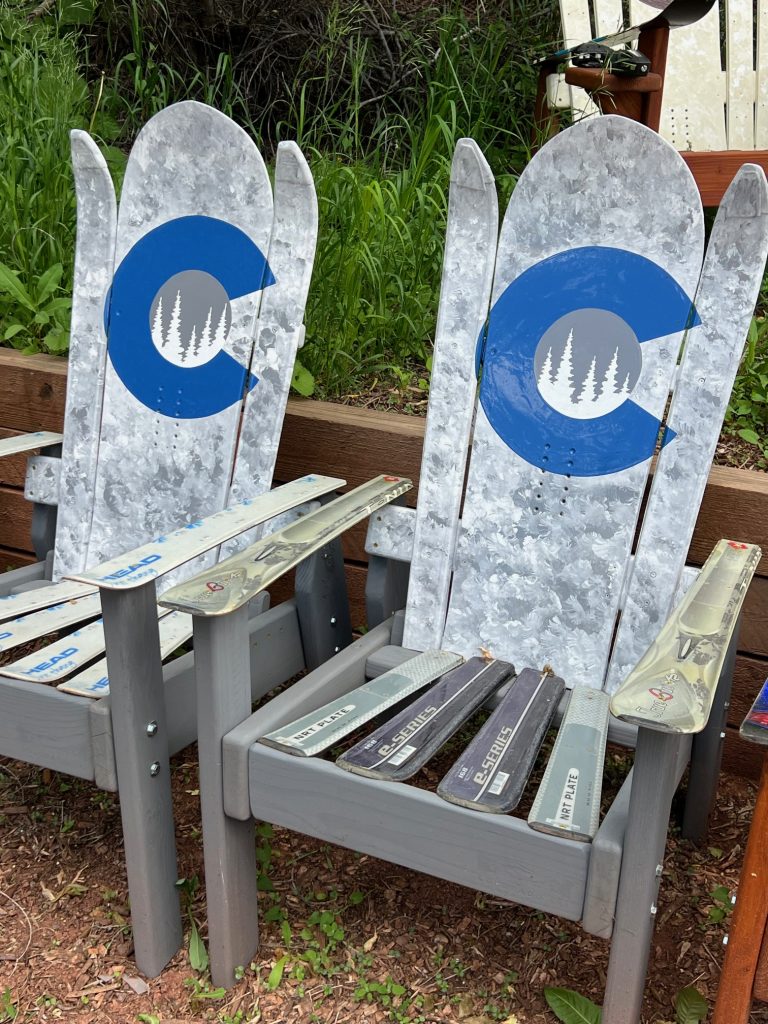
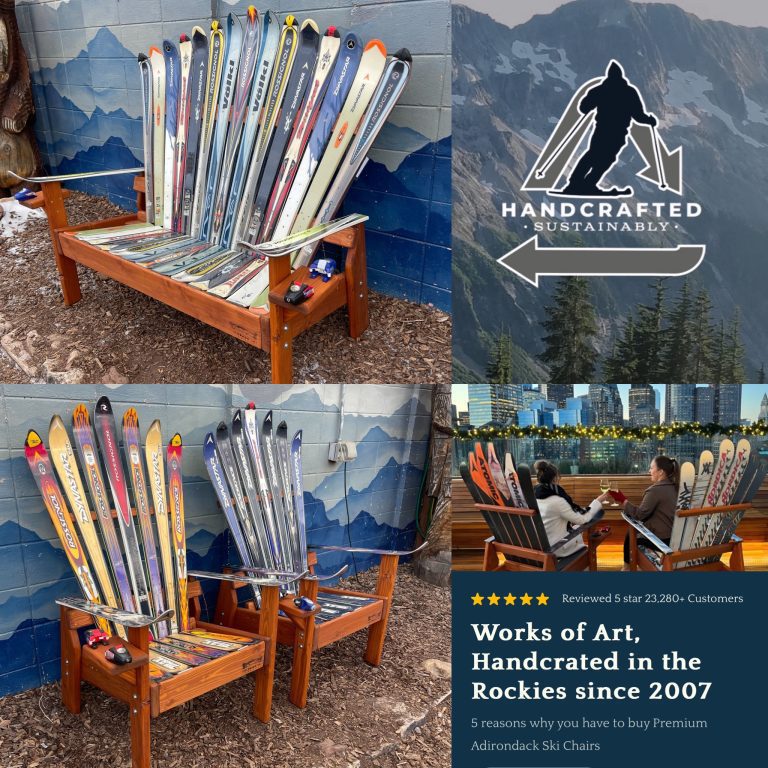
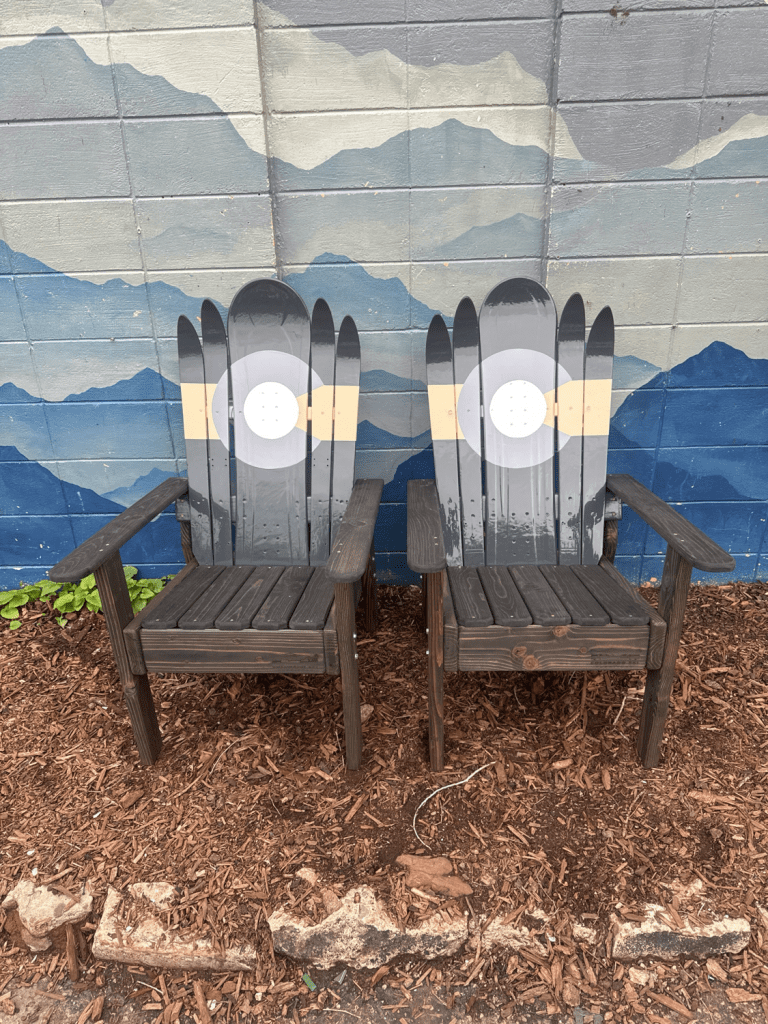
A matched set of two chairs takes eight to ten pairs. That is a real pile of skis, and it is why people who want a set usually end up collecting from the whole family, or from a ski swap, or from a shop that is happy to hand over what came in on trade. If you get there, Sentimental Ski Chairs as a set of two is $1,088, which comes in under the price of two single chairs ordered separately.
Snowboards work differently because the material is wider. A snowboard chair needs at least three boards. A single snowboard, on the other hand, does make a fine coffee table or a bench, and that is often the right answer for someone with exactly one board they care about. The Customizable Single Snowboard Coffee Table is $397 in whatever colors you ask for, and if what is in the rafters is skis rather than a board, the Ski Coffee Table at $291 is the smallest way into any of this. If that is your situation, look at Tables before you start hunting for two more boards you do not have.
The math runs the same way for other gear. A hockey stick chair takes twelve to fifteen sticks. A golf club chair takes one full set, so eleven or twelve clubs. In every case you are supplying the skin of the piece, and it turns out a chair has a lot more surface area than a single pair of anything.
The good news is that mismatched pairs are welcome and usually look better. A chair built from five different eras of graphics has more going on than five identical skis ever would. Nobody has ever gotten one back and wished it were more uniform.
What Happens to Your Skis in the Shop
People imagine we bolt skis to a frame. It is a fair guess and it is not what happens.
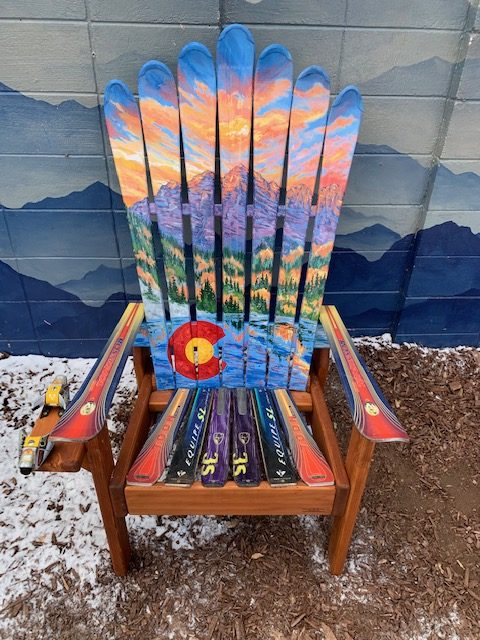
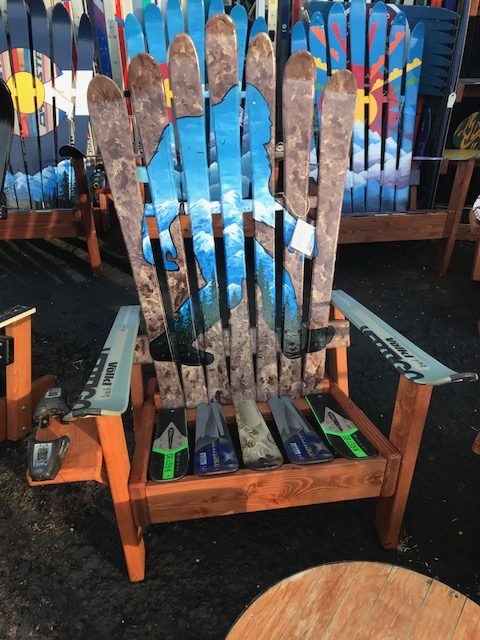
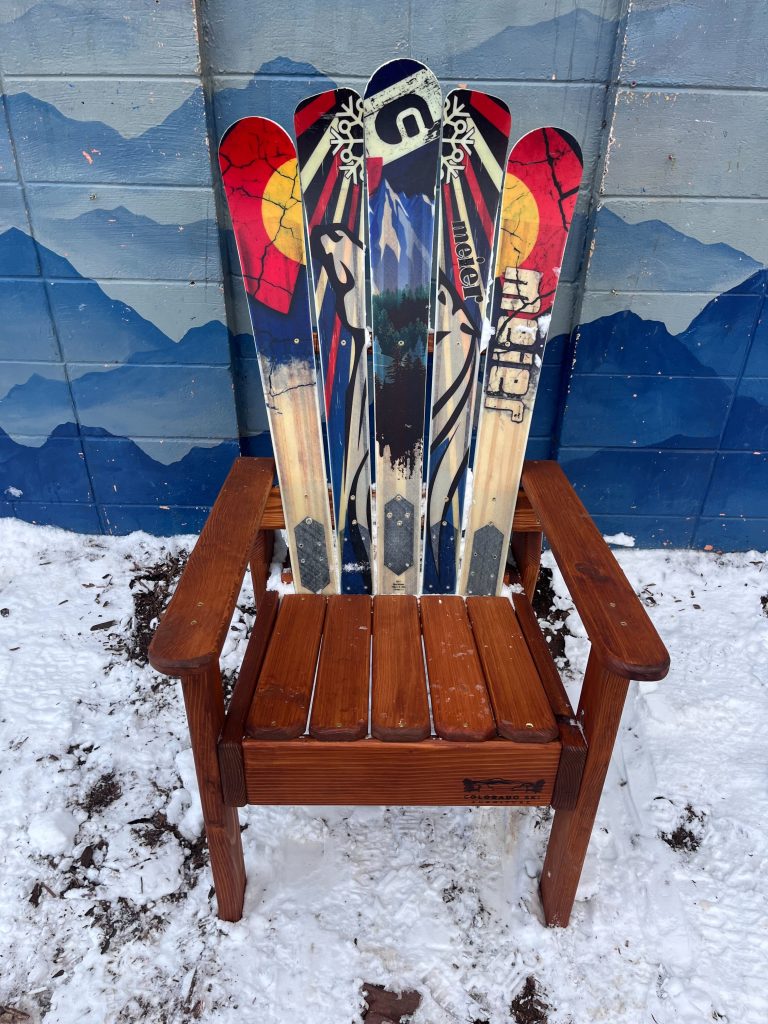
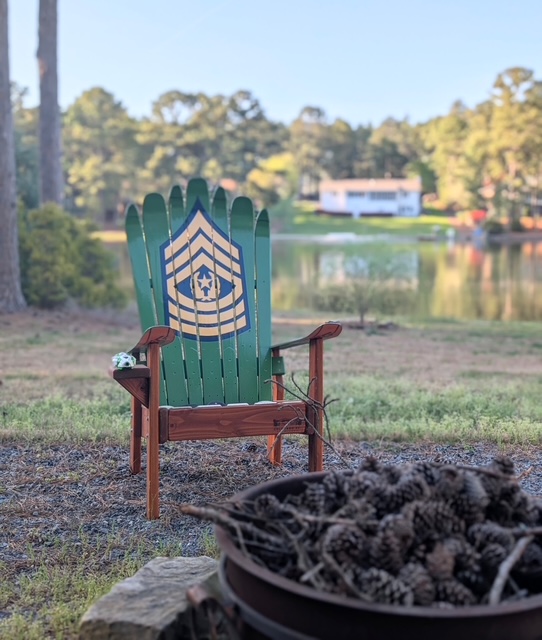
The skis come in and get sorted first, by graphic, by color, by which sections have the visual information worth keeping. A ski is not uniform down its length. The tip and the shovel usually carry the brand and the artwork, the waist is where the model name lives, the tail is often the plainest part. Laying out which section lands on the back, the seat and the arms is a design decision made before anything gets cut, and it is most of what determines whether the finished chair looks composed or looks random.
Then they get cut. Skis fight back a little here. Steel edges are hard on blades and the laminate wants to delaminate at a bad cut, so it is slower work than cutting lumber and it eats tooling. Then the pieces get shaped, the edges get dealt with so nothing is sharp where a hand is going to land, and the whole thing gets fitted to the frame.
Fasteners go through the ski material into the Douglas Fir structure underneath, and the frame is what actually carries load. The skis are the surface and the story. The fir is the engineering. That distinction matters, because it is the reason the chair is rated for real weight instead of being a decorative object that flexes when you sit down.
If you have asked for a hand painted front board, that happens in exterior oils alongside the ski work, and it is the piece that ties the whole chair together visually. It is a $75 to $100 add and it is the option I would pick first.
The Parts That Are Not Skis
A chair made entirely of recycled material would be a nice press release and a bad chair. Here is what else is in it and why.
The base is Douglas Fir. It is stiff, it takes fasteners without splitting, and it holds its line through freeze and thaw cycles, which is the actual test in Colorado. The frame is what makes the chair sit flat on a stone patio instead of rocking on one leg every time you shift your weight. Skis are wonderful material and they are not structural in this application.
The finish is a high quality exterior oil paint, colorful and weatherproof. It penetrates rather than forming a film on the surface, which is the whole ballgame outdoors. Film finishes crack and peel and then you are stripping a chair. Penetrating oil fades slowly and refreshes with a rag.
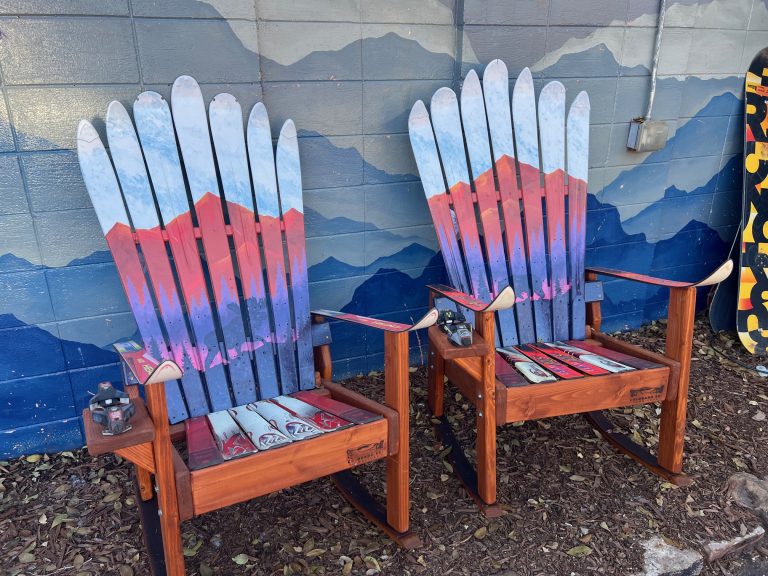
The cup holder is a repurposed ski binding, which is the detail everybody notices and nobody expects. It is sized for a stein rather than a shot glass, which tells you something about the design priorities around here.
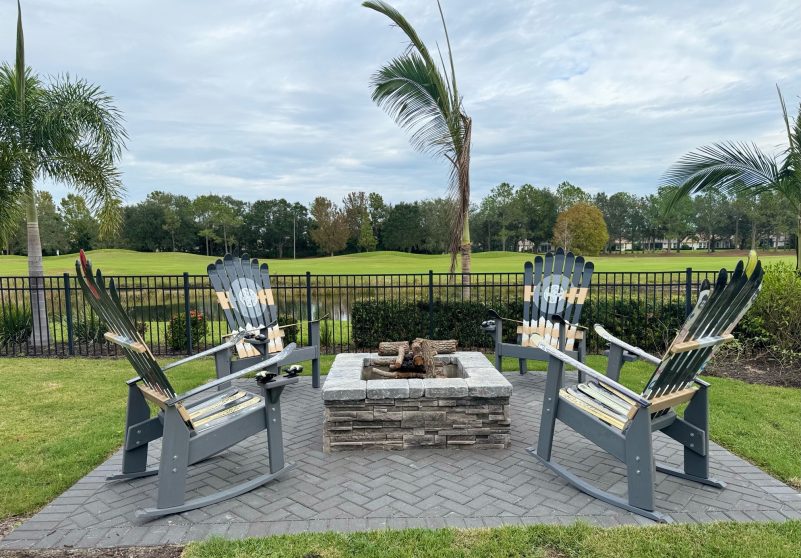
If you want a rocker instead of a fixed base, that is $75 more, and the rockers are cut from repurposed oak wine barrel slats. More material with a previous life. The curve on a barrel slat happens to be very close to the curve you want under a chair, which is one of those coincidences that feels like it was arranged.
And if this is a chair for a business and there is a logo involved, the logo goes on as a decal floated onto the painted background, with aluminum and plastic appliques as alternatives. We do not paint logos. A decal reproduces your exact colors and edges. A brush reproduces an interpretation of them, and outdoors the fine detail is the first thing to soften.
Recycled Does Not Mean Fragile
There is a lingering assumption that anything built from reclaimed material is a craft project with a short life. Worth addressing directly.
The finished chair measures 45 inches tall by 36 inches deep by 32 inches wide, which is a full size Adirondack, not a scaled down novelty. It is comfortable for people from 3 feet to 6 feet 10 tall, so it works for the grandkids and for the tall uncle without either of them being uncomfortable about it.
Weight capacity is 400 pounds. That is a two people and a dog rating, not a sit gently rating.
It carries a 3 year hassle free warranty. Yup. No registration card, no proof of purchase treasure hunt, no clause about normal wear that quietly excludes everything that ever happens to a chair. You call, we sort it out.
The durability comes from a boring place, which is that skis are already the most weather abused object most people own. They spend their working lives soaking wet, frozen, scraped and salted. Fiberglass, epoxy and steel edges do not care about your sprinkler. In terms of raw resistance to the outdoors, ski material outperforms almost anything you could buy new for a patio.
The parts that need attention over the decades are the wood and the finish, and both of those are maintainable by a normal person with a rag on a Saturday. Nothing about this piece has a planned end of life. That is the part that makes it genuinely sustainable rather than sustainably marketed.
Getting Your Skis to Manitou Springs
Three ways this happens, and none of them are complicated.
Drop them off. If you are in Colorado, bring them by the shop in Manitou Springs. This is the version I like best, because you get to see other pieces in progress and we get to look at your gear together and talk about what should go where.
Ship them. Skis ship fine, they just ship awkwardly. Call before you box anything up and we will walk you through it, because a badly packed ski shipment is an expensive way to learn about dimensional weight. Note that if you want the finished chair shipped back to you, that return shipping is billed separately from the chair.
Colorado pickup. Depending on where you are in the state, we can often come get them. Ask.
Now the question that comes up constantly. What if the skis are already gone? Sold at a swap, given to a nephew, thrown out during a move you now regret. It happens all the time and it is not the end of the project. Tell us the brand, the model if you remember it, and roughly the era, and we will track down something close. It is not the identical pair, and it is remarkable how much of the feeling survives the substitution. The graphics were most of what you remembered anyway.
Same applies if you want a themed chair with no personal history at all. Plenty of people just want a great looking piece built from vintage gear, and the shop has a supply. You do not have to have a story to buy one, though most people who do end up with one develop one.
Care Through the Seasons
The whole maintenance program takes about an hour a year, and most of that hour is in the spring.
Spring, hose it down and let it dry, then look at the horizontal surfaces. The seat and the tops of the arms take the sun and hold the water, so they age first. If the painted wood has gone chalky or stopped beading water, refresh it with exterior oil. Rag, can, done. The ski surfaces themselves need nothing beyond soap and water, which is the nice thing about building furniture out of a material designed to live in a snowbank.
Summer, essentially nothing. Rinse off pollen and bird traffic. Try not to point a sprinkler head directly at it four times a day, because constant wetting is harder on wood than weather is.
Fall is the ten minute job that matters most. Get the leaves out of the seat before they mat down. Wet leaf litter sitting against wood all winter is the single most common cause of trouble on outdoor furniture, and clearing it is genuinely the highest value thing you will do all year.
Winter, leave it outside and leave it alone. It is built for that. Do not wrap it in a plastic cover, because trapping moisture against the piece does more damage than snow ever will. A ski chair wearing six inches of fresh is a good thing to see out the kitchen window, and it is arguably the natural habitat.
Over the long run, expect the paint to want refreshing every several years depending on exposure, and expect the ski graphics to be exactly as bright in year fifteen as they are in year one. They were printed to survive this.
Why These Make Absurdly Good Gifts
This is the most common reason one gets ordered, and it is worth understanding why it works so well.
A gift built from someone’s own gear cannot be bought by anyone else. There is no version of it at another store. It is not a nicer example of a thing they already have. It is their history, made into something with a job.
The occasions repeat. Retirement, where the skis represent thirty years of Saturdays. A milestone birthday for somebody who has everything. A wedding gift built from both people’s old gear, which is a better metaphor than most wedding gifts manage. And memorial pieces, which is the one people are quietest about and which matters most. A parent’s old skis, rebuilt into a chair that sits on the porch at the family place. If that porch wants two seats facing the same view rather than one, the same build exists as the Sentimental Ski Bench at $1,441, and it eats a good deal more gear than a chair does. It gives the gear somewhere to be other than a closet, and it gives people somewhere to sit.
Practical advice if you are planning a surprise. You need the skis, which means you need an accomplice, and you need lead time. Do not start this three weeks before Christmas and hope. Start it in the fall.
If you cannot get the skis without blowing the surprise, order it as a promise. A card explaining what is coming, and then you collect the gear together afterward and pick the design as a joint project. That version is often better anyway, because the person gets to say which pair goes on the back.
The Sentimental Ski Chair is our steady best seller and this is why. It is a keepsake you can sit in with a beer.
How Ordering Works
Pricing starts at $575 for the chair. The hand painted custom front board runs $75 to $100 depending on complexity. The rocker conversion is $75 more, on repurposed oak wine barrel slats. Those are the real numbers and there is nothing hiding behind them.
Made to order pieces generally run two to four weeks in the shop once we have your gear, longer if there is involved custom artwork. Some finished pieces are ready to ship right now with no wait, so if you are working against a date it is always worth asking what is already built before committing to a custom build.
Most of our chairs ship free to the lower 48, and we deliver locally across Colorado. The exception worth repeating is that shipping your skis to us, and shipping a finished custom chair back, are billed separately on the sentimental builds. That is not fine print, it is just how it works when the customer supplies the material.
The conversation usually starts with a phone call, because a build like this has more variables than a form can capture. What gear you have, what condition it is in, what you want on the back, whether it is a rocker, whether there is a date to hit. Ten minutes on the phone saves a week of email.
If you want to see the range of what has been done before you call, the Chairs collection is the place to browse. Nearly every one of those started as somebody’s used equipment.
Where a Ski Chair Belongs
People overthink placement and then put it in the wrong spot anyway, so here is the short version of what works.
Front porch, facing the street. This is the classic and it is classic for a reason. A ski chair on a porch starts conversations with neighbors you have lived near for eleven years and never spoken to. Somebody will recognize a topsheet. That happens more often than you would believe.
Back deck, facing the view. If you have mountains, or even a decent stand of trees, point the chair at them and put it where the morning coffee happens. A chair that is part of a daily habit gets more use in a month than a beautiful one in the wrong corner gets in a year.
Cabin or mountain house, anywhere at all. This is the natural context and it is hard to get wrong. Two chairs and a small table on a covered porch, and you have built the spot everybody in the family fights over. If the porch is narrow, one piece does the same work, and the range is in ski benches.
Around a fire pit is the arrangement I would push hardest. The seat angle on an Adirondack is already tuned for leaning back and looking up, which is exactly what you do around a fire. A pair of them at a fire pit gets used constantly, in every season, including the ones when the neighbors think you are crazy.
Indoors is a legitimate option too, and people forget it. A ski chair in a finished basement, a mudroom, a lodge lobby or a shop entry works as furniture and as decoration at once. The Indoor Decor and Furniture pieces exist because enough customers put an outdoor chair inside and then asked for more.
The one placement to avoid is the spot chosen purely for display, somewhere nobody actually sits. This chair is at its best when it is used. It was built from equipment that spent its whole life being used, and it would be a strange fate for it to retire into a museum in your side yard.
Frequently Asked Questions
How many pairs of skis does one chair take?
One Adirondack ski chair takes four to five pairs, and a matched set of two chairs takes eight to ten pairs. A snowboard chair needs at least three boards, though a single snowboard makes an excellent coffee table or bench.
What if I do not have my old skis anymore?
That is fine and it happens constantly. Tell us the brand and roughly the era and we will source something close from our supply, or we can build the piece entirely from vintage gear we already have on hand.
Is furniture made from recycled skis actually durable outdoors?
Yes, and the ski material is the toughest part of it. The chair sits on a Douglas Fir base, is finished in weatherproof exterior oil paint, is rated to 400 pounds, and carries a 3 year hassle free warranty.
How big is the finished chair?
It measures 45 inches tall by 36 inches deep by 32 inches wide, which is a full size Adirondack chair, and it is comfortable for people from 3 feet to 6 feet 10 tall. It includes a cup holder made from a repurposed ski binding.
How long does it take and what does it cost?
Pricing starts at $575, with a hand painted front board at $75 to $100 and a rocker conversion at $75 more. Most builds run two to four weeks once your skis arrive, and some finished pieces are ready to ship immediately.
If those skis are still in the rafters, the shop is one phone call away at 303.775.7273. Tell us what you have, how many pairs, and what you want the chair to look like, and we will tell you honestly whether you have enough gear or need to go find a couple more pairs. Start with the Sentimental Ski Chair or browse the full Sentimental collection to see what other people’s garages turned into.